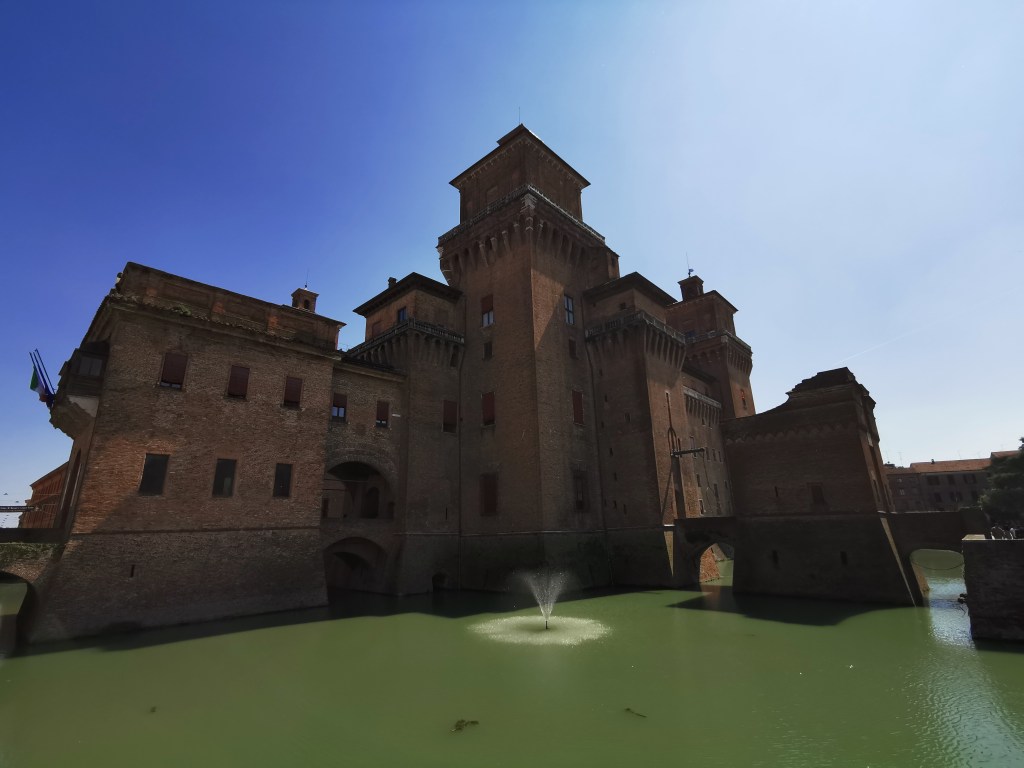
Castello Estense, Ferrara
On a gorgeous May Saturday, I take the Trenitalia Regionale from Bologna Centrale to Ferrara; an easy and affordable 30 minutes coasting through the verdant Emilia-Romagna countryside, horizon studded with the hallmarks of the region’s agricultural industry: this land is Bologna’s breadbasket, apt given that it is as flat as a piadina. Despite the perfect weather, the low-lying land means I’m unsurprised to learn of serious flooding currently causing havoc further east along the Po Valley.
Immediate impressions upon alighting at Ferrara might not be jaw-dropping, but after a half-mile stroll lined with inoffensive post-war blocks the old city begins to reveal her alluring self. Clustered around the moated Castello Estense – looking as solid as it is imperious – Ferrara’s renaissance-era centre is a charming maze of warm ochre.
As usual, I set out to explore on foot with no fixed destination and only cursory peaks at a map. On many occasions I find myself alone in a silent cobbled street with only bird song as a soundtrack – compare that to Bologna’s bustle –until, turning one somewhat rustic corner, a pair of acoustic guitars strike up in rehearsal from behind a nearby shuttered window.
In most streets away from the tourist epicentre, the only company I seem to keep are locals passing by on boneshaker bikes. The locals go everywhere on two wheels – though never at speed – and watching them clatter over the cobbles I begin to worry for the impact that spending a lifetime on those saddles must have on Ferraresi male fertility rates. Some streets are at least paved with a rarely used strip of flat stone to allow safe passage for cyclists. Bikes lean against every lamppost, occasionally unlocked.
On every turn a palazzo followed by a row of charming red brick homes followed by another palazzo, packed full of character.
Where the Ferraresi travel by bike, I continue to aimlessly weave my way by foot until hunger encourages me to seek out a hosteria. Normally suspicious of restaurants where I may end up paying for the view, I throw caution to an outdoor table at Savonarola – directly opposite the Castello. I take it as a good sign that I’m probably the only tourist there, and am not disappointed. The glorious wobble of the turret of polenta topped with crispy pancetta is as satisfying as the following bowl of cappelletti in brodo is silky. The accompanying glass of lambrusco provides some fruity fizz.
I had been drawn to Ferrara by my holiday reading – Giorgio Bassani’s The Garden of the Finzi-Continis, set in the late-30s among the city’s wealthy Jewish community (the only Jewish community in the region to exist continuously since the middle-ages) – and by a recommendation from my Airbnb host, Aldo. At one point I stumble upon Bassani’s former home, a handsome house of Van Goch yellow on Via Cisterna del Follo next door to yet another palazzo (Bonacossi).
I was particularly keen to explore Corso Ercole I d’Este, the real-life boulevard where the fictional Finzi-Continis lived. Bassani’s narrator describes it as “broad, straight as a sword from the Castello to the Mura degli Angeli, flanked its whole length by the sepia bulk of upper-class residences, with its distant, sublime backdrop of red bricks, green vegetation and sky, which really seems to lead you on towards the infinite…”, which remains accurate to this day.

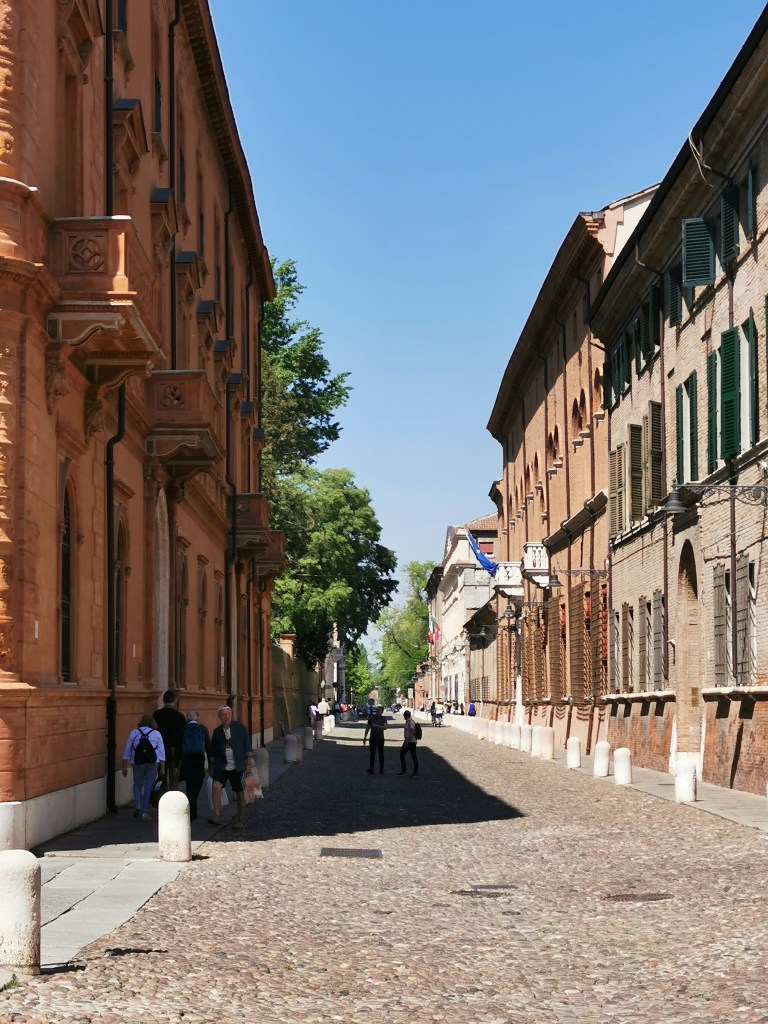
It is the Este family name, rather than the Finzi-Continis, that is a recurring feature on the map of Ferrara, appearing on street signs and buildings. The ‘younger branch’ of the House of Este ruled over the city from the 13th-16th Centuries as the Dukes of Ferrara & Modena, building their eponymous Castello in the centre of town as a means of safety from rebellious Ferraresi. One member of the family, Alfonso, became the third and final husband of Lucrezia Borgia while the ‘older branch’ included the Hanoverian dynasty of Britain’s George 1st. A house of some repute.
Continuing along the Corso, I don’t find the titular garden – despite a precise description of its location, it is in fact entirely fictional – but do wander into Parco Massari on the eastern side of the street where a flower festival is taking place in full bloom below a blazing sun.
As described by Bassani, the Corso comes to an end at the Mura, the old city wall, and it is here that I find shade under the horse chestnuts that line the footpath along the banks where the wall once stood. Despite the shade, refreshment is needed, so I meander my way back towards Piazza Trento e Trieste.
Finding a street-side table at a side street bar, I decide to mull over Ferrara whilst nursing a well-earnt Aperol spritz served with a bowl of black olives bigger than walnuts. Just as I take my first sip, horns are sounded down the street, drums roll and get louder, and into view appears a long procession of some 100+ comprising noblemen cloaked in full ermine livery, passing slowly while holding aloft the hands of ladies in fine renaissance dress, followed by armour clad knights, footmen holding aloft velvet banners (presumably the heraldry of the region’s noble families) and others – again all in renaissance finery – displaying two dozen town flags. The procession is notable for being made up mostly of young people, leaving me to wonder if such a public display of civic and historical pride would happen in the UK.
It’s time for me to return to return to Bologna, just as the city seems to be getting busier now that the evening is beginning to cool. There is a part of me that would like to stay and watch Ferrara liven up for the evening – whisper it, but I’ve preferred its charm and tranquility over busy Bologna.
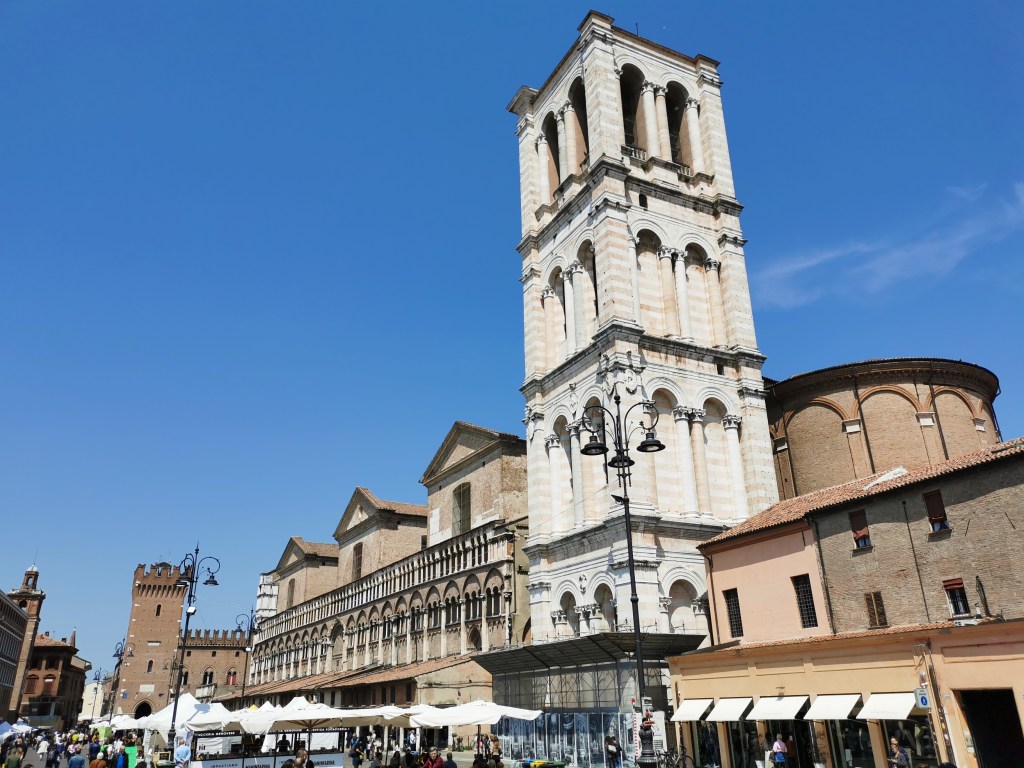
Piazza Trento e Triesto with the campanile of the cathedral in the foreground

 Tom the Curious: Ramblelogue
Leave a comment