
Piazza Maggiore, Bologna
When setting out to write about a visit to Bologna, the first decision that English writers are obliged to address is whether to embrace or ignore the standard clichés about Emilia-Romagna’s largest city. I normally detest clichés, but this time find them hard to resist from the get-go: colour, specifically red, is unavoidable here in ‘la Rossa’.
However, before I experience the different shades of Bologna’s red, the first colourful character that I encounter is Aldo, the proprietor of the Airbnb in which I’m staying. A recognised expert on antique fans, and owner of a collection worthy of a museum, Aldo admires the pretty things in life and exudes a stylish flamboyance, which, I’ll come to discover, echos his hometown.
It would be natural to set out from my lodgings in the direction of Viali di Circonvallazione, the ring road laid out along the route of the old city walls, within which sit most of Bologna’s attractions. Instead, my first sortie is to head north a couple of blocks to the Museo per la Memoria di Ustica, a memorial to those lost in the ‘Ustica massacre’ of June 1980 when Flight 870 from Bologna to Palermo exploded over the Tyrrhenian Sea between the islands of Ustica and Ponza. All 81 on board were killed; a definite cause of the tragedy has never been confirmed.
Contained inside the museum is the salvaged wreck of Flight 870, reassembled by artist Christian Boltanski. It is truly remarkable. Stationed around the wreckage are 81 black mirrors, one for each of the lives lost, and nine large black boxes containing what personal effects were recovered. Snatches of ghostly whispers of conversation are played on loop, while 81 lightbulbs hang above, slowly brightening and dimming.

Museo per la Memoria di Ustica
Taking my time to reflect on such a profound experience, I do what I always do: head into the city and lose myself in the unfamiliar surroundings.
Given the strength of the mezzogiorno sun, I’m immediately grateful for the miles of covered porticoes (24 miles, in fact), which shade virtually every street. As practical as they are, they provide the cityscape with distinct character, and are sufficiently impressive to have earnt UNESCO status.
Today, the city is dusted with billions of poplar seeds, their cotton-wool form floating in the warm air giving the illusion of a flurry of snow against a sunny day, just as at home where a drab May is being disguised as November.
Arriving in Piazza Maggiore, I seek further refuge from the sun in the gothic Basilica di San Petronio. Whist the chapels are as ornate as I would expect, I find the nave somewhat plain for this non-believer’s ostentatious taste (that is not to say unattractive, just lacking in that fan vaulting or gaudy gold that I love). It’s a theme I find in other basilicas around the city, including San Domenico and San Pietro, where I find myself inadvertently part of the congregation for mass (cue sheepishly side-stepping behind a pillar to conceal my escape).
Returning to the theme of colour, I decide that it is insufficient to merely describe Bologna as ‘red’. Almost every wall is painted something between vermilion and carmine – rather than the post-box red of my beloved Arsenal – which immediately leads to the next cliché to be ticked off: the city’s left-wing leanings (something I sympathise with, but won’t explore here).
However, something else adorns these walls of red: graffiti. Maybe not as pervasive as I’ve seen in other Italian cities, but many a slogan, often political, can be seen daubed black on red in the labyrinthine side streets. “Basta air bnb” (noted!), “no alla guerra”, “paska libero”, and “fuck austerity” all appear in the same hand. The statements may pack a punch, but no effort is made in turning them into anything that could be termed ‘street art’.
Speaking of which, I had hoped to see art of a more inspirational kind, but was left wanting, by the modern pieces at MAMBo. The Pinacoteca Nazionale, on the other hand, home to a collection of Giottos and masterpieces by Raphael, Tinteretto and Titian, delivered manna for my eyes and soul.
As for manna, Bologna sells itself as Italy’s food capital, and rather than being a honeytrap for another cliché, it would be remiss of me to overlook this – it is, after all, the main reason I’m here: to consume enough pasta that I might evolve into a talking tortellino. I manage, in my first 48hrs, to devour four pasta dishes, adding a 5th (Bologna’s signature lasagna verde – I couldn’t not!) and a 6th (a marvellous salmon and spaghetti frittata) before I depart. Each is perfectly al dente to the point of being chewy. Pasta is simply durum wheat flour and eggs, so why does it always taste so much better in Italy compared to at home? Similarly, I find that the mortadella that Aldo has kindly left in the fridge for me is superior to any I’ve eaten in England. That said, as world-class as Bolognese cuisine undoubtedly is, for me it takes bronze behind that of Naples and gold medallists Sicily.
Basta pasta. Having burnt off some carbs exploring the university district – Università di Bologna being the world’s oldest – I find a shaded spot at Giardini Margherita where I take off my shoes to enjoy the grass between my toes and open up my book, The Garden of the Finzi-Continis by Bologna-born Giorgio Bassani. However, I’m distracted when I find myself eavesdropping with envy on the nearby group of Erasmus students from a dozen countries all chatting away in perfect English – how I’d love to rewind the clock and find myself in their place.
Although my Italian is limited to that learnt from Gazetta Football Italia, it strikes me that conversation is something the Bolognese excell at. The monks of Santo Stefano aside, no one seems to be in quiet contemplation. Instead, everwhere I look an expressive back-and-forth is taking place, dinner tables are surrounded by groups in mid-debate long after the plates have been cleared, and if they aren’t talking in person, the Bolognese are always on their phone. Rarely do I see them idling away the time looking at their screen, however.
I need to walk off some more calories, and so it’s time to tick off that last cliche: it is obligatory when writing about Italy to mention the ‘passegiata’, that Italian evening institution whereby everyone – and in Bologna’s case it really does seem like everyone – takes to the streets to simply walk and talk. The dresscode is ‘urbane’, the pace keeps time with each conversation.
Over the weekend much of central Bologna is pedestrianised, allowing for the crowds to flow freely along Via Indipendenza and Via Rizzoli in contrast to Bolognese norms whereby no one crosses a road unless directed to by a green man, even if perfectly safe to do so (something I also noticed in Berlin, but the similarities between the cities end there). The day before, while following the locals’ lead and waiting patiently (against my instincts) at a crossing, a fellow pedestrian screamed “pericoloso!” at her apparently impudent boyfriend as he skipped across a road, no car in sight.
Usually, I’m comfortable and content to travel solo, but Bologna strikes me as a particularly sociable city. As the family-oriented passegiata winds down, groups of well-heeled friends flood into the city for their nights out. I think of a line that jumped off the page at me from the Finzi-Continis, “who knows from what, and why, a vocation for solitude is born”, and a wave of loneliness catches up with me.
I’ve enjoyed Bologna, but not fallen in love here. For reasons I can’t decipher, writing about it has been a greater challenge than for any other location thus far, and, as a result, I must say grazie mille to each and every of my new-found friends, those clichés.
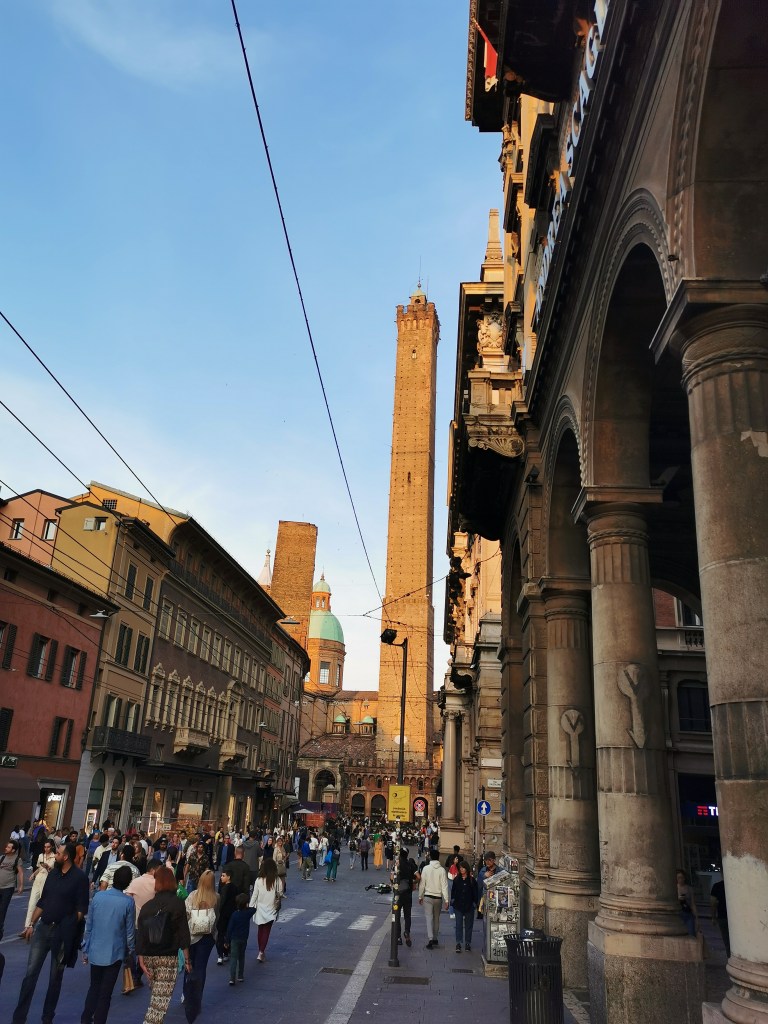
Passeggiata towards le Due Torri

 Tom the Curious: Ramblelogue
Leave a comment