If memory serves, my first encounter with Canary Wharf was via a TV appearance by Radiohead around 1995, Thom Yorke introducing ‘Fake Plastic Trees’ by informing the viewer that “this is a song about Canary Wharf”. It was the beginning of a near-30 year love of Radiohead and a simultaneous cynicism for that sterile corner of London, E14.
My second encounter, and first personal visit, came a couple of years later on an A-Level Geography field trip, being bussed in to, presumably, survey the ‘success’ of the regeneration of the northern half of the Isle of Dogs (bafflingly, this excursion culminated in a stop at the now-extinct Beckton dry ski slope (AKA ‘Beckton Alp’), despite none of us being allowed to take part in any actual skiing).
Canary Wharf is now an occasional destination for me – a convenient meeting point, its relatively quiet streets and sterile environment making it a good spot for my niece and nephew to charge around.
Today’s visit marks the first time that I travel there via the Elizabeth line – only the second or third time I’ve used the line in the year it has been open. Clean, quiet and futuristic, just like Canary Wharf, the Elizabeth line stations are impressively spacious, even if gliding down the escalators through giant tubes of sandblasted white concrete does make me think of the set design for 2001: A Space Odyssey.
Perhaps a coincidence, but I find the next most interesting building here to be the Bladerunner-style Canary Wharf DLR station. From distance, say from the South Terrace at Ally Pally, the compact steel and concrete mountain range that the area’s skyscrapers form can look impressive, but from street-level there is nothing about the architecture here that that floats my boat. It’s, frankly, dull and unimaginative.
My plan for the day then is to find and sketch one of the many sculptures that dot the area’s streets; most of them far more interesting than the buildings that tower over them. And so, after finding my way out of the jaundiced hellscape that is the shopping mall, I head east through Jubilee Park. The trees in this lone rectangle of greenery are real enough, but the grass is most definitely fake and plastic. Well-heeled Arabic families take selfies, a guy in a gilet and moccasins talks loudly in Spanish on his phone, 30-something twin sisters sit cross-legged in heated debate, no one interacts with anyone outside of their own bubble.
The first sculpture I stop at, ‘The Knot’, is a series of entwined mirrored curves that reflects its high-rise surrounding back on itself. It’s a good one for a quick warm-up exercise, allowing for my pencil to trace circles around the page. A passing kid tries to climb it, only to be swiftly beckoned back down by her Starbucks-wielding parents.
A miserable looking guy drives by in a burgundy Ferrari, then loops past a further two times, half an eye on the road, half an eye looking for anything to distract his boredom. A lone driver in a humongous Rolls passes in the other direction. Sunday afternoon, the sun is out, and the roads are otherwise empty.
The pair of sculptures that I’m keen to track down are ‘Standing Man 2019’ and ‘Standing Woman 2020’ by Sean Henry. This couple, staring each other down in either rapt desire or confrontational contempt, would be hyper-realistic were it not for their giant stature, standing above 7ft. There’s something about their wet-look leather attire that puts me in mind of some dystopian sci-fi movie, set in the near-future – Standing Man could have been modelled on an adult John Connor.
Set up with coffee, pastel de nata and sketchpad at an outdoor table, I can’t help but eavesdrop on the couple seated behind me, evidently on a first date. He’s “in selling financial news”, he travels a lot for work (Frankfurt and Madrid, not that she asked), and his “favourite genre of music is ‘movie soundtracks’”, which strikes me as a somewhat broad genre. I wouldn’t know what her work or taste in music is – he didn’t ask.
During the hour or so that I spend sketching Standing Woman, two-dozen people stroll by, but none stop to admire her until a pair of children attempt to scale her mighty legs. “It feels like plastic”, the younger sibling declares, to my delight. It hadn’t occurred to me to reach out and touch my muse – a child’s curiosity trumping my own – so, upon packing away my pencils, I pass a palm down her arm: satisfyingly plasticky and slightly tacky from the afternoon sun.
I decide against visiting one of Canary Wharf’s more droll pieces of street sculpture, the aptly named ‘Traffic Light Tree’. Maybe I’ll investigate it next time. Sterile, artificial, superficial this place may be – this place that could be anywhere but could only be here – the antithesis of what I admire, but it does make for a good spot to draw and think without interruption.
Inevitably I’ll be back, but that probably says more about me than it does of this town full of rubber plans.
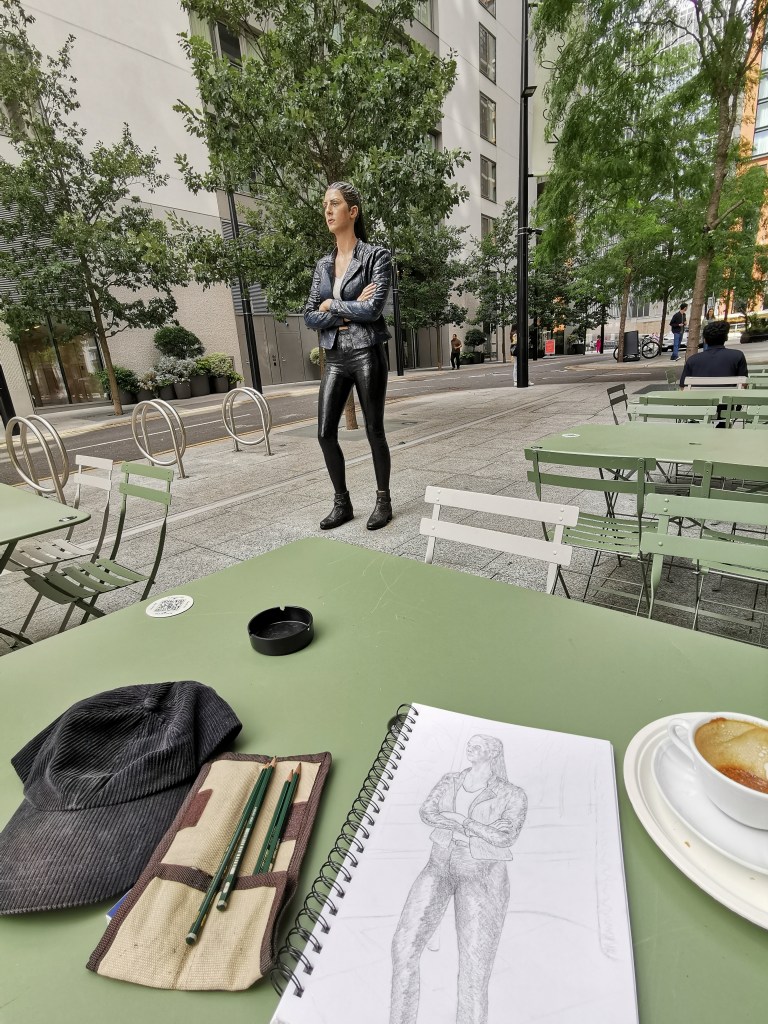
Standing Woman by Sean Henry in Park Drive, E14

 Tom the Curious: Ramblelogue
Leave a comment