Or, what actually is it that I’m looking for when I visit somewhere?
As I was resolutely not going to write about my visit to Los Angeles to see my brother and his better-half (now my sister-in law!), this post isn’t about Los Angeles. Firstly, it would be unfair to write about a city that I don’t much care for, given that my hosts so do. Secondly, I had predetermined that I couldn’t possibly enter into the headspace required to formulate my observations and commit them to Ramblelogue unless travelling solo, which on this occasion I wouldn’t be.
So this isn’t a post about how much I preferred Manhattan Beach, with its affluent urbanity, its lack of billboards (but the Goodyear Blimp!), and – a rarity in LA – its paucity of plastic surgery, over the tat of Santa Monica. Nor is it about how the botoxed vulgarity of Beverly Hills earns it first prize in the list of most loathsome places I’ve ever visited.
Therefore, this post also can’t be about the bits of Los Angeles that I did enjoy: Griffith Park and its observatory are genuinely iconic; in a city with such a dearth of appealing architecture, The Broad is an exception, and houses a brilliant collection of modern art; so too does LACMA; and the botanical gardens at the Huntington are truly extraordinary and surely the jewel in the city’s gaudy beauty pageant crown.
A better writer than me could go to town explaining how much they enjoyed the Korean BBQ at Pigya, which included possibly the most ‘fucking-hell-that’s-unbelievable’ single mouthful of food I’ve ever experienced. Great company and great food.
But this post isn’t about that melting pork belly wrapped in marinated sesame leaf. Despite spending four paragraphs definitely not writing about Los Angeles, this post is in fact an opportunity for me to explore what it is that I value in the location I’m visiting at any given time.
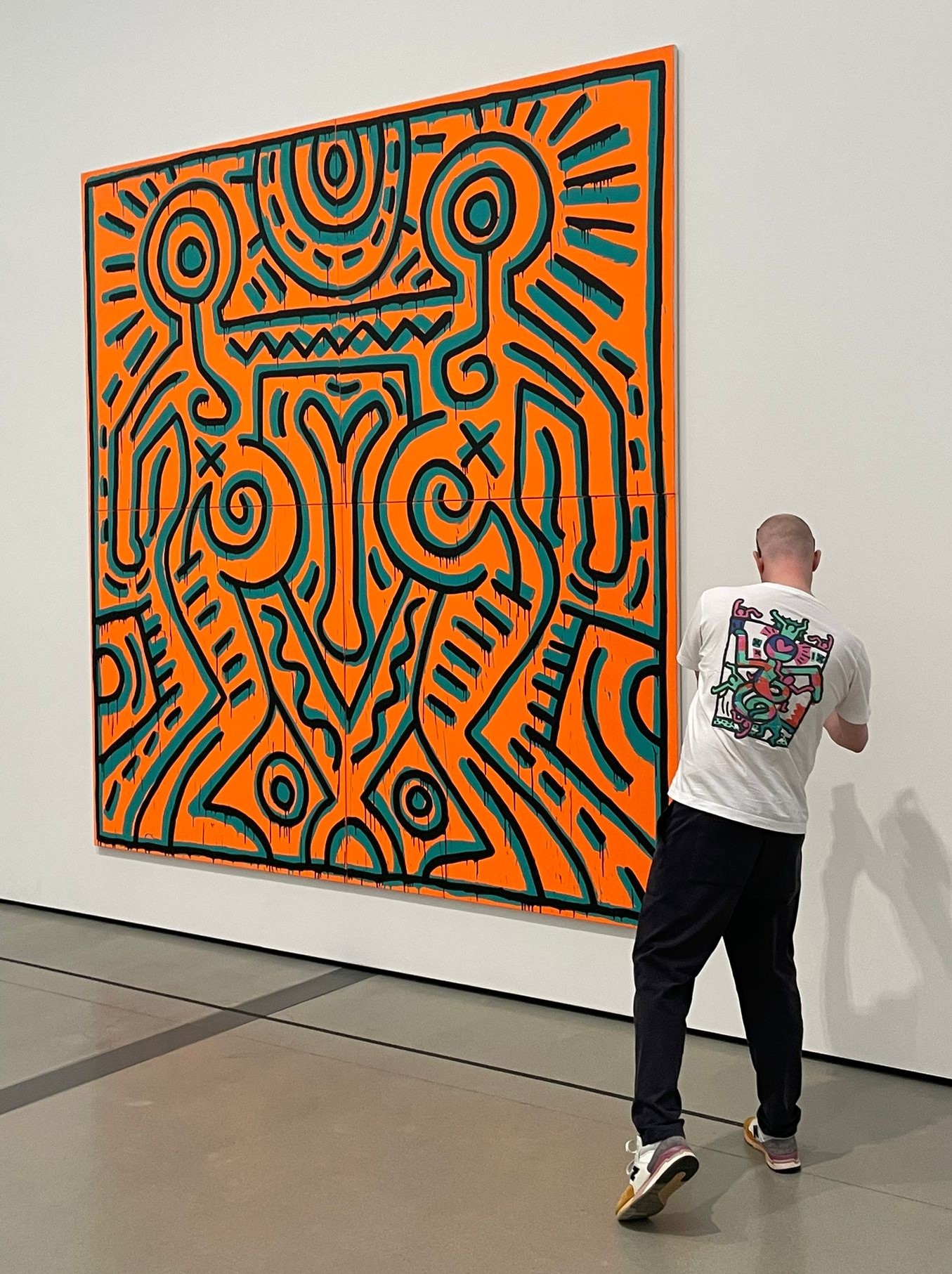
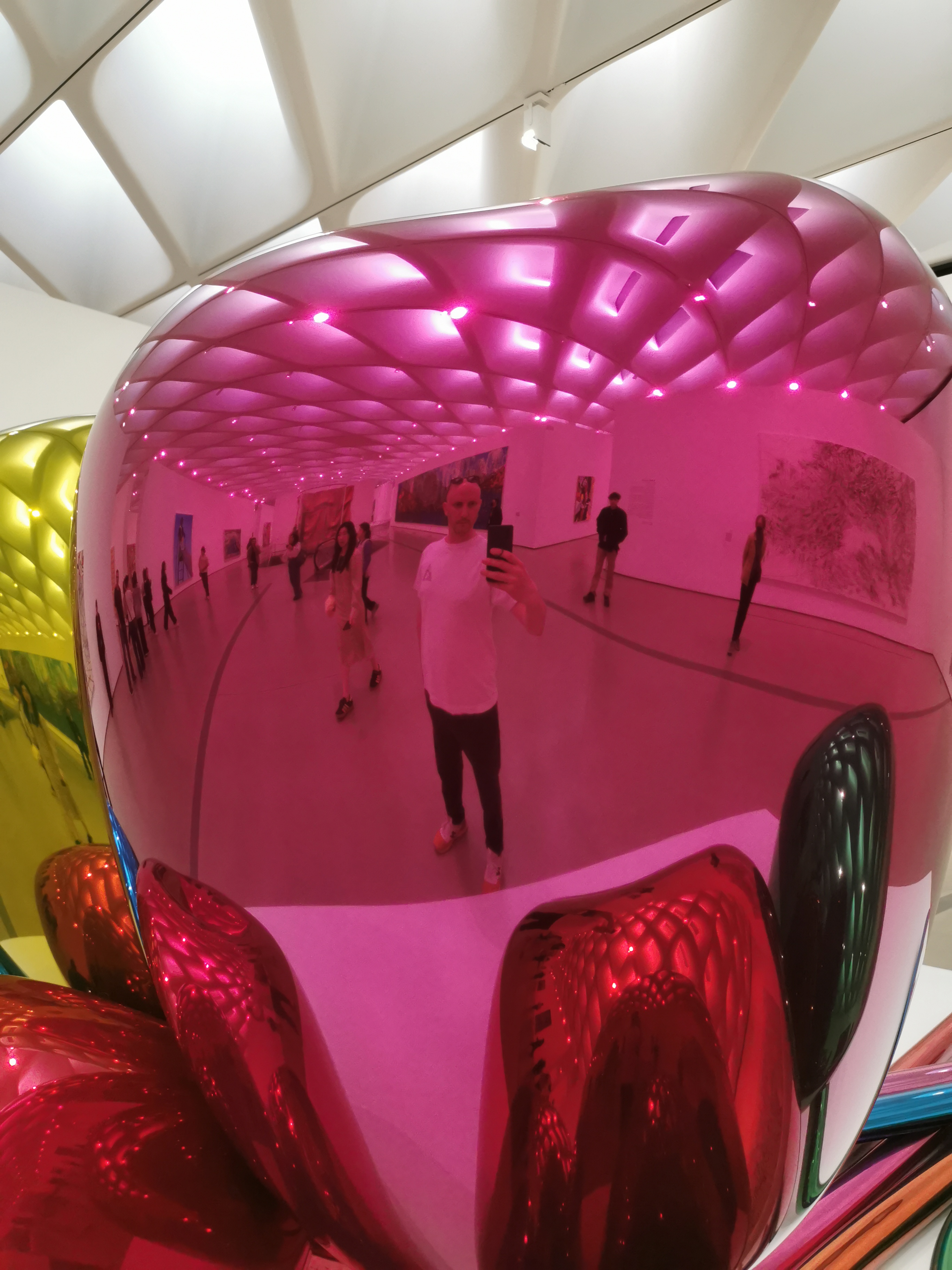
(Above – getting up close to Keith Haring and Jeff Koons at The Broad, LA.)
When considering this in the context of LA, the most obvious starting point is being able to walk a city versus needing a car. Hell, I’ve even been known to enjoy travelling by public transport. It might be stating the bleeding obvious, but being able to negotiate a city bipedally slows things down and allows for a 360-view on our own terms instead of being dictated by the rules of the road and the restriction of a seat-belt. Famously, LA was built for the car and those freeways can feel like an infinite bowl of concrete spaghetti. Even walking a few blocks can take longer than anywhere else, with the constant stopping at pedestrian crossings every hundred metres. The value of being able to hear conversation and even being better placed to smell our surroundings means two feet trump four wheels by virtue of delivering a more immersive experience. And how can a sense of community grow if people are so confined to their car?
This isn’t a criticism of LA alone though, as plenty of other cities that rapidly developed during the age of the automobile suffer the same. Jakarta may be much older than LA (previously as Batavia), yet I recall it being especially hellish for pedestrians, largely owing to being overwhelmed by urbanisation in the latter-20th century.
Other questions arise about what, for me, makes a city worth visiting: is ‘authenticity’ important and where does that sit with a city’s identity? Where does architecture fit with that identity and how we navigate the place? What is of cultural value to me in the context of a place? How much of our experience is predetermined by our expectations before we travel?
I wonder if I can land on answers to those questions on authenticity, architecture and identity by comparing Los Angeles with Vienna – a very different major city. I associate LA with fakeness, but is it really any more artificial than baroque Vienna, all pristine facades and snooty elegance? I feel that both have very strong identities – I wager that I’d know where I was if I were dropped at random in either – and in both cases much of that identity stems from the city’s success (in fact, LA’s success is somewhat more democratic than Vienna’s – the American Dream might leave many behind, but at least LA was built by many a self-starter compared to Vienna being forged in the image the Habsburg’s wanted to project). Yet I don’t consider Vienna’s appeal to be only skin deep. Why? Is it simply a case of something intangible that we can never properly define or is there an equation that we can each apply to tell us what we like?
Culture + walkability x (cuisine + climate) / cost of the local beer = X
Vienna can’t be more authentic than Los Angeles purely because of the longevity of its particular style, surely? Or do I secretly love carefully realised uniformity over a sprawling hot mess? And there was me convincing myself of my love for the chaos of Bangkok and madness of Naples.
I love Vienna, but is that preference because of my interest in history, which I am attaching to the Austrian capital and not Los Angeles? If so, why am I giving primacy to early modern Europe over 20th century America – wasn’t it the American century that I was born into after all?
Vienna was home to two of my favourite artists – Klimt and his protege Schiele – and seemingly every classical composer worth his salt passed through, but it doesn’t have Hollywood. However, there seems to me a Hollywood paradox whereby the world’s great writers, directors, actors and assorted visionaries assemble to hold up a silver screen mirror where the rest of us can examine ourselves in intimate, terrible high-def detail, yet to this visitor the city itself seems to be so lacking in depth and self-awareness.
Yet, this the city of Tom Waits, Captain Beefheart and Laurel Canyon, so how can it possibly be soulless?
Perhaps, then, I’d already decided to dismiss LA before I arrived. I’d visited previously, some 20 years ago, but was determined to keep my mind open. I’ve been burnt by preconceived ideas of a city before – in opposite to LA, a decade ago I went to live and study in Buenos Aires, convinced by a romanticised notion that I would fall in love with the place, only to end up in frustrated ambivalence. But LA is the victim of its own inescapable global reputation, reinforced by so many blockbusters, cliched hip-hop video, and every mention of the bloody Kardsahians. The city sells itself to us and we lap it up, with or without consenting, until we OD on LA.
Maybe it always is about Los Angeles.
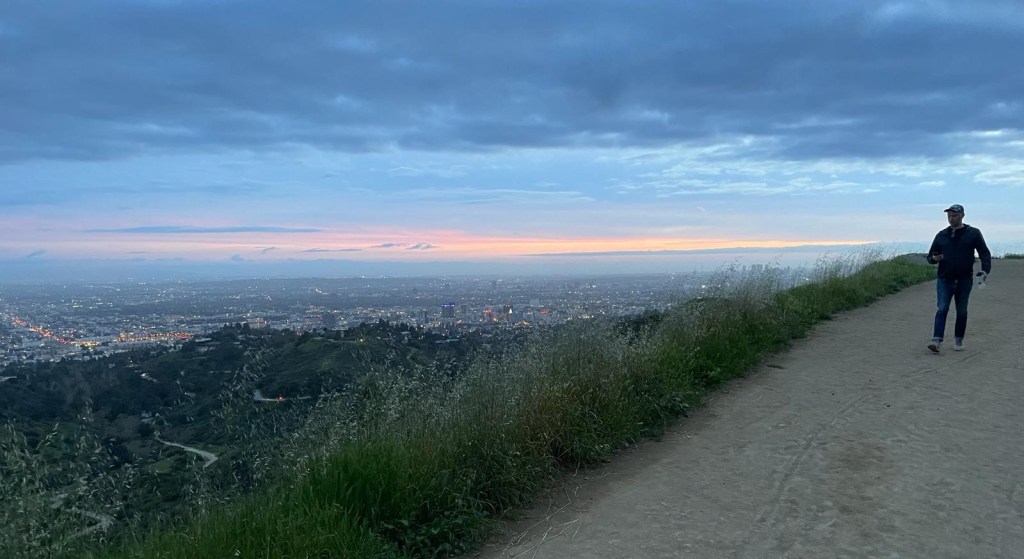
(Above – your correspondent in Griffith Park at dusk, photo courtesy of his brother.)
 Tom the Curious: Ramblelogue
Leave a comment