“Why they changed it I can’t say, people just liked it better that way” Istanbul (Not Constantinople) – The Four Lads
With tendrils spread out among the hidden ruins of two previous versions of the city it serves, Istanbul’s swift and gleaming metro system provides a contrary first impression to the ancient megalopolis above ground.
Hurtling towards the downtown districts of the city’s European side, the M11 metro line passes through stations with complex-sounding names – İhsaniye, Göktürk, Kağıthane – the announcements of next stops introducing a language unknown to me, with a seemingly familiar script hiding new letters. Why the two i’s? All those diacritics. What does that strange ğ signify, that I’ve seen before in the surname of Turkey’s president? Indeed, Recep Tayyip Erdoğan makes an appearance via the video screen in my carriage, cutting ribbons on visits to various major infrastructure projects (often the sign of a wannabe dictator).
Changing onto the M2 at Gayrettepe and finally resurfacing in the historic centre of the city at the Vezneciler stop, I take the T1 tram to Sultanahmet where, hopping off and looking up, I have my first wow moment: right in front of me is the Blue Mosque, huge and spectacularly lit up against the night sky. Wow.
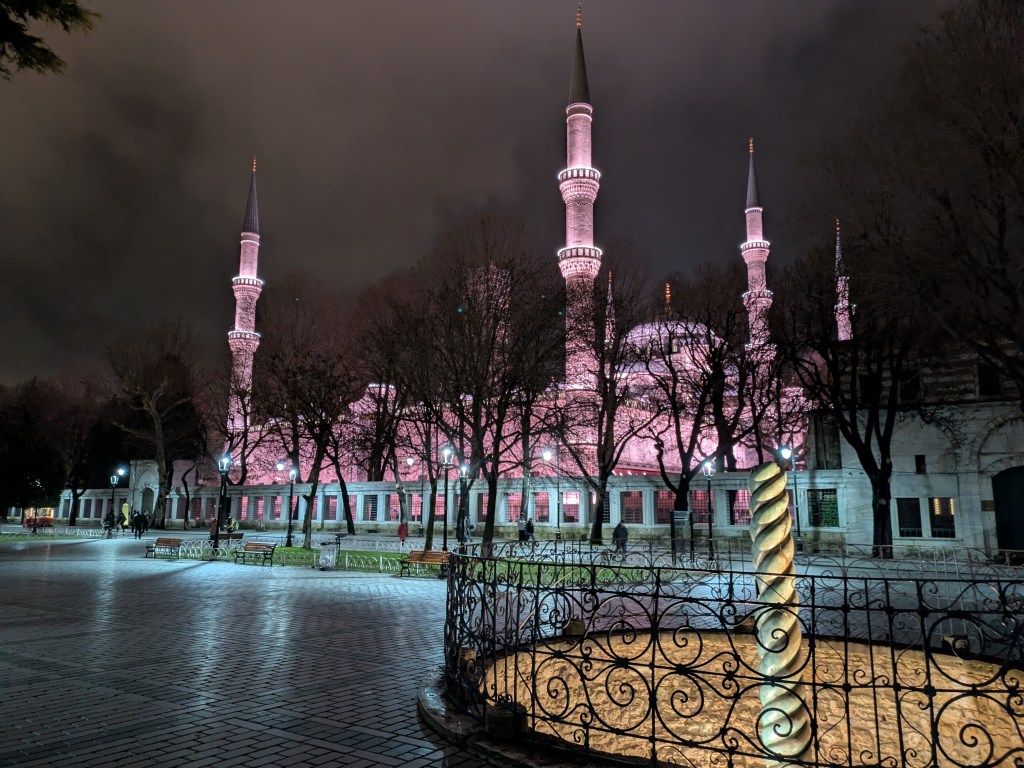
I’m staying in what is now the epicentre of Istanbul’s historic tourist hub, but was once the heart of Constantinople and before that Byzantium. Some twenty-eight centuries of history lie beneath my feet, on this peninsular surrounded on three sides by water. To the immediate north, the inlet known in English as the Golden Horn (Haliç in Turkish), to the south is the Sea of Marmara, and acting as a maritime super-highway to the Black Sea is the Bosporus Straight. Speaking of language, ‘Bosporus’ apparently stems from something akin to ‘Ox-ford’ in Ancient Greek.
It is customary, it seems, when writing about Istanbul, to be drawn into the trap of either questioning whether the city represents east or west or a blend of the two, or to declare that it is where east meets west, or to suggest the same about Europe and Asia, or that this is where antiquity clashes with the modern. As for east and west, the twain never really meet, of course, but this mammoth city – home to over 15 million Istanbullus – is, perhaps, the hinge between Asia and Europe as they face each down other across the Bosporus.
Reading about Istanbul ahead of my trip, it struck me that many western writers conflate east-meets-west with antiquity-meets-modern, implying that the east is synonymous with the outdated whilst we westerners signify the modern. I wonder what the view of eastern writers would be (my duty to find out). Why do we need to impose the division between the two hemispheres onto Istanbul at all? It’s inevitable – we study history partly to understand our own place and time. I’ll return to this theme, inevitably, but instead decide that an apt metaphor for Istanbul could be a compass, or even better, a geohistorical sextant.
One writer that doesn’t waste much time on the Istanbul as east-meets-west debate is the Nobel winning Orhan Pamuk, whose book on the city is a far superior travelling companion than any guidebook. Although he does say that the Turks like tell themselves that they became “a western nation” that “severed its Ottoman roots and became a more ‘logical and scientific’ people” after the founding of the Republic.
What Pamuk does keep returning to is a theme of melancholy, or as he puts it “we might call this confused, hazy state melancholy, or perhaps we should call it by its Turkish name, hüzün, which denotes a melancholy that is communal rather than private”. In fact, the Wikipedia entry on ‘hüzün’ even describes it as denoting “a sense of failure in life, lack of initiative and to retreat into oneself, symptoms quite similar to melancholia”, which sounds uncomfortably close to the internal monologue that I manage daily.
This all leads me to spending my first 24 hours in Istanbul looking out for this legendary hüzün. A ridiculous task – as if anyone could detect such a collective state of being on their first visit as a tourist – which is made all the more ridiculous once the weather takes a turn for the bleaker. Pamuk describes Istanbul as being aesthetically monotone, and the snow that arrives within a day of my arrival certainly contributes to that picture, a horizontal blizzard that makes me zip tight my puffer jacket and avert my eyes to the ground (so much for my mantra to always look up when in a city).
There’s definitely no hüzün in the Istanbullu response to the snow. Whilst I shuffle along Istiklal Caddesi, the city’s most famous boulevard, though now lined with uninteresting chain stores, countless retail staff leave the warmth of their shops to take selfies as huge snowflakes waft down, providing a wintry stage. All is white. Snowballs become as common a hazard as the treacherously slippy paving, the Hagia Sofia a majestic backdrop for a snowfight.
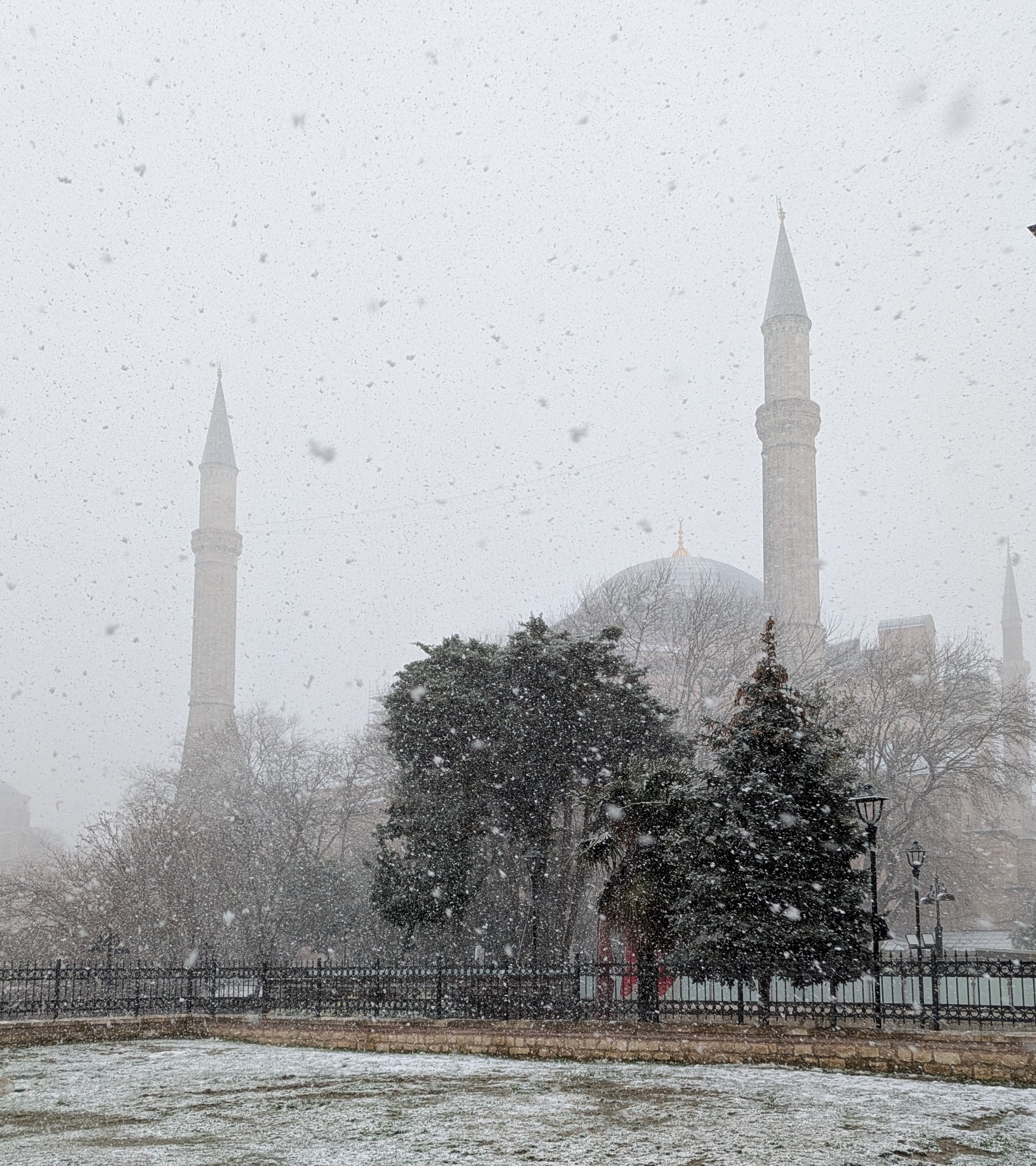
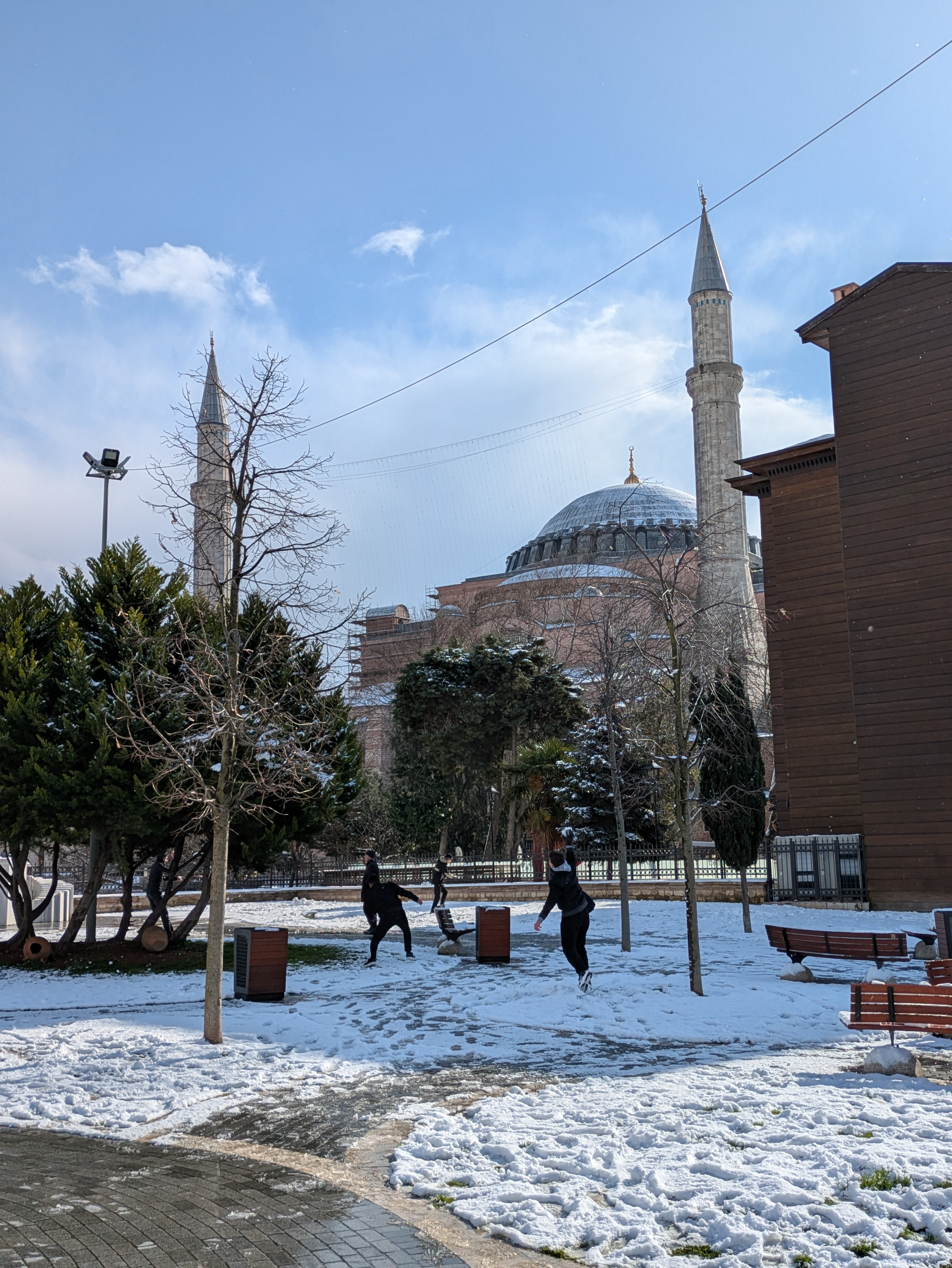
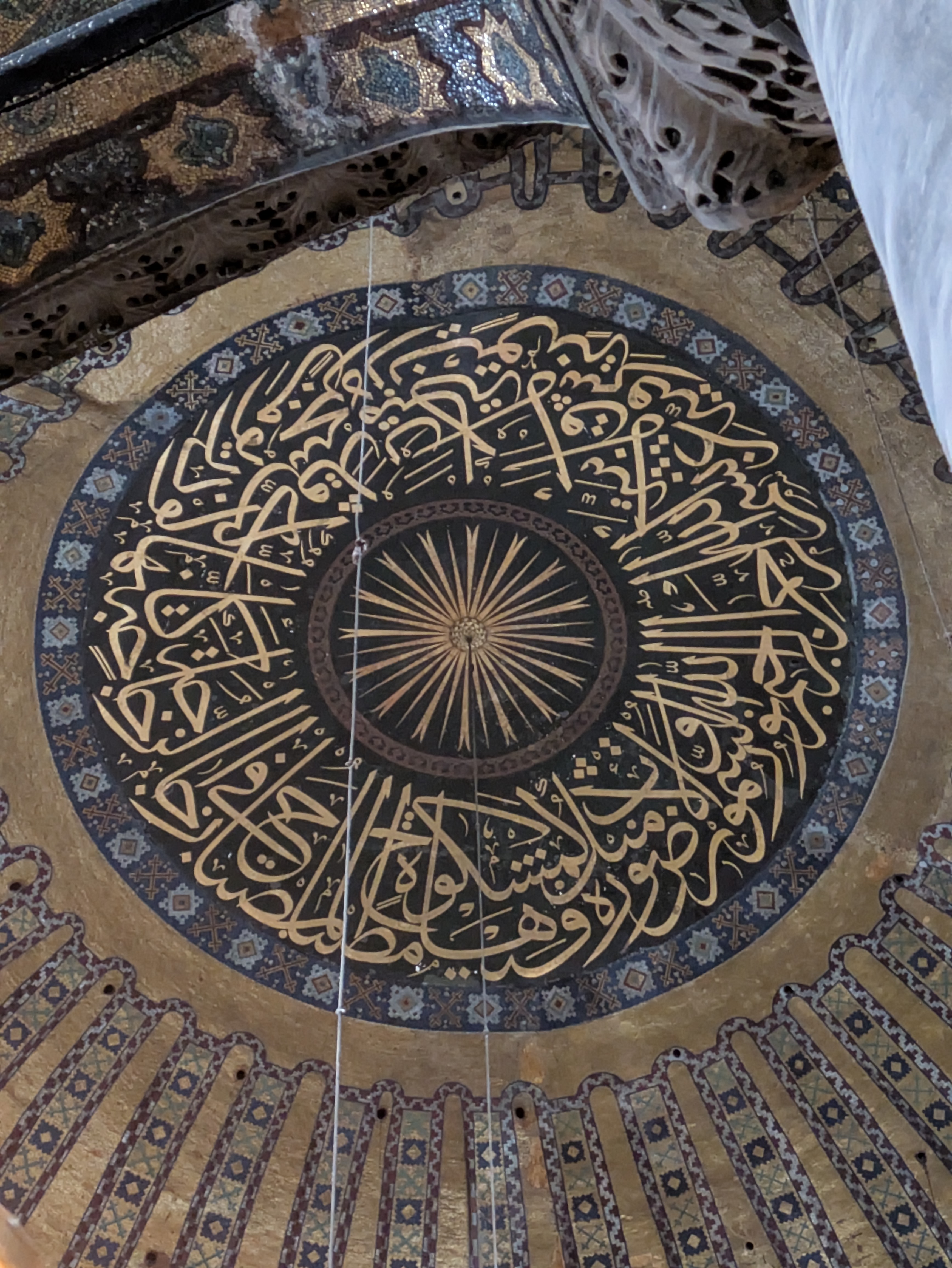
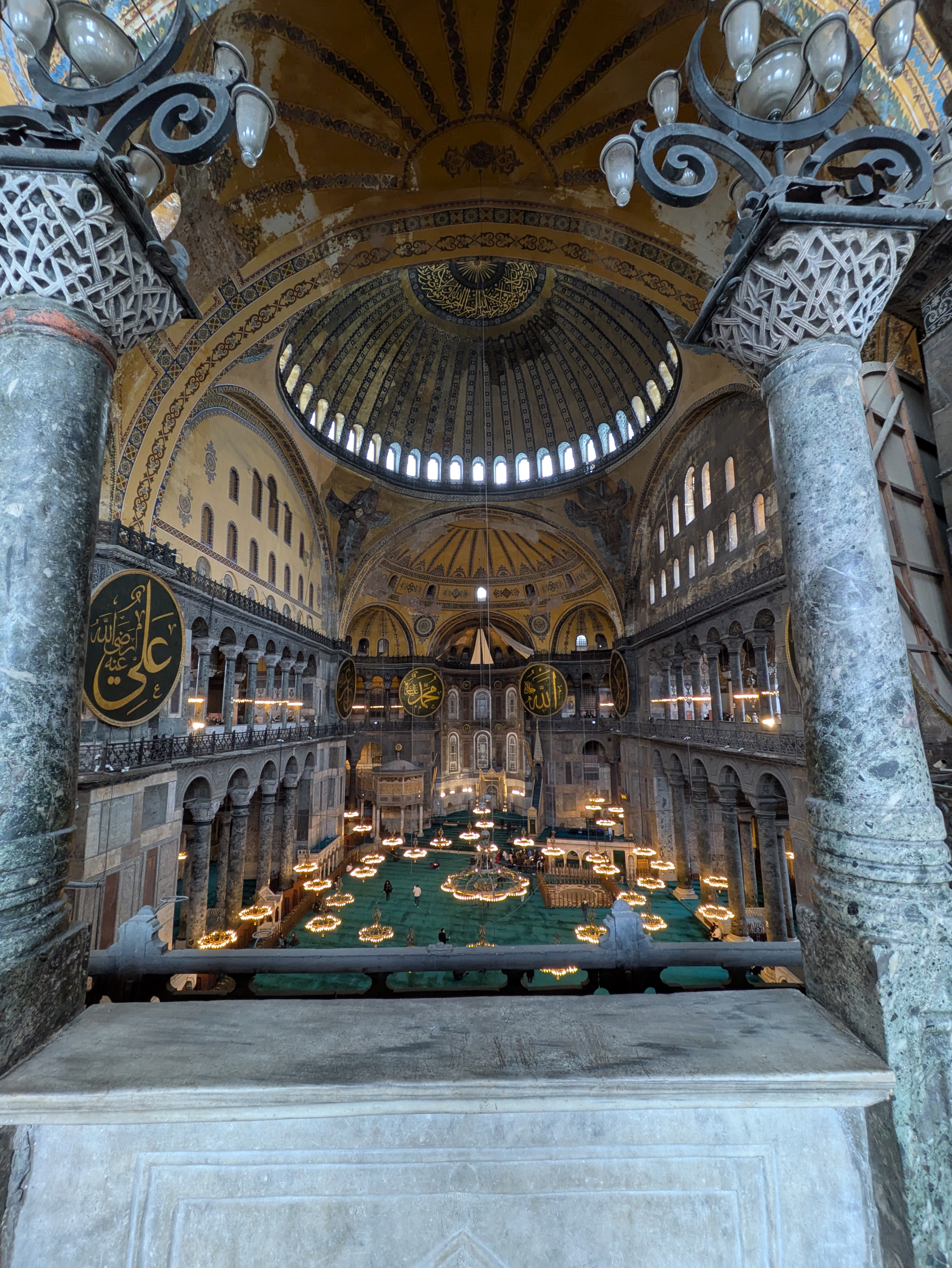
I’m not alone in the Hagia Sophia being the primary attraction for a first-time visitor to Istanbul. First built as a church in the mid-4th Century CE, much of the current building was completed by 537 under the reign of the Byzantine Emperor Justinian I, making it over a millennia older than the nearby Blue Mosque. It remained the centre of the Eastern Orthodox Church for over 900 years until the Fall of Constantinople in 1453 (or the ‘Conquest of Istanbul’ from a Muslim perspective), when Mehmed the Conqueror converted it into a mosque as one of his very first acts upon entering the city. For nearly six centuries the Hagia Sofia functioned as a mosque, until 1935, when the founding father and first president of the Turkish Republic, Mustafa Kemal Atatürk, had the building transformed into a museum as part of the country’s secular constitution.
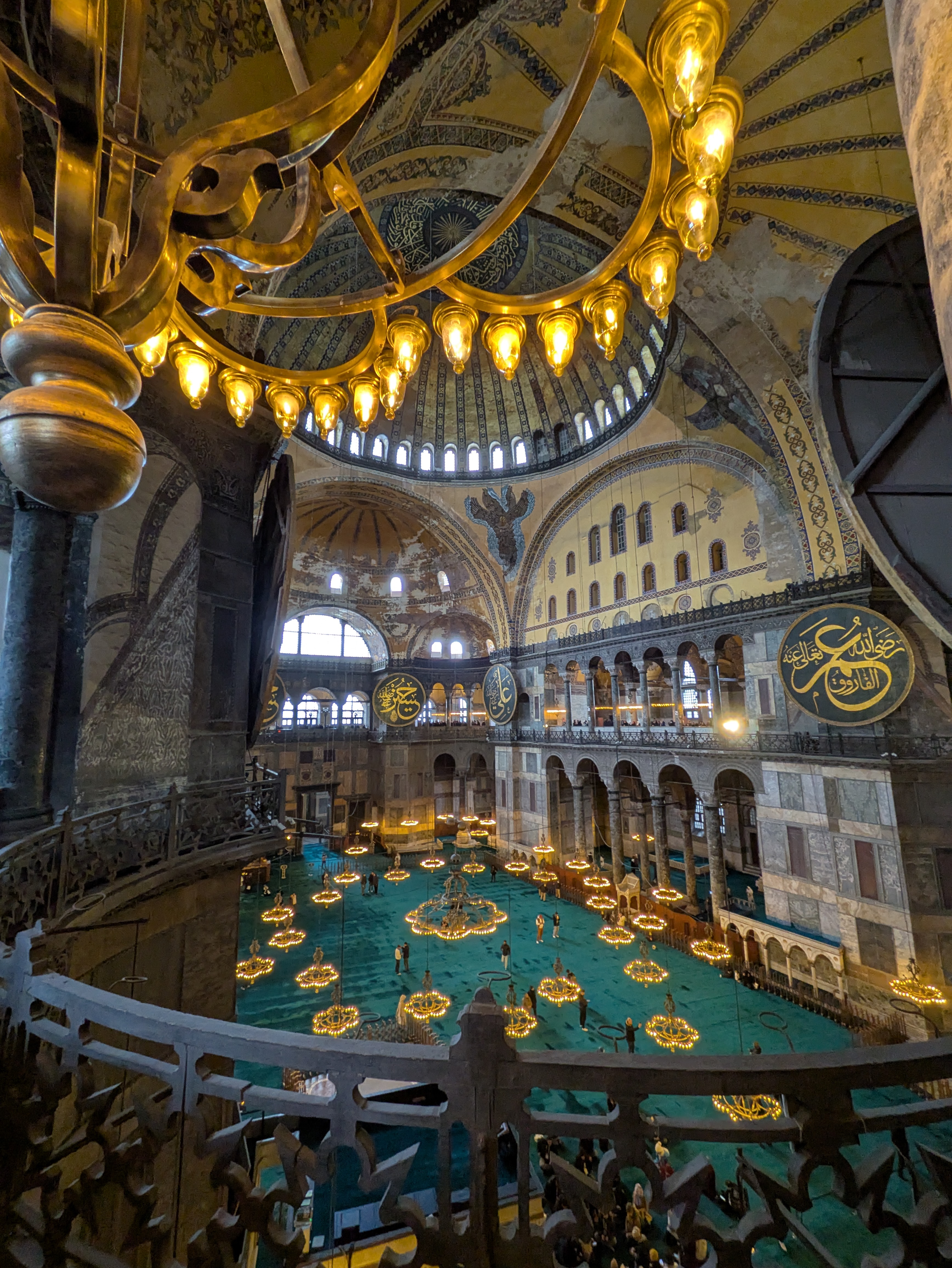
So it was until 2020 when President Erdoğan decreed that the Hagia Sophia should become a mosque once more. An admission fee (see notes on fees at the end of Part 2) was applied to non-worshipers last year and, much to my regret, the ground floor made available only to Muslims for prayer. For the tens of thousands of annual visitors who don’t practice Islam, this means we are not able to fully wonder at the astonishing and architecturally ambitious dome just as millions who have looked up in awe from ground-level have done over the 1,500 years before us.
It shouldn’t be for me – a non-Turkish atheist – to preach to another nation, religion or culture as to what they do with their heritage. Indeed, many Muslims will point to the Prophet Muhammad’s Hadith that “Verily you shall conquer Constantinople“, which inspired the Ottomans to take the city. However, in this case, the building was a church for almost twice as long as it was a mosque, had been built as a church three centuries before Muhammad lived, and was taken by force. And, is there a question about certain buildings being so internationally significant that they should instead belong to everyone? I discussed this with the hosts at my hotel, who agreed with each other that this was an example of Erdoğan “making decisions just for old men” and that “no one else actually wanted this”.
This is a moot point though. We, the non-faithful, still get to visit and marvel at this incredible spectacle, circling the first floor with its golden Byzantine mosaics, from which we can arch our necks to gawp at that great dome. After my initial disappointment, which is likely to have stemmed from a deep suspicion of grand gestures made by populist leaders, I’m satisfied that this arrangement is a good compromise. That said, it was a shame that even during lunchtime prayers the cavernous space was being used by barely half a dozen worshipers and a couple of their companions taking photos.
Adjacent to the Hagia Sophia lies the Topkapi Palace, home to Ottoman sultans, their family and harem, and some 4,000 staff, including 800 working in the kitchens alone. Despite covering over 170 acres, the palace complex is far too elegant to describe as ‘sprawling’, each courtyard carefully revealing itself with a new set of colonnades, low-rise outbuildings and manicured gardens. Thankfully, being designed to keep its residents cool during the summer also meant shelter from the snow, although this didn’t protect me from slipping bum-first down one flight of marble steps.
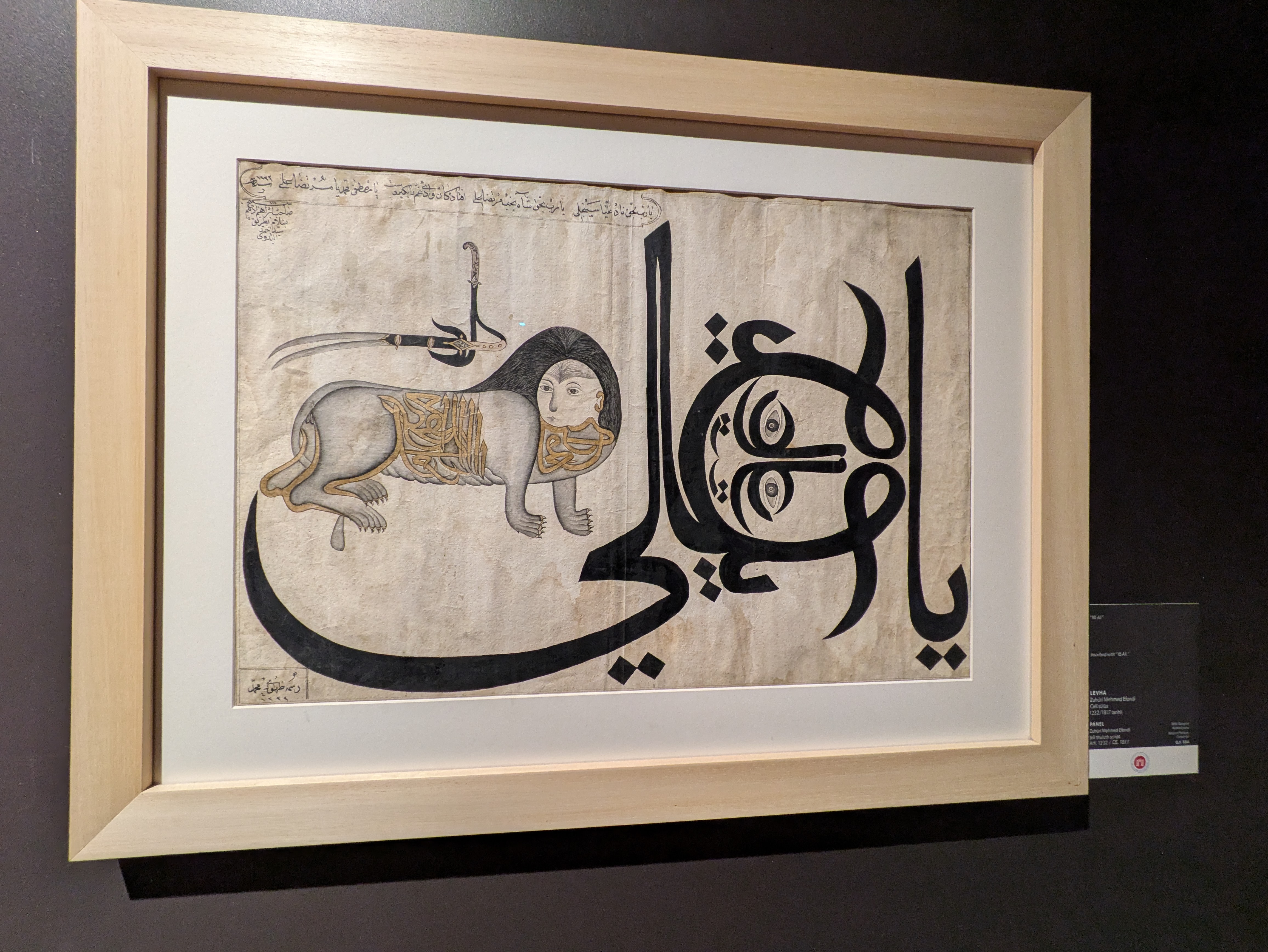
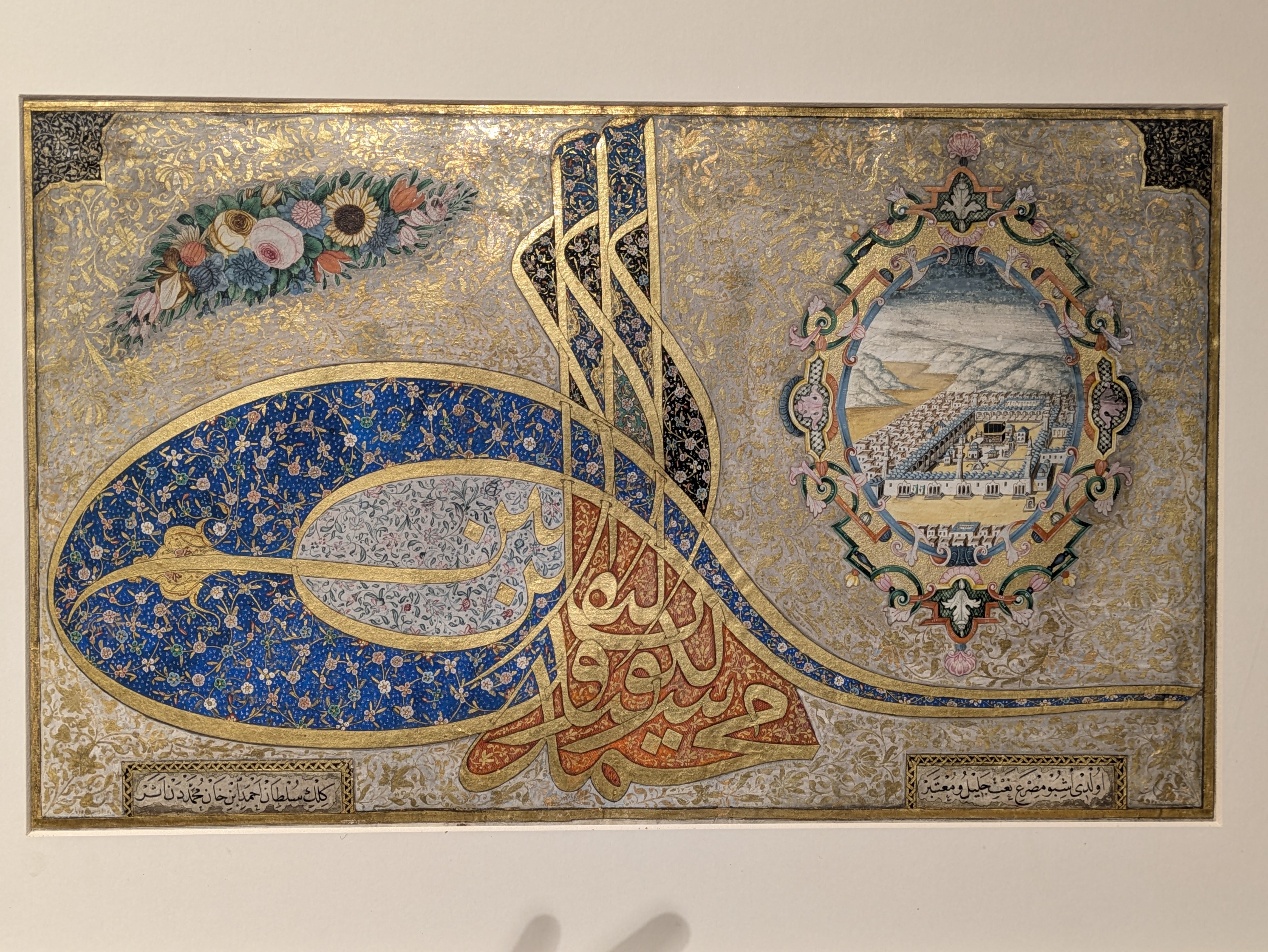
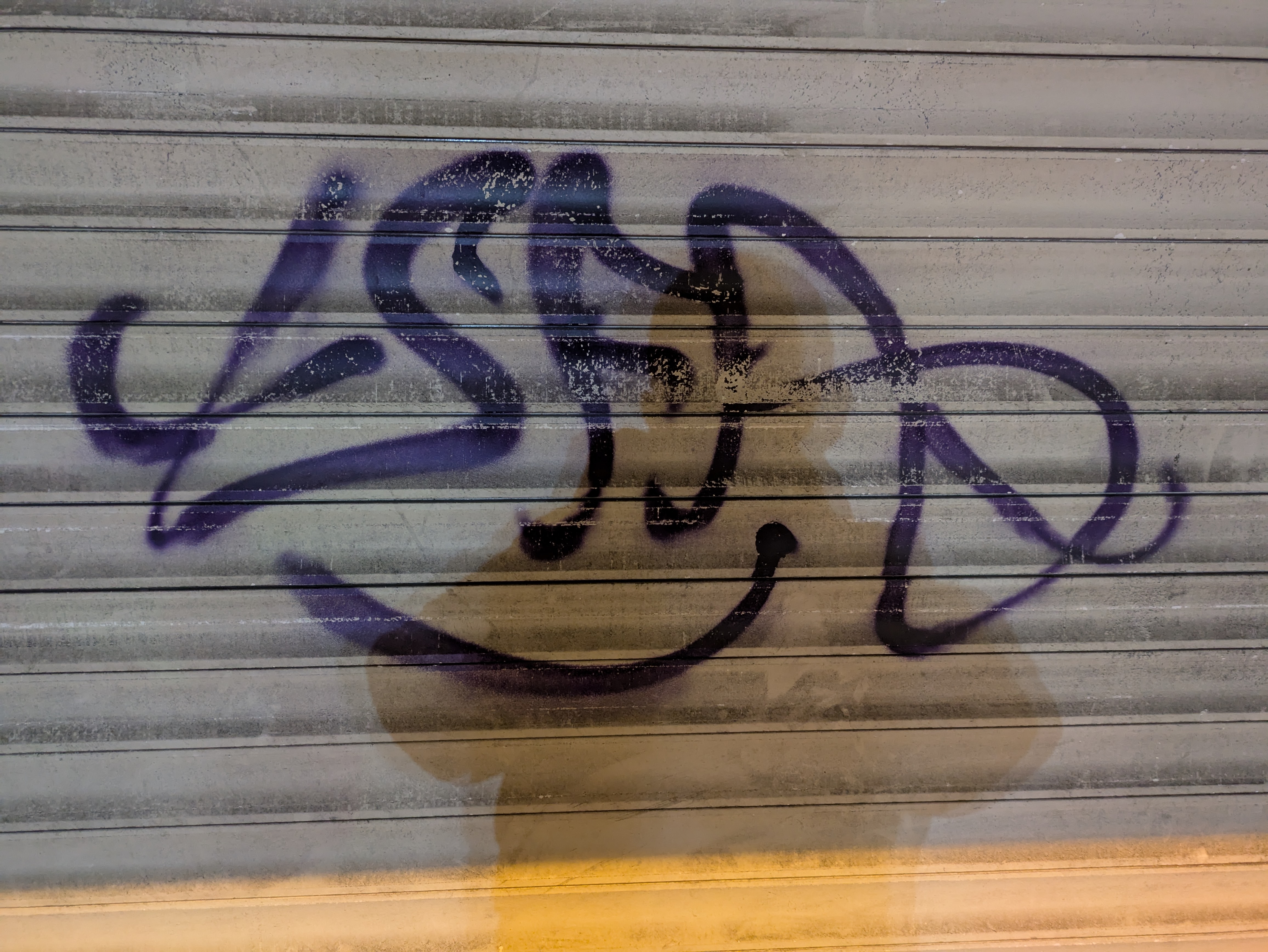
I spend an age in the rooms dedicated to Arabic calligraphy, mesmerised by the grace, colour and pure genius of scripture as art. Old gold glides, drips, rises and dips across lacquered blacks, pearly whites and azure blues. One piece of white with black script even tricks my phone’s camera into thinking it’s scanning a QR code – an 18th century artist reaching through time to toy with a world he couldn’t have ever imagined. Later that night, so obsessed am I with these masterpieces, that I even start to see Arabic script in an ugly graffito tag on a shop shutter.
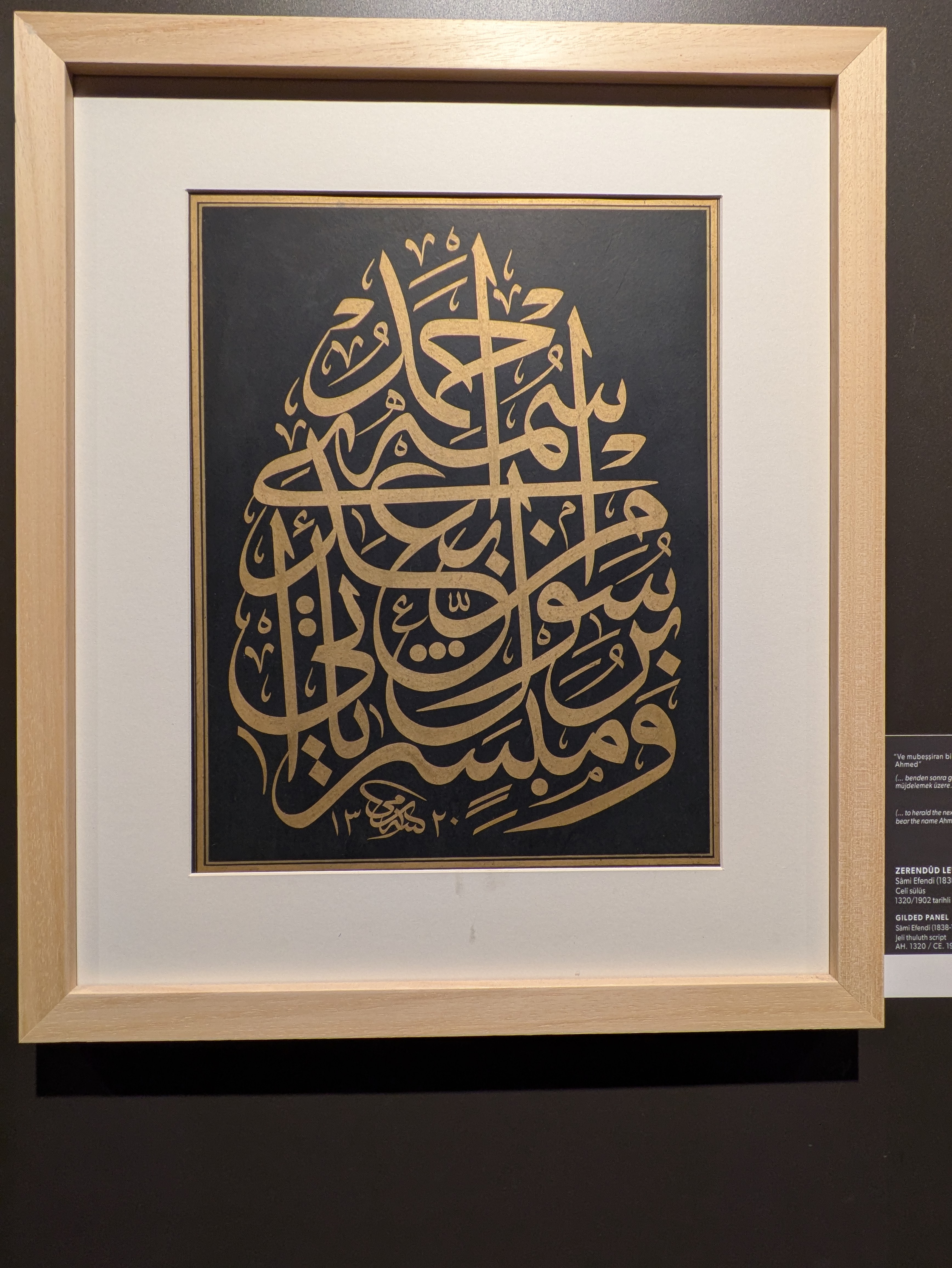
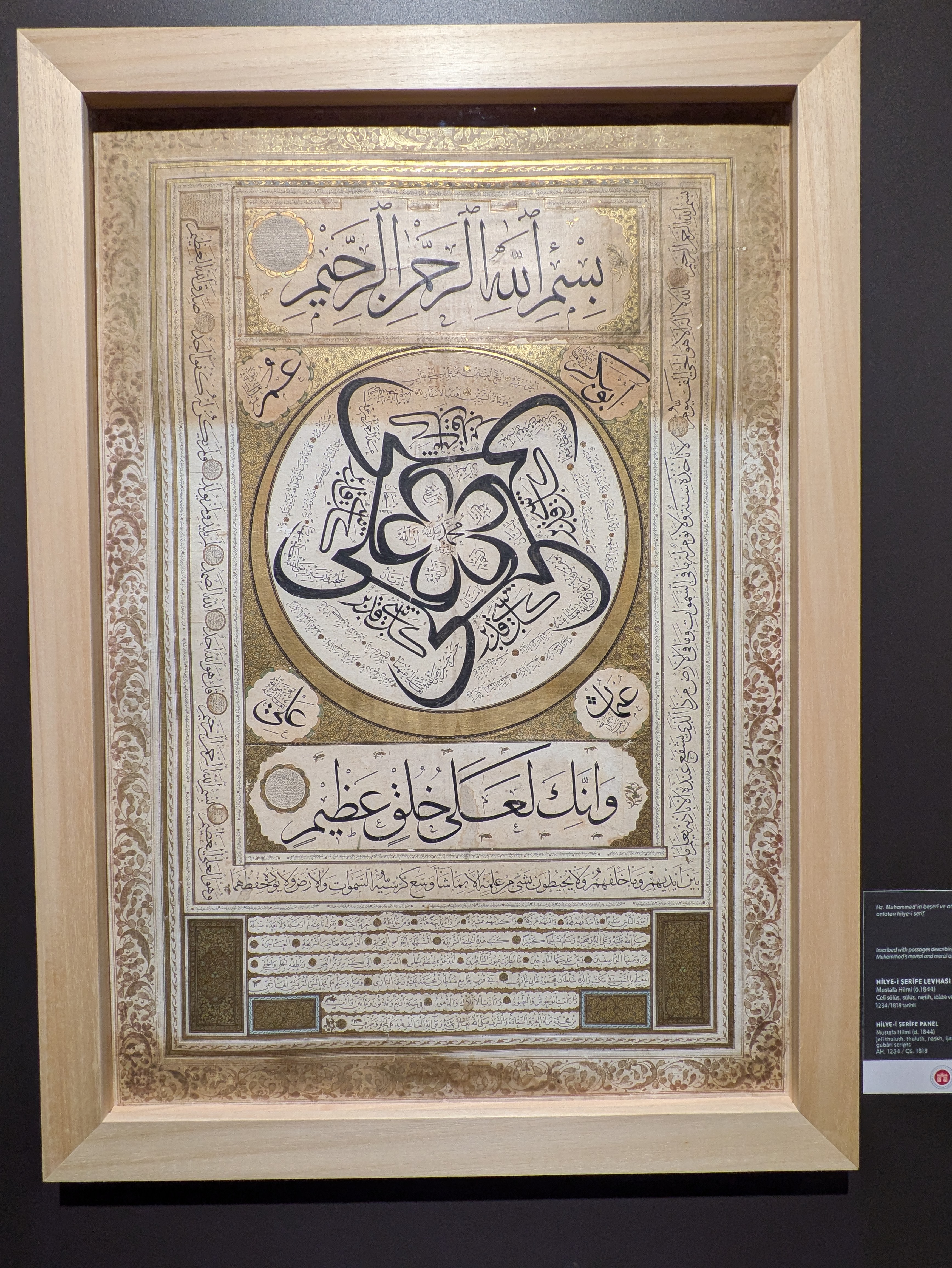
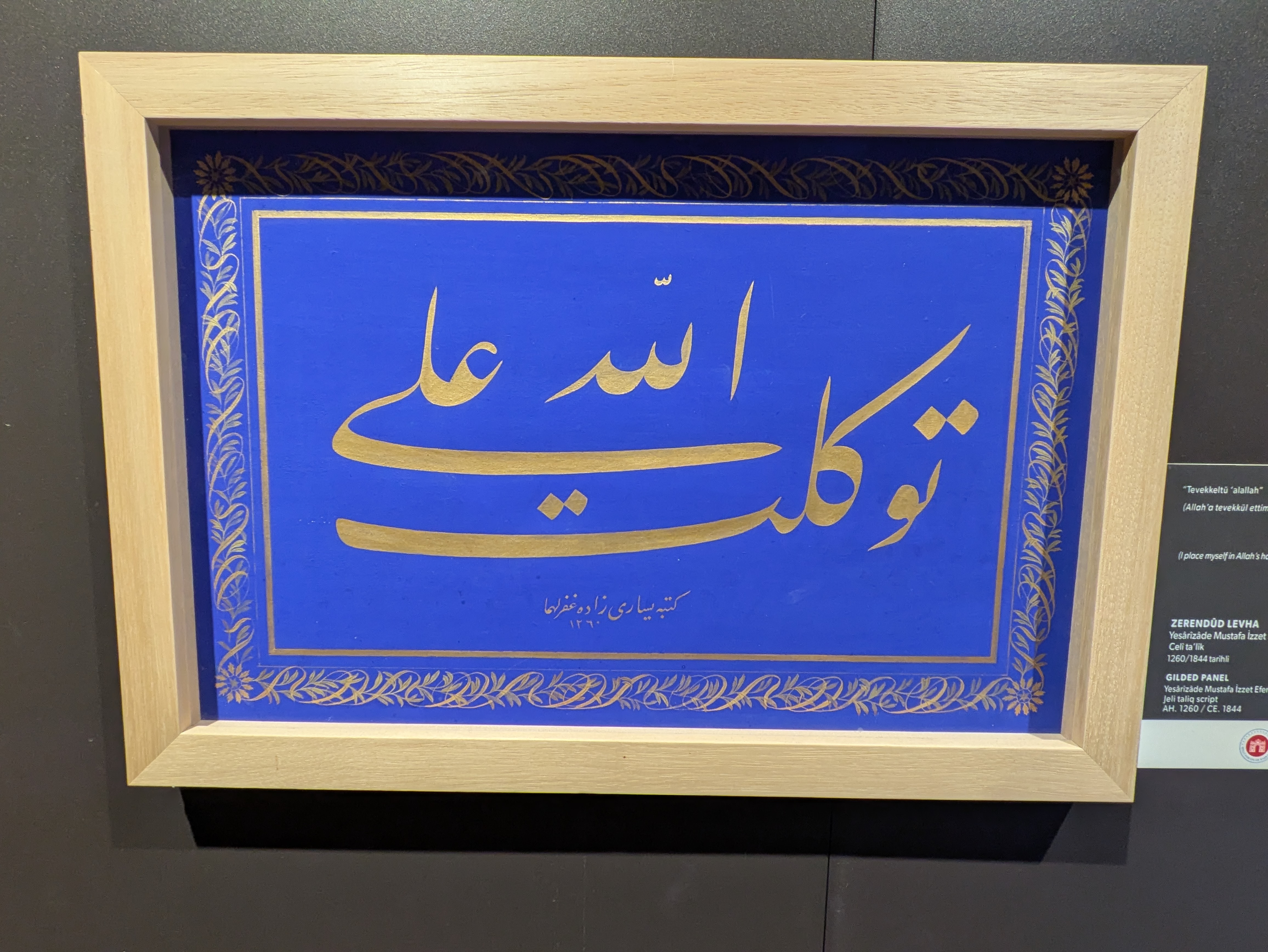
Equally as astonishing are the Topkapi’s collection of holy relics. My brow must have been constantly furrowed as I passed through rooms hosting various beard clippings, sandals and even a cardigan of Muhammad’s, his daughter Fatima’s clothing, fragments of John the Baptist’s skull, Moses’s staff (in remarkably good nick for a 3,300 year old stick), and David’s sword.
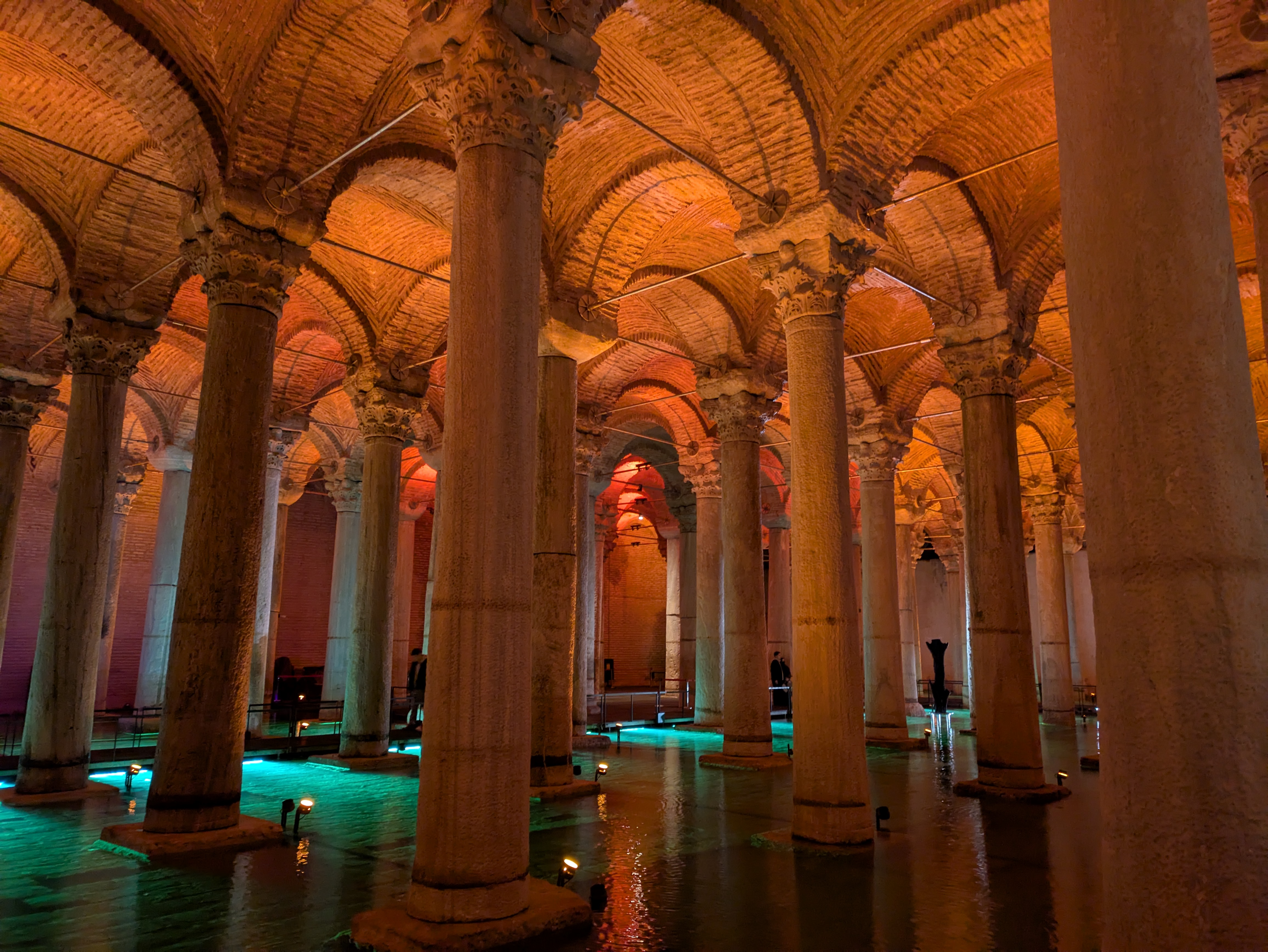
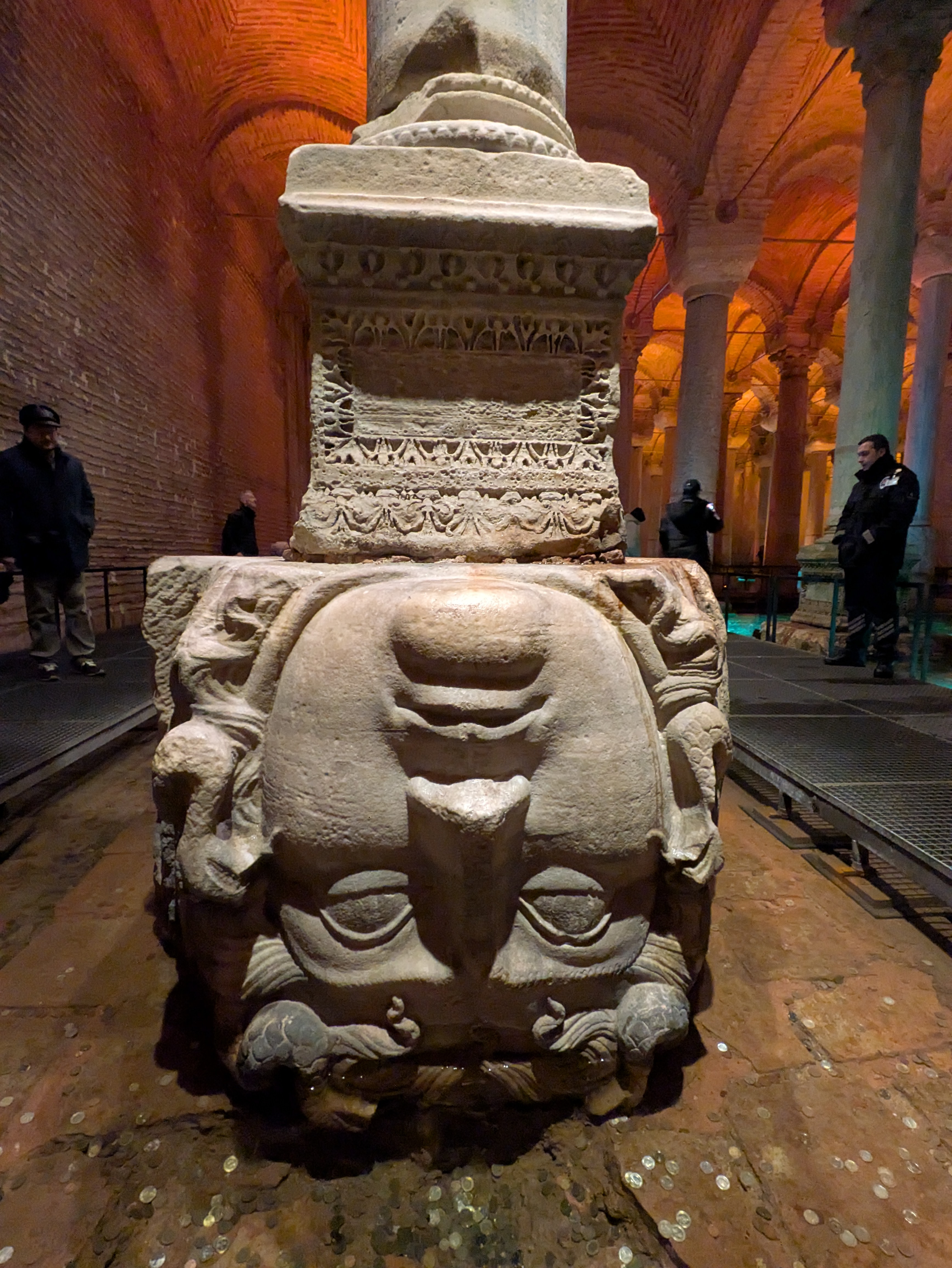
Despite Istanbul’s commanding position on the Bosporus, it has no natural source of drinking water. The engineers of Justinian I solved this conundrum by building a series of subterranean cisterns into which potable water flowed via a network of aqueducts that had been initiated by the Romans. Today, we can descend into the atmospheric Basilica Cistern, illuminated and photogenic.
Having been wowed by the Blue Mosque on my arrival to Istanbul, I needed to visit by day to see inside. Taking its colloquial name from the countless Iznik tiles mounted on its walls, but officially the Sultan Ahmed Mosque, this became Istanbul’s primary mosque upon completion in 1617. As with the Hagia Sophia, on my visit tourists outnumber worshipers by 10:1, but unlike its older neighbour, the Blue Mosque is free and access is open to all. Whilst bigger than the Hagia Sophia, and certainly beautiful, it doesn’t have the same atmosphere of reverence, nor is its construction quite as ambitious.
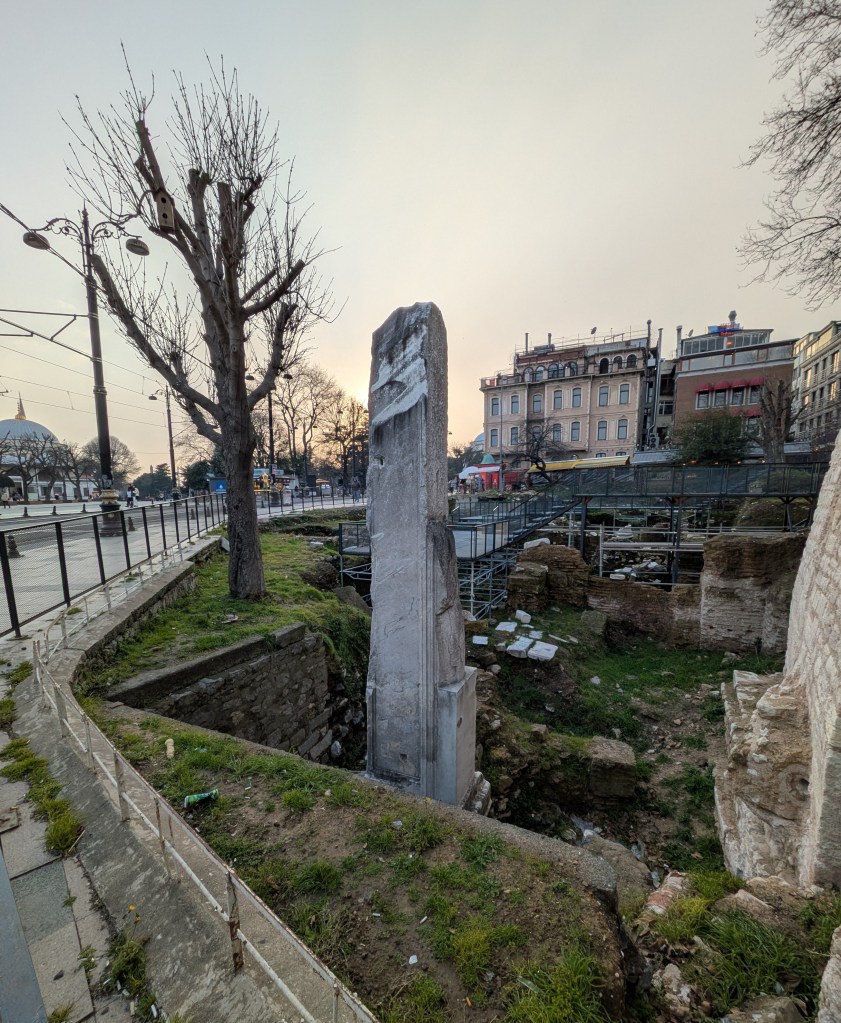
Close to all these sites, in an inconspicuous corner just off the Hippodrome, an unglamorous lump of stone stands sentry, surrounded by empty beer cans and strips of plastic wrapping. To call it an obelisk or even a pillar would be flattery. It no longer even has a plaque to draw attention to its significance. Unsurprisingly, it goes completely unnoticed by almost every passer-by, but this is what remains of the Milion, which 17 centuries ago on the re-founding of the city as Constantinople was installed as the mile-marker from which all distances across the Eastern Roman Empire were measured; this was mile zero in what would become Year Zero for a city already a millennia old.
So here in the city that all writers are at pains to describe in those east-meets-west terms, rests a mundane block of masonry that really did once define the world around it – that geohistorical sextant. Istanbul defined its world, it wasn’t for the world to define Istanbul.
 Tom the Curious: Ramblelogue
Leave a comment