“If one had a single glance to give the world, one should gaze upon Istanbul.” Alphonse de Lamartine.
As alarm clocks go, the 6.20am call of the Muezzin that reverberates around Istanbul is as gentle as they come. It also makes for a rather evocative reminder that my plans each day will involve the peace of mosques and noise of this endlessly bustling city.
Having spent my first three days in Istanbul on not-so-dry land, I need to get out onto the Bosporus. My original plans of a boat trip to the Princes’ Islands had been thwarted by the snow. Unperturbed, I take the commuter ferry from Eminönü to Kadikoy on the city’s Asian flank. For roughly a quid, this is a far more preferable way to explore than by the many pricey tour boats that cruise the waterways.
Kadikoy is home to what remains of Istanbul’s Greek and Armenian communities, although this isn’t evident during the few hours I spend there (disappointingly, the Armenian church is closed). I may have been snowblind, but it is not a pretty area. However, as is often the way with diverse but seen-better-days neighbourhoods, it is the centre of an artistic community, and is known for its street art. This prompts me to set out on an improvised walking tour seeking out notable murals, only to be thwarted again by the snow, which is now ridiculous.
Sodden and frozen to the bone, the only smart move is to seek refuge in a cafe in the maze-like market. An opportunity to sample a local icon: Turkish coffee. Am I impressed? I am not. I may occasionally be partial to bitter coffee, and whilst acknowledging its cultural importance, there is nothing particularly pleasant to this over-roasted, viscous tar with its grainy sediment finish. Sorry, Turkey, but with such a bitter brew you’re missing out on all those wonderful floral notes that quality coffee offers.
Taking my coffee snobbery with me, I jump onto the Beşiktaş-bound ferry just as the snow pretends to halt. This is the crossing that the Istanbul-based British journalist Hannah Lucinda Smith describes to Misha Glenny as “the best commute in the world” during their conversation on Turkey for Radio 4’s impeccable How To Invent A Country, and there’s no reason to disagree. Clouds are beginning to part, allowing the masonry clad shoreline to brighten from an apologetic dull grey to a refined sandstone, all with a silver-blue sheen. I begin counting the minarets on the skyline and then do the same for the log-jam of tankers waiting to travel north up the Bosporus: I stop counting at 30 for the former, a dozen for the latter.
Equal to the view from the ferry is the voice of a busker rising up from the lower deck. Accompanied by classical guitar, it’s a beautiful, lilting, feminine falsetto – perhaps with a hint of that famous hüzün. On disembarking at the Beşiktaş pier I’m stunned to see it was a male singer.
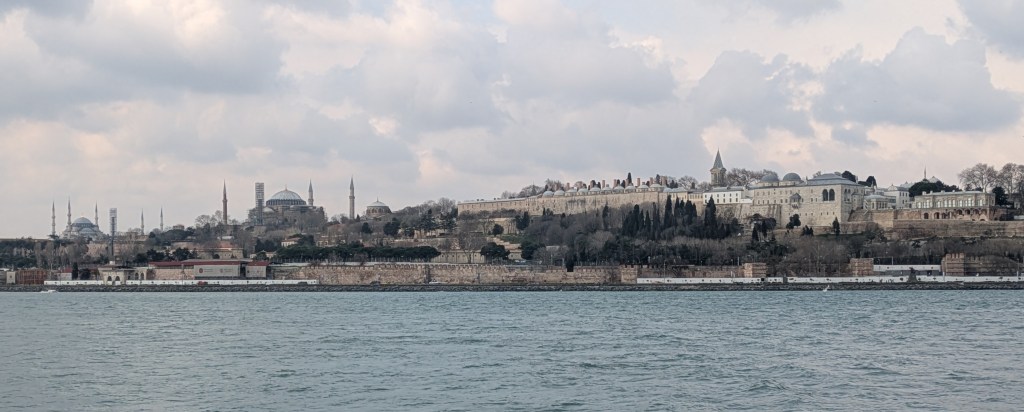
Hagia Sophia and Topkapi.
After boats and minarets, stray cats are the next most frequent sight. Mostly healthy-looking, they’re everywhere. Sheltering in mosques, prowling markets, stalking the subway, even earning their sea-legs on the ferries. The locals leave food and water for them on street corners, so they’re clearly welcome residents, perhaps returning the favour by keeping vermin under control. In fact, they’re so loved that in one cafe a lady jokingly scoops up a kitten and drops it into her shopping bag, to much mirth among fellow customers.
Whilst I notice many female Istanbullus socialising in cafes and restaurants, it’s rare that I notice any working in them. I start to wonder where all the women work. Sure, there are the white-robed old ladies who sit on the floor of the many bakeries kneading dough, and some of the US/European chains employ female servers, but in a reversal of European tradition, it seems that most customer-facing roles are fulfilled by men, often with several of them performing tasks that would logically be carried out by one or two. It means that three smartly-attired waiters might serve a single table, with much performative brushing-off of crumbs, while being bossed around by the same number of scowling older staff. This tends to speed service along at quite a pace, meaning I don’t feel I can take my time to watch the world go by in cafes or bars, one of my favourite hobbies.
One workplace that is heavily dominated by stubbly men smoking while tapping their phones is the Grand Bazaar and smaller Egyptian (or Spice) Bazaar. I found the labyrinthine Grand Bazaar particularly disappointing, with store after store of worthless tat. The repeated patter of stallholders with “Hello, David Beckham” or “Hey, Prince William” was mildly amusing the first time I heard it 20 years ago, but is now tedious. A cheeky “Brother, will you buy my socks”, whilst pointing to a pair of sockless ankles, was a better effort.
Basic English is spoken by most retail and hospitality staff, but I encounter very few anglophone tourists, despite it being February half-term in the UK. Instead, Turkic and Slavic tongues are more common, and on several occasions I hear Russian for the first time in several years.
One local who didn’t speak English was the kindly security guard at the Arter contemporary art gallery. Having slid my way down the snowy backstreets of the Beyoğlu district – an interesting looking area with its musical instrument stores and matching boho vibe – I arrived at the impressively sleek yet monumental new gallery to find the entrance locked. Using his phone’s translate function, he apologetically explained that they had been forced to close for the day because of the blizzard. Hiding my incredulity that an art gallery would need to close as a result of a bit of snow, I made an attempt at following my hotel’s receptionist’s advice on how to say ‘thank you’ (teşekkür ederim): “just say ‘tea, sugar and dream’ and we’ll understand you”. Cue an expression of pure confusion on the uniformed guard’s face.
Having been thwarted by the weather from enjoying some art at Arter, I changed direction and headed for the Pera Museum. Housed in an elegant former 19th Century hotel, the travel guide description of exhibits of Ottoman weights and measures didn’t heighten my expectations. This was to my benefit, as what I found was a wonderful experience. After warming my hands around a cup of cappuccino in the Pera’s super-stylish art deco dining room – complete with gold wall tiles, baby grand, and Billie Holiday soundtrack – I had the galleries virtually all to myself.
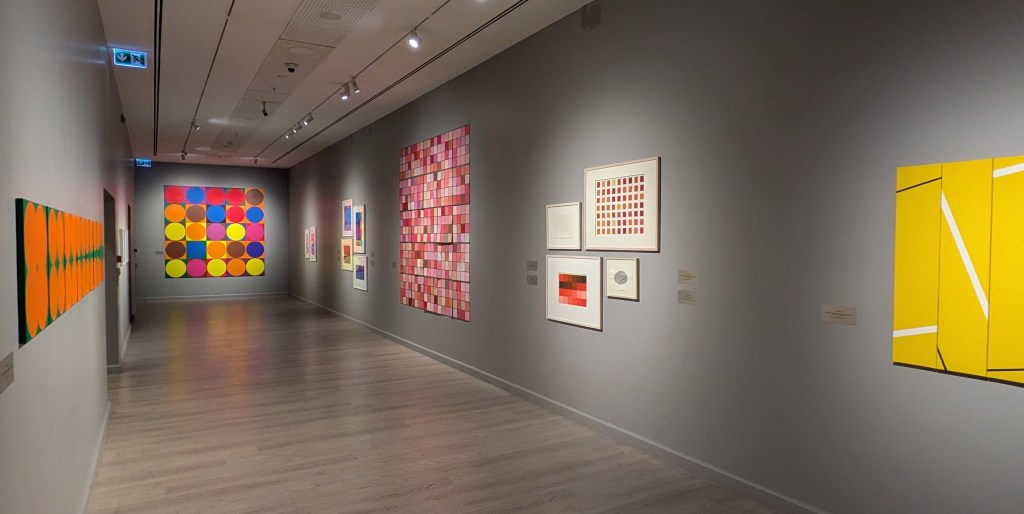
The Calculations and Coincidences exhibition of ‘algorithmic art’ brought a colourful, modern spin on the repeat patterns and concentric circles found in Islamic art and architecture, even if this wasn’t the original inspiration for the Hungarian artists it showcased. Other work on show literally put the viewer into the frame, using cameras and AI to create ever-changing interactive pieces.
Winding my way back to Galata, passing the eponymous tower, I returned to Postane for lunch. I had previously ducked into this peaceful space with its high-beamed ceiling and vast canvassed artworks so to escape the blizzard a few days previously. The friendly staff recognised me with warm smiles and “merhabas” and taking a table, I re-ordered the best thing I had eaten in Istanbul – their lentil soup, so wholesome that I felt healthier with every slurp. In fact, Postane’s whole ethos is wholesome, with the produce either grown on their roof terrace or sourced from sustainable growers. A main of golf ball-sized bulgar kofters in a creamy tomato sauce is equally delicious and proves the value of taking a chance on independent, unknown establishments rather than following the tourist crowds. It also shows what can be achieved by talented people who actually give a shit about their craft rather than just chase the tourist Lira.
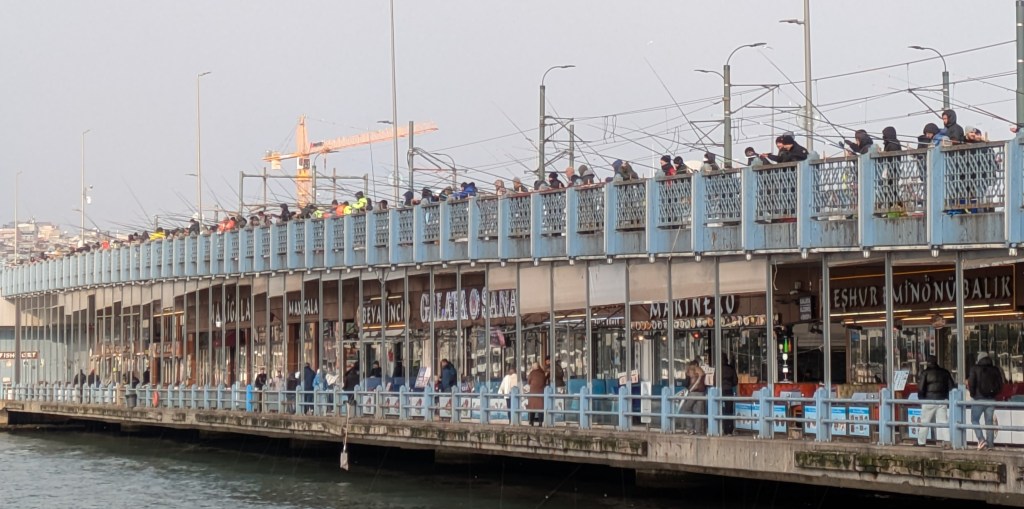
Crossing back over the Golden Horn via the Galata Bridge, the air that had until now even smelled cold turns whiffy with the stink of fried mackerel sandwiches (‘balik ekmek’) being served from the boats at the Eminönü shoreline. The bridge itself is only interesting for the body of water it spans and for the hundred-odd fishermen that cast their rods over the side, reeling out their silvery catch to take home for dinner, hüzün & chips for the unsuccesful.
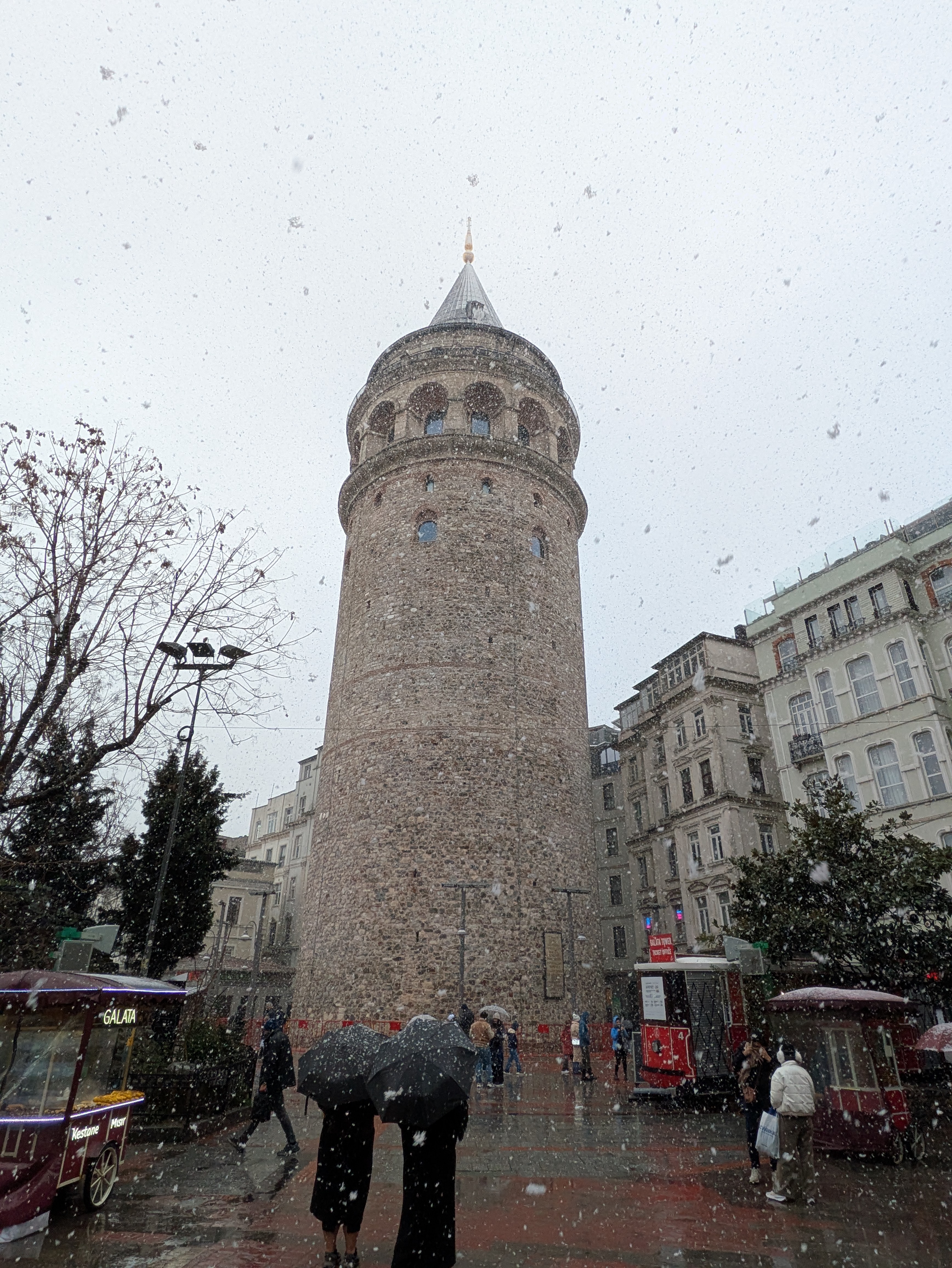
Below, the Galata Tower and a heritage tram on İstiklal Caddesi.
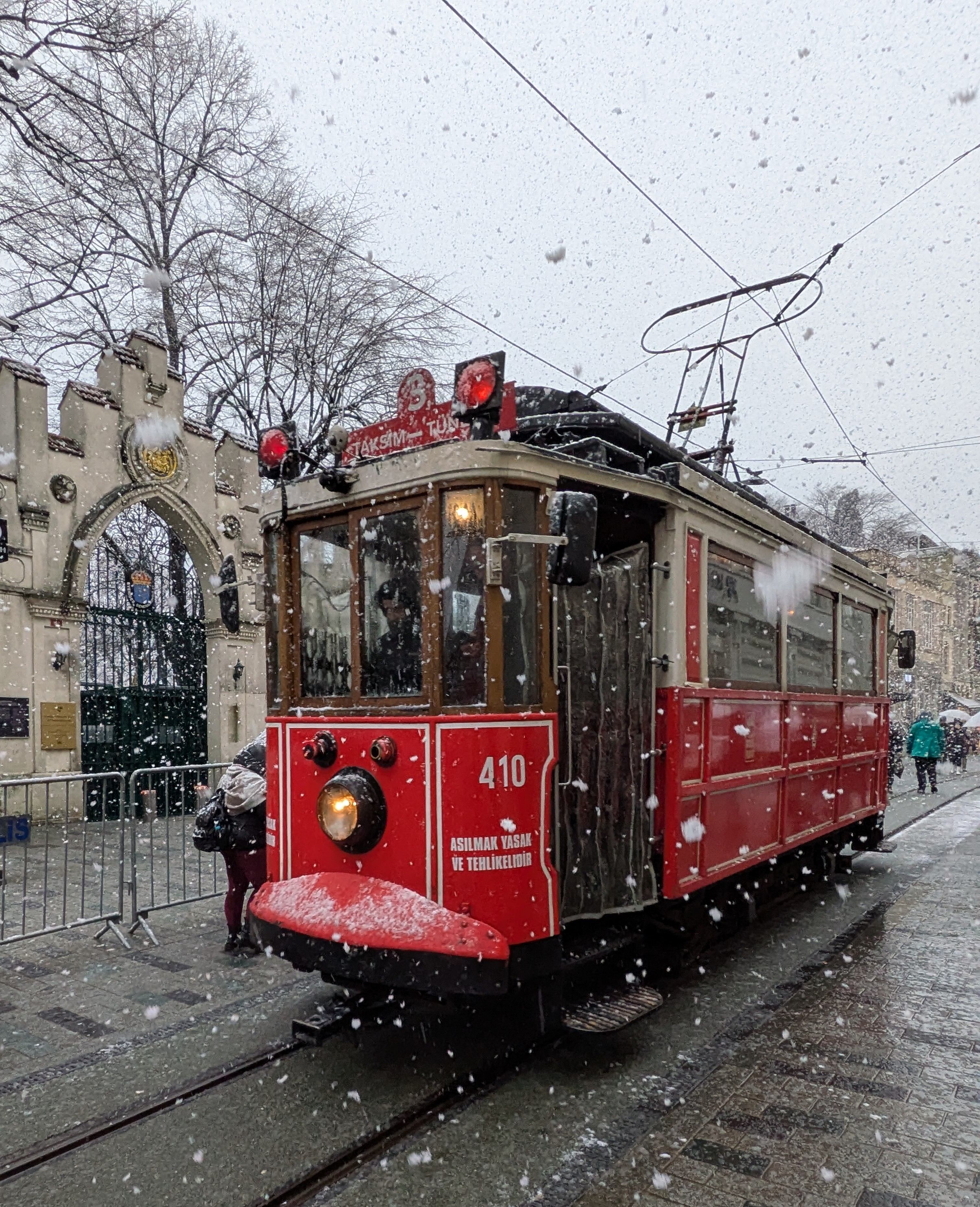
Despite the best efforts of the God of Snow, my spirits haven’t been dampened in this sacred city: no hüzün for me. I shall return, at a warmer time of year, with so many more sights to see and neighbourhoods to explore. Tea, sugar and dream, Istanbul.
Istanbul travel tips
Reading: As mentioned in Part 1, Orhan Pamuk’s ‘Istanbul‘ is the perfect local’s view of the city. Bettany Hughes’s Istanbul: A Tale of Three Cities is a suitably epic, comprehensive and highly readable biography.
Listening: I highly recommend BBC Radio 4’s How To Invent A Country, which did four episodes on Turkey. History Extra’s ‘History’s Greatest Cities’ podcast has an Istanbul episode from 2023, which is worth a listen.
Whilst there…
Istanbul’s transport system is quick, safe and very cheap. Buy an Istanbulkart from the airport’s metro stop for easy top-up and use on the metro, trams, buses and ferries. A downloadable metro map is available from https://www.metro.istanbul/en/
British visitors should keep in mind that Turkey isn’t covered by free EU roaming, so mobile data charges will apply.
Entrance fees to attractions are, I think, often extortionate. For example, without a Museum Pass, Topkapi costs €44 + extra to enter the Harem; the palace is comparable to Versailles in size and significance, yet Versailles currently costs only €24 for full entry.
A Museum Pass at €105 is therefore good value, although it doesn’t include every attraction (for example, Hagia Sophia isn’t included). However, I do applaud the Turkish state for making entry fees for Turkish citizens very cheap, giving them affordable access to enjoy their own remarkable heritage.
There are plenty of well-maintained public toilets but, bearing in mind the age of the city, disabled access didn’t seem great. Marble floors may look nice, but are worn by the ages and often slippy when wet.
Food is fine but somewhat underwhelming. I had been told before visiting that the Turkish food in north London is better than in Istanbul, which my hotel’s receptionist agreed with (and so do I). Even a waiter in one restaurant told me that “for good Turkish food you need to go to Anatolia”.
Water is apparently safe from the tap, but isn’t particularly pleasant.
I felt perfectly safe at all times, including at night. There is a prominent police presence, far more metal detectors than are necessary, and the locals are friendly and helpful. I would go as far as saying that Istanbul felt like the safest major city I have been to.
 Tom the Curious: Ramblelogue
Leave a comment