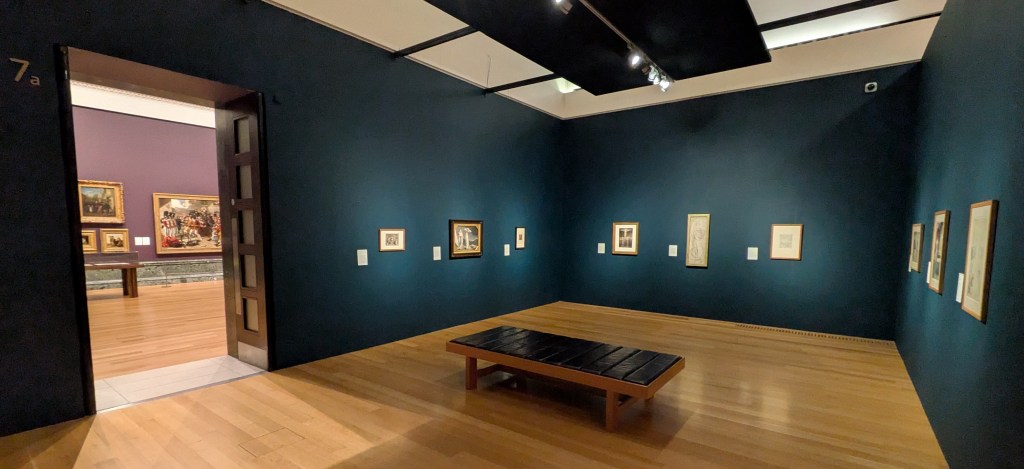
The silence in Tate Britain’s room 7a, the William Blake Room, could be mistaken for reverence if there were anyone else in it. But it’s empty. And it’s small. Just the eleven artworks – etchings and paintings – are on show here. This, I feel, is emblematic of our failed collective acknowledgement of someone who should be on a list of England’s greatest cultural icons after Shakespeare and Bowie – I have a coffee mug with Shakespeare’s portrait on it and even a doorstop shaped as Aladdin Sane-era Bowie, but how many of us wear t-shirts emblazoned with the image of Newton or a tattoo depicting Urizen?
One unseasonably warm Saturday in spring, I decided to ramble my way through the London of William Blake – between locations sometimes imagined, otherwise real, and often now lost. Blake described his unique perspective of London in many of his works, but also re-imagined the city as Golgonooza, built by ‘Los’, Blake’s ‘eternal prophet’ and embodiment of human creativity.
Taking room 7a as my starting point, my route would cross the Thames to Lambeth, double-back through the West End, and then head east to Blake’s final resting place at Bunhill Fields.
‘I wander thro’ each charter’d street, Near where the charter’d Thames does flow.’
Stepping out of the ambienced calm of Tate Britain into the kind of afternoon sun that draws a bead of sweat after 100 yards, I had ahead of me the thread of an idea and an improvised route around what we know as London’s zone 1, but would have been almost the extent of the city in William Blake’s day.
Crossing Millbank, and heading north along the Thames – that is, downstream – and into the small patch of greenery at Victoria Gardens South, the first thing a time-travelling Blake might notice is the collection of tents in the corner of the park, homes to the homeless. Being in sight of Parliament and Lambeth Palace – the home of the Archbishop of Canterbury – seems an especially poignant place to pitch up. Each of the pedestrians taking the same shortcut as me clearly notices these tents, incongruent to their surroundings as they are, but their location says that as a society we have tacitly agreed that ‘this is ok’. Despite rubbing shoulders with the wealthy and the influential, Blake lived and died in poverty. His strong moral compass often directed his ire towards Georgian London’s employment of chimney sweeps – average life-expectancy: 14 – so perhaps today we would see him campaigning on behalf of those with no roof above their head.
Over Lambeth Bridge, traffic crawling, the Thames somehow manages a shimmer, despite being an unnameable colour somewhere between grey, brown and green, as if mimicking a pigeon fluffing its plumage. Turning behind Lambeth Palace and through Archbishop’s Park (taking a passing interest in the 5-a-side matches that are being played at a walking pace) I find myself under the dank railway arches of Centaur Street, SE1, with trains rolling overhead, in and out of Waterloo Station. This is the unprepossessing home to a series of mosaics put up in homage of our muse. The tribute is a nice idea, but could a better nearby location not have been found? One, perhaps, where the fear of getting mugged in a dark side-street doesn’t deter the passer-by from stopping to enjoy the mosaicists’ efforts?
At the end of Centaur Street, stepping out of the gloom back into the sky burning bright, a blue plaque is immediately visible, explaining that ‘William Blake, poet & painter, lived in a house formerly on this site, 1793’. He had lived here through most of the last decade of the 18th Century with his wife Catherine, until they moved to Felpham in West Sussex. This part of Lambeth would then have been London’s south-facing front garden, a green and pleasant respite from the city, but the Blakes would have witnessed its growth and transformation as a result of the Industrial Revolution, gathering momentum at the time. Legislation meant that new industry had to be located outside of the city limits, therefore often pushed south of the Thames, so that the Blakes became neighbours to those ‘dark satanic mills’ of Jerusalem fame.
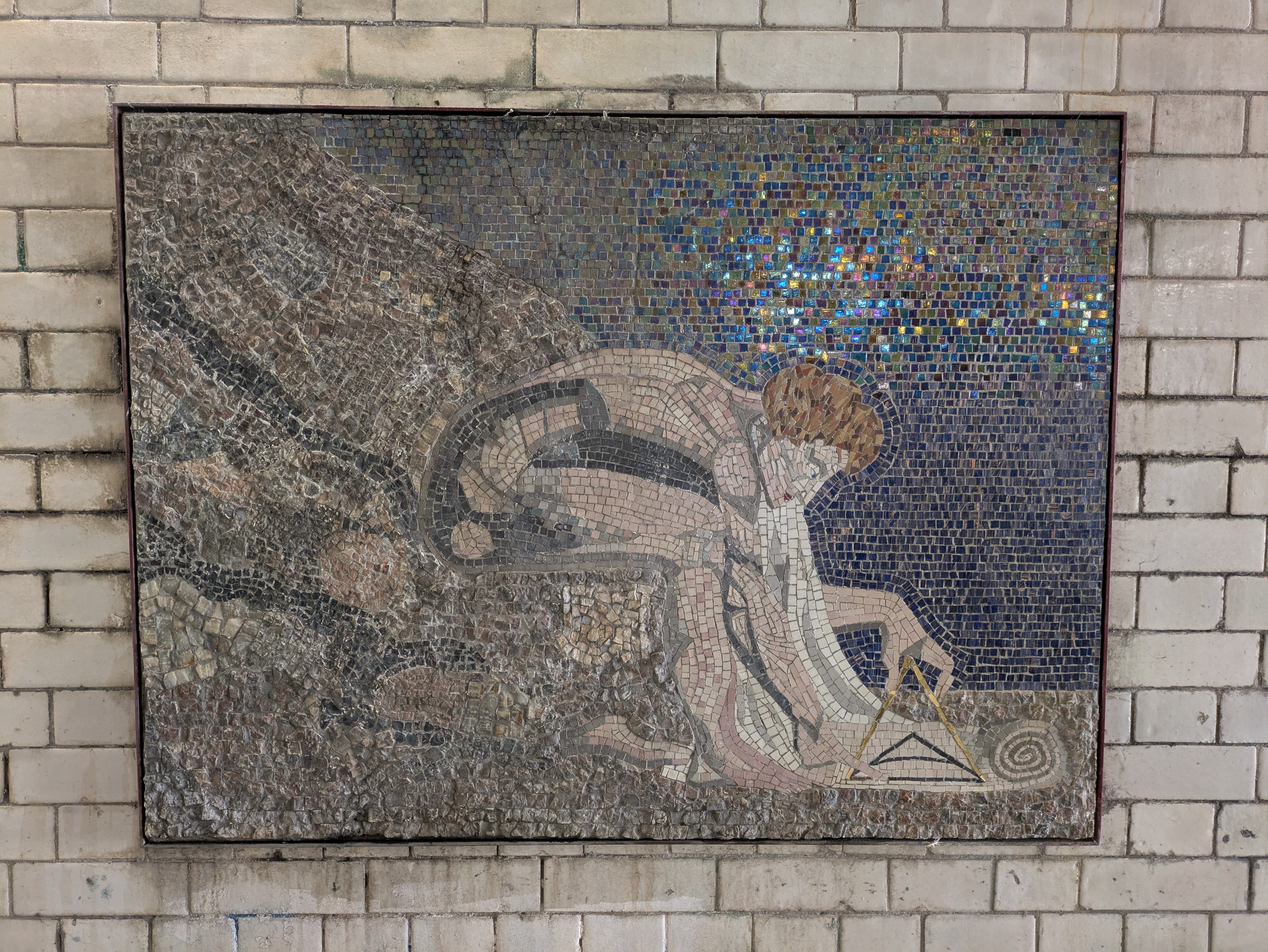
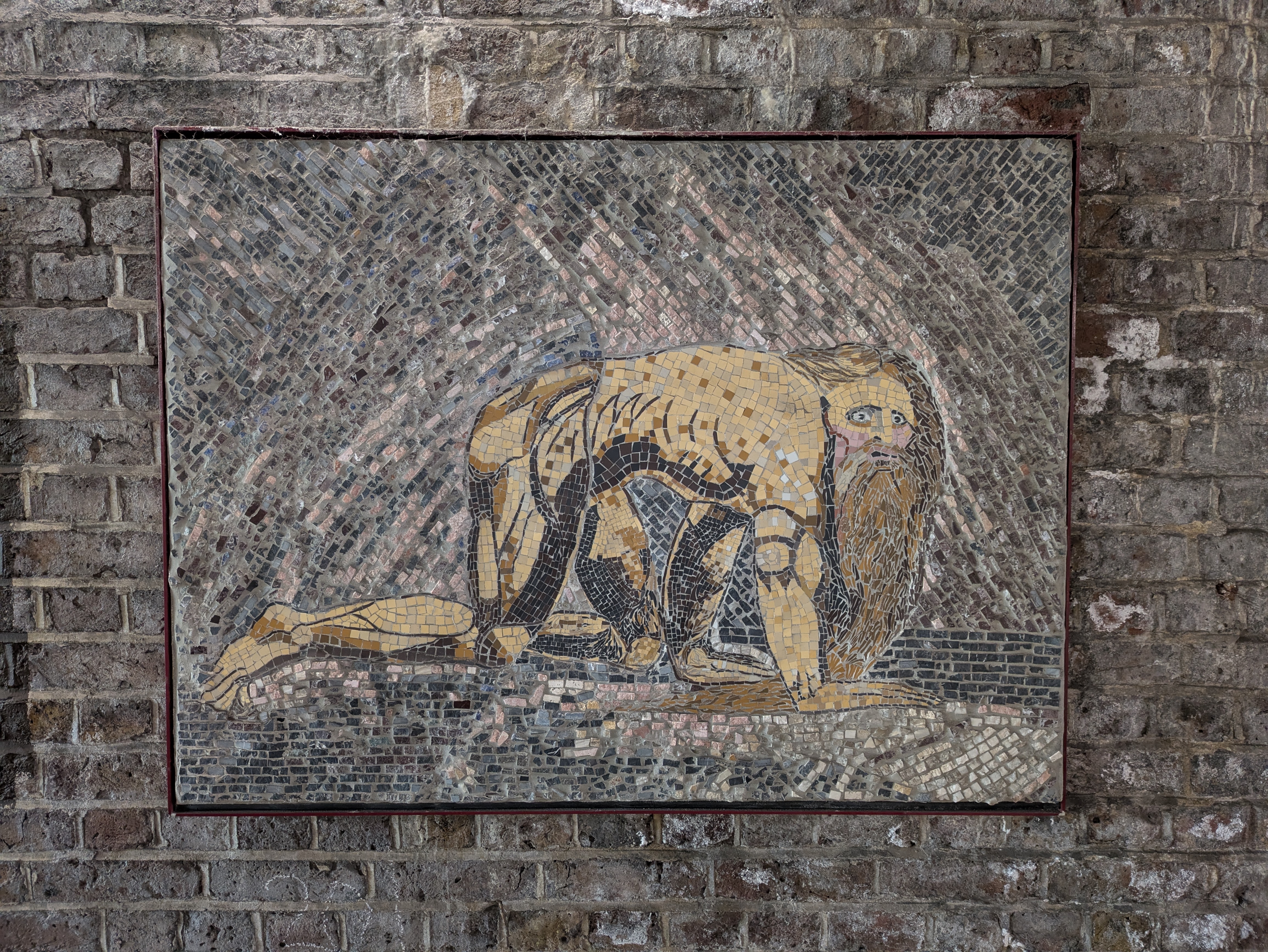
Blake’s former home was pulled down a year after the end of WW1, and on the site now stands a post-WW2 red brick, low-rise block of flats. From here, we’ll cross back over the river towards the few square miles in which Blake spent most of his life. My path weaves through that hellish stretch by the London Eye, dodging open top buses, swerving the tourist hordes, evading purveyors of promo leaflets, even dipping a shoulder to avoid a Peaky Blinders-themed stag party (shouldn’t they have gone to Birmingham?).
Arriving at Irving Street, on the south-east corner of Leicester Square, I’m reminded that this is possibly my least favourite acre of London, saved only by the presence of the Prince Charles Cinema and a couple of my favourite places to eat – Tokyo Diner and Leong’s Legend. In Blake’s day, this was Leicester Fields and Irving Street was Green Street. He and Catherine lived here at number 23, moving in as newly-weds – William’s father having fallen out with him for marrying someone uneducated (signing her name on her marriage licence as X, Catherine was clearly illiterate, but William loved her very much). William Hogarth and Joshua Reynolds, who lived nearby at the same time, this then being an artistic quarter, were until recently commemorated by statues in Leicester Square. A sign of the times, and of how trashy the Square now is, is that a decade ago they were replaced by statues of Harry Potter and that titan of British culture, Mr Bean.
500m due-west of Leicester Square stands the Christopher Wren-designed church of St James’s Piccadilly, where William was baptised. In the past, I’ve stumbled upon free lunchtime classical recitals here, but today the doors are locked shut. The adjoining Redemption Roasters serves a good macchiato though – an aptly named social enterprise to be serving the faithful – and a churchyard bench is as good as a pew for enjoying a rest. Wren worked on St James’s at the same time as he did St Paul’s, but they couldn’t be more different: St James’s is boxy austerity to St Paul’s ostentatious grandeur.
I wonder which of those two places of worship best reflected our subject’s own unconventional approach to Christianity? Blake’s belief in Jesus was absolute, and he repeatedly weaved Him into his work, embodying an approach to his faith where creativity was next to godliness. Despite his deep faith, he is not thought to have attended church regularly, so my question is probably moot, but perhaps there is an argument that Wren’s controversial design and outrageous creativity for St Paul’s better reflects Blake, rather than the limitations of St James’s.
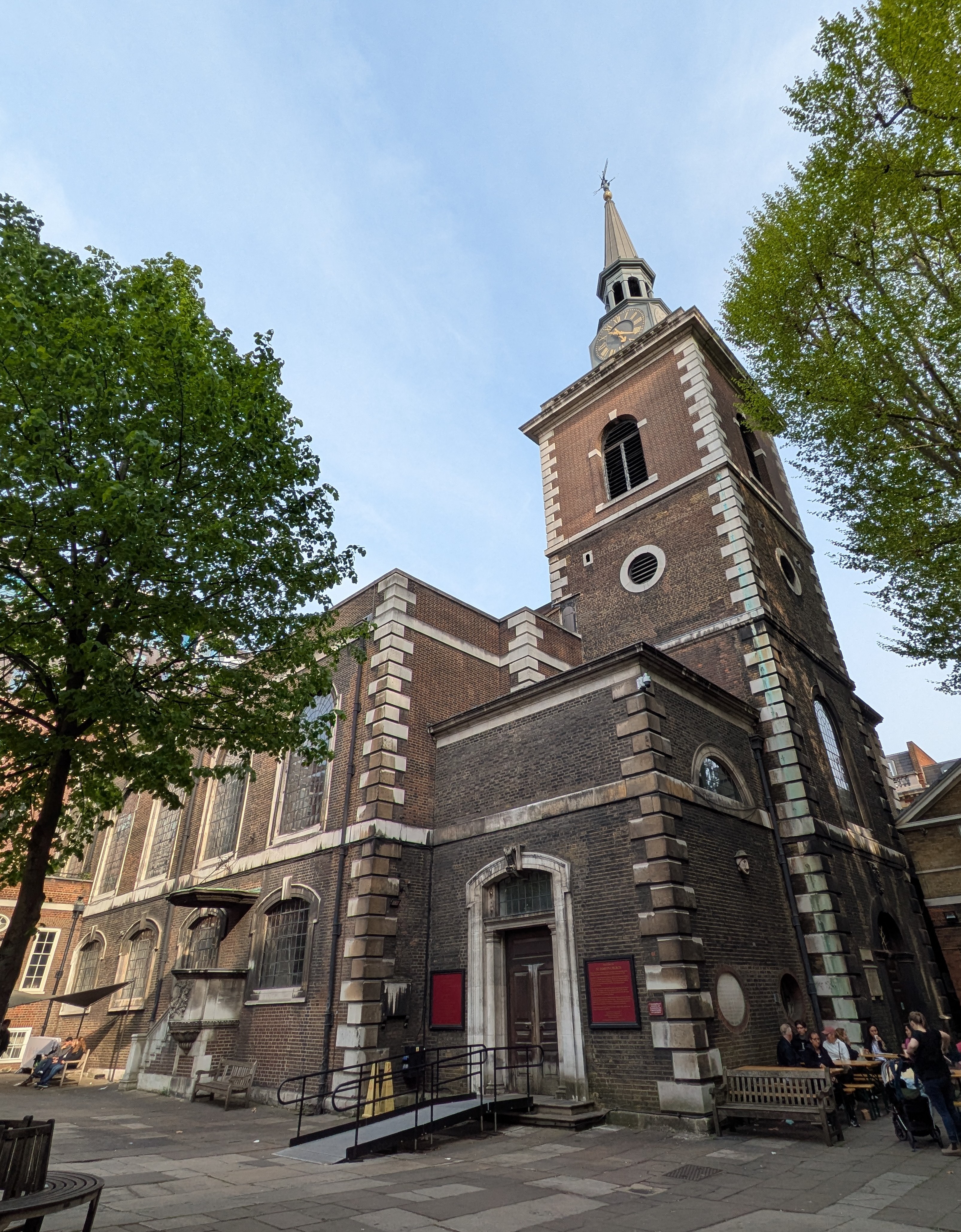
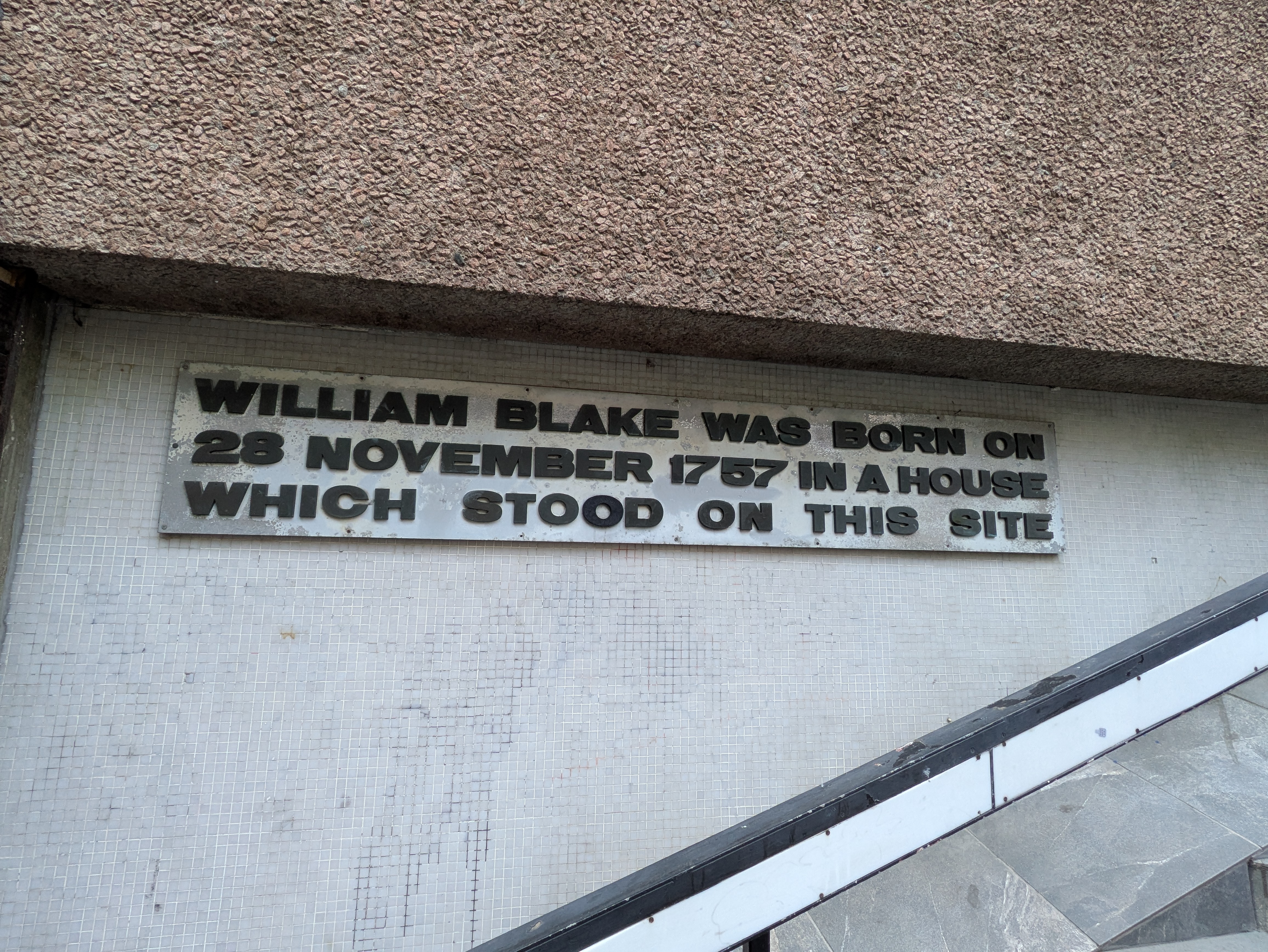
Above: St James’s Piccadilly; 28 Poland Street; the location of Blake’s birthplace on the corner of Marshall and Broadwick Streets, Soho.
Exiting the self-restrained calm of St James’s churchyard, my path traverses north through Mayfair, that latticework of well-heeled streets north of Piccadilly, rolling my eyes at the botoxed wannabe reality stars parading their oversized Longchamp bags down New Bond Street. Despite being ever poor, and uninterested in the superficial, Blake would have been used to seeing such wealth himself, not only through living cheek-by-jowl with the rich of Georgian London but often being invited to the dinner tables of the chattering classes, counting the likes of such revolutionary heroic figures as Mary Wollstonecraft and Thomas Paine as friends. Indeed, Piccadilly itself apparently took its name from the fashionable lacewear ‘piccadill’ – that Jacobean successor to the ruff – so, high-priced haut-couture was as familiar in Blake’s time as it is in ours.
Passing the ‘Hendrix & Handel House’ on Brook Street, my target is 17 South Molton Street, where William & Catherine lived from 1803-1821, on return from Felpham. However, on arrival I find the entirety of the north-western end of the street – and thus number 17 – to be hidden behind scaffolding in preparation for a new development. Yet more of Blake’s London being supposedly ‘upgraded’.
Doubling back a mile east into Soho, I’m headed for 28 Broad Street, now Broadwick Street. William Blake was born here – the family home above his parents’ hosiery shop – on 28 November 1757. The address no longer exists, but a monochrome plaque can be found above a flight of steps a few yards up Marshall Street near the junction with Broadwick Street. When I arrive there are five or six clusters of people sat on the steps chatting away, barely even noticing me taking the above photo of said plaque. It strikes me that most passersby wouldn’t realise the significance of this spot, just as they don’t with the ‘Broad Street Pump’, just a few yards away outside the Jon Snow pub. The pump, a replica, is of medical importance, as it acknowledges the location where Snow, a 19th Century epidemiologist, identified the source of the 1854 cholera outbreak, and thus that the infection is waterborne.
By all accounts, William had a very happy childhood, despite the deaths of two of his seven siblings. His parents took a laissez-faire approach to his schooling, realising early on that he was somewhat different to other children, and from Soho he was allowed to roam freely, often escaping the clamour of the city for the peace of such country idylls as Peckham! In fact, it was on one such ramble south of the river that the young William experienced a vision of a tree full of angels. John Higgs brings to life this episode in ‘William Blake Vs The World’ and uses it to explore the theory that Blake experienced hyperphantasia, and succeeds in convincing me that he surely did. Hyperphantasiacs are likely to be more open to “new experiences, broad interests, an active imagination and a likelihood of experiencing positive and negative emotions more keenly than other people”, which certainly helps to begin to explain Blake, albeit speculatively.
Moving deeper into Soho I head for 28 Poland Street, where the Blakes lived for a few years to 1791. The mundane modern building houses a retail unit and offices to let, but the address is of significance in William’s story, as it was here where he invented his very own printmaking technique, allowing him to combine images with text, thus he could illustrate his own poetry, the style of publication for which he is best known.
Winding my way southeast from Poland Street, my next stop is the place of William’s death, Fountain Court, just off The Strand. Or, as it now is, the Coal House Tavern. Time for a pint. The Blakes lived in happy squalor here from 1821-1827, when William died aged 69 (nearly twice the average life expectancy of a Londoner of the time – 38 years – which itself was around a decade longer than in contemporaneous Paris, even before Madame Guillotine got to work). Among Blake’s last known words were those to the love of his life, “Stay Kate. Keep just as you are – I will draw your portrait – for you have ever been an angel to me”, suggesting that he was creative and in love to the very end.
Close to Coal House Tavern/Fountain Court stands Somerset House, formerly the home of the Royal Academy, where the 21 year old William had been admitted to study and occasionally exhibit. Lacking the financial security of many of his peers, William continued working as an engraver during his studies, and evidence of his poverty can be found in him receiving a grant of some £25 for ‘laboring under great distress’, approximately £2,000 in today’s money.
From the splendour of Somerset House, my route takes me on a long stretch with no Blake reference – the eastern end of The Strand, Fleet Street, the start of Ludgate Hill, and then left into Old Bailey. The Old Bailey – the Central Criminal Court, officially – was formerly Newgate Prison. The current building, built in 1904, is emblazoned above its main entrance with the words ‘Defend the Children of the Poor & Punish the wrongdoer’, words that Blake may well have approved of. There is a Blake connection here via the Gordon Riots of 1780, witnessed by Blake, during which the Newgate Prison was attacked by rioters and gutted by fire.
From the Old Bailey, mine – and Blake’s – final destination is barely a mile as the crow flies, or a short, zig-zag walk past familiar territory.
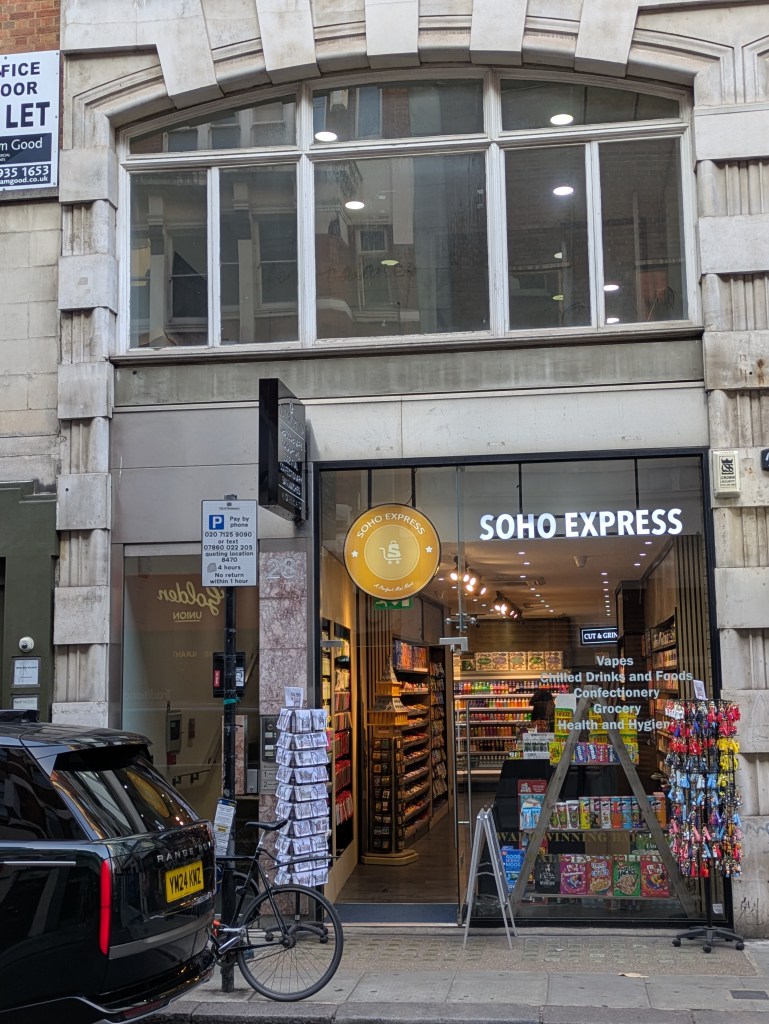
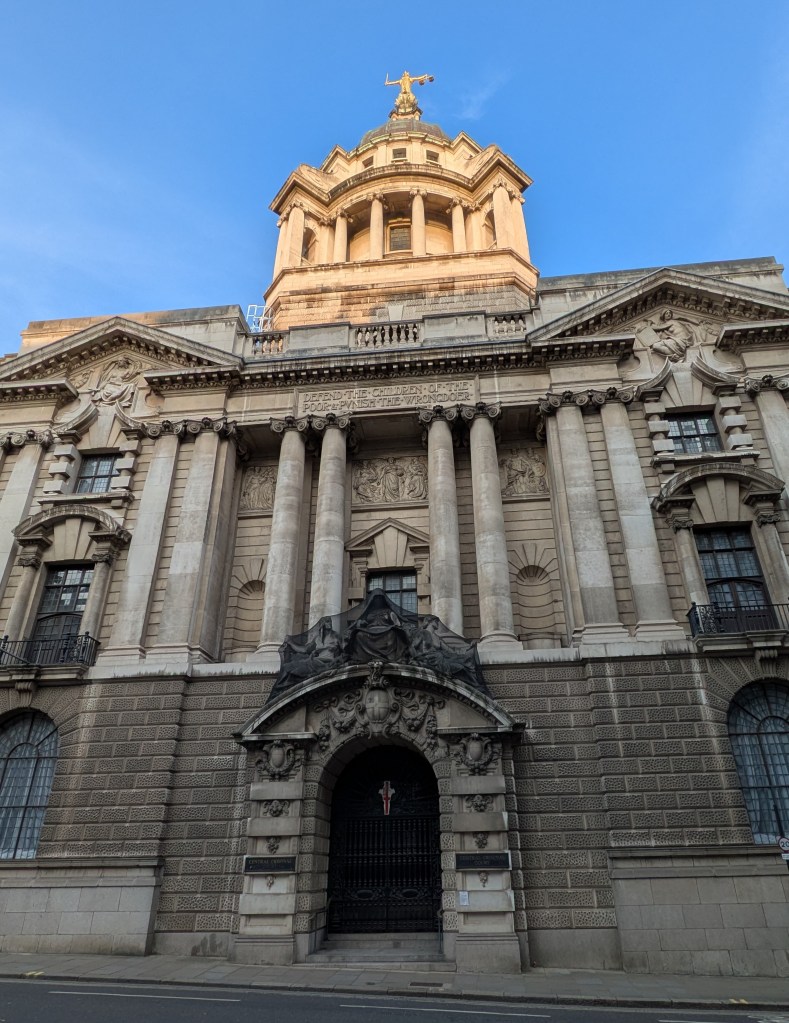
Above: 28 Poland Street, uninspiring; the Old Bailey (once Newgate Prison) with it’s Blake-esque inscription to ‘Defend the Children of the Poor & Punish the Wrongdoer’.
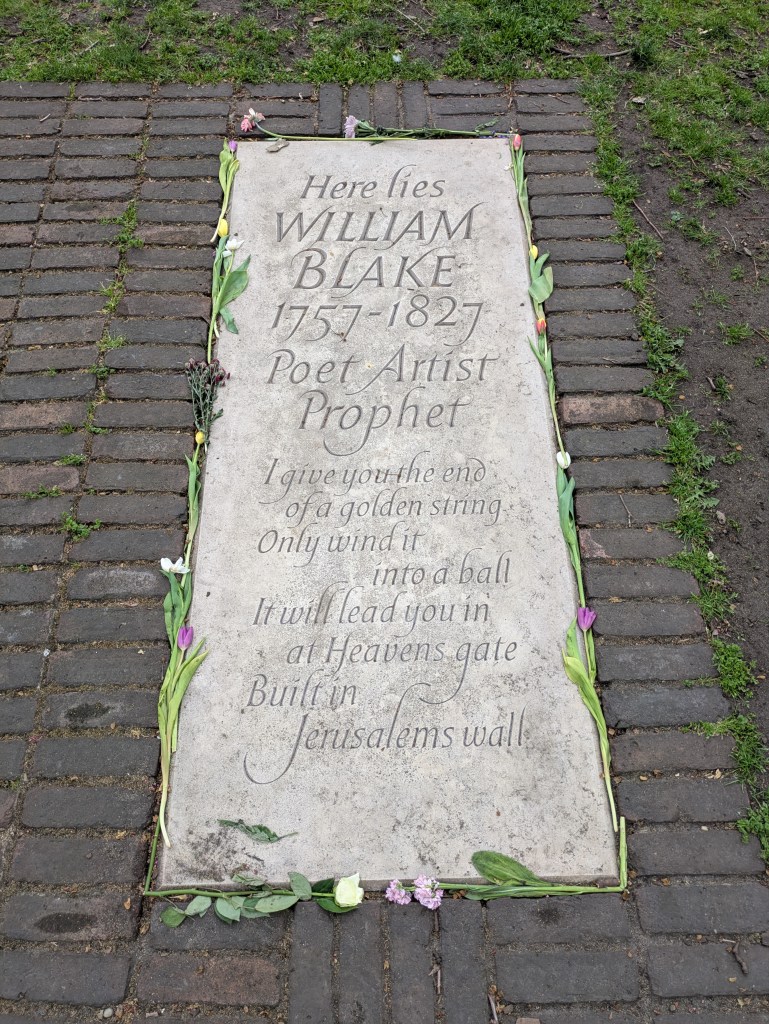
‘I give you the end of a golden string’
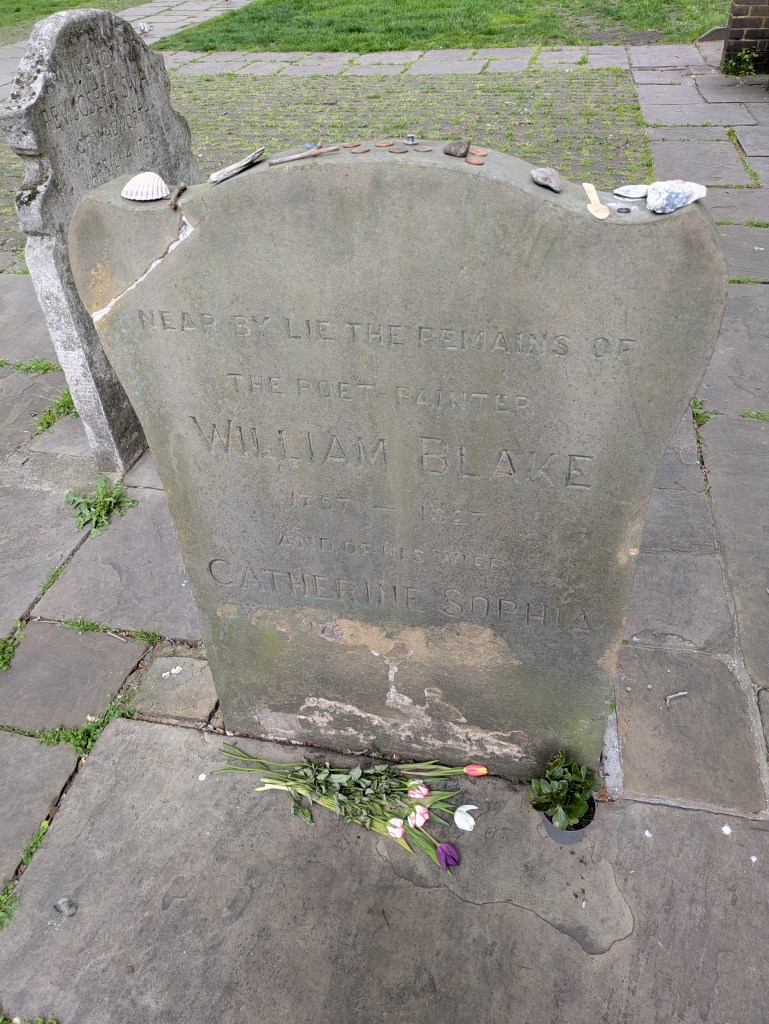
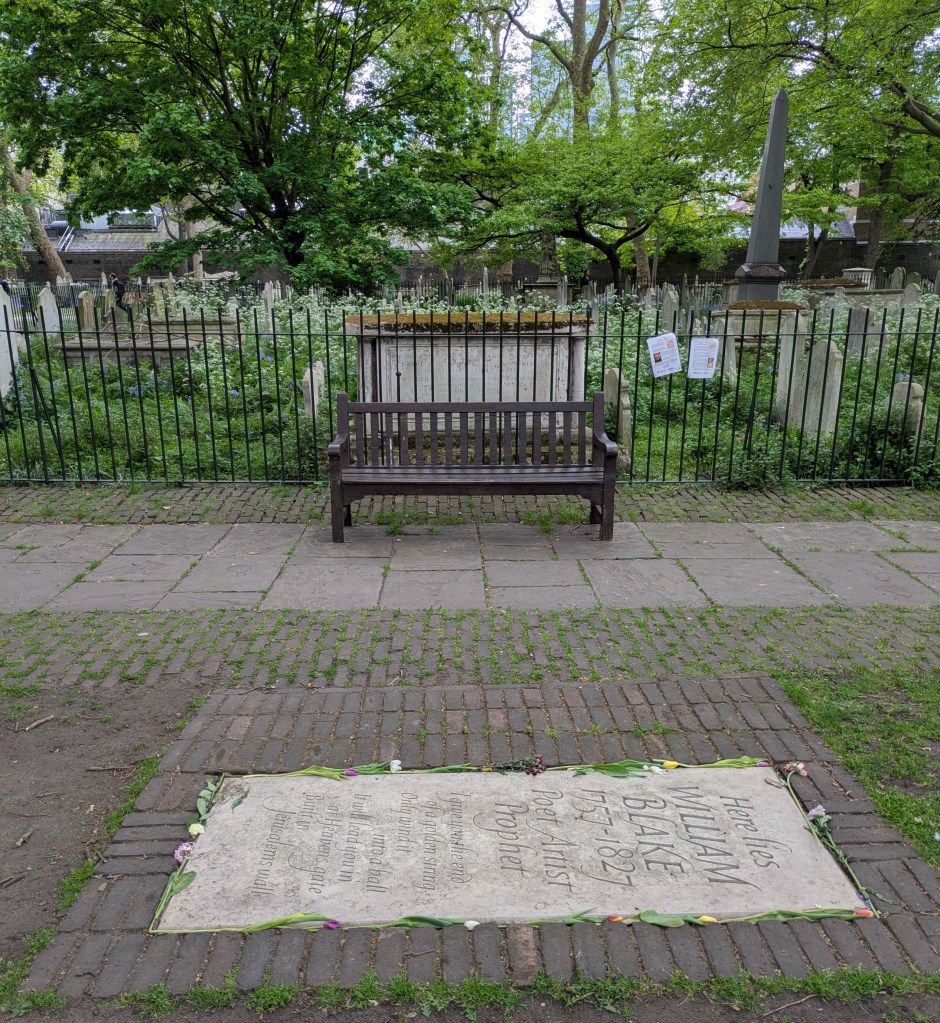
William Blake’s final resting place is at Bunhill Fields Cemetery, just west of Moorgate and north of the grounds of the Honourable Artillery Company. For the first two centuries after his death, it was unclear where exactly William was buried, demonstrative of how soon he was forgotten. A weather-beaten gravestone – decorated on the day of my visit with wilting flowers and a collection of stones, shells, and (bizarrely) a small wooden spoon – marking where it was believed he rested, next to Catherine, with a cenotaph for Daniel Defoe a next-door neighbour. Providing shade to this spot, a London plane, accompanied today by one of those omnipresent emblems of modern London, the Lime Bike.
Recent research has shown that William is in fact interred 10 metres away at a spot now marked by a new stone, with an inscription carved by Lida Cardozo and funded by the Blake Society. Facing William’s grave is a park bench, and it’s here that I take a pause to meditate. I’ve tried and failed to meditate many times in the past, but today it comes easy to me – the warmth, the light breeze lifting the branches of that plane tree as if to weigh them in its palm, the smell of pollen, the bird song, the faint hum of buses approaching Old Street roundabout; after spending the day stimulated by such an inspirational chap, barely a thought in my mind.
By my count, of the locations I’ve visited on today’s route, only Lambeth Palace, St James’s Piccadilly, parts of Somerset House, and the charter’d Thames itself would have been known to William; each of my other stops before William’s grave have been rebuilt or even renamed in the 198 years since his passing. But, perhaps that doesn’t matter when William himself reimagined London as his own mythical city of Golgonooza.
A lovely moment to end on: after my meditative moment on the bench facing William’s ‘new’ grave, I take a loop around Bunhill Fields, enjoying the greenery above my head and imagining skeletal hands reaching out of the gaps in the cracked, aged graves at foot-level. On a final pass to salute our hero, a handsome young guy has sat cross-legged, facing William’s ‘old’ grave. In the palm of his hands, a book of William’s verse, which he is quietly reading out in tribute to our resting hero.
The walk: My route ran just shy of 17km/11 miles, which took a little over 3 hours. Some sections could be covered by bus if needed, especially for the long stretch between Somerset House/The Strand and Bunhill Fields.
Blake quotes used:
‘I wander thro’ each charter’d street…’ is from ‘London’
‘I give you the end of a golden string’ is from ‘Jerusalem’
References/further reading:
The quite brilliant writing of John Higgs is a great place to start on Blake: https://www.weidenfeldandnicolson.co.uk/titles/john-higgs/william-blake-vs-the-world/9781474614375
Although I’ve yet to get around to his second one on our man: https://johnhiggs.com/books/william-blake-now/
https://www.tate.org.uk/art/artists/william-blake-39/william-blakes-london
https://blakesociety.org/ – where their (academically-oriented) Vala magazine can be downloaded for free.
https://divinity.uchicago.edu/sightings/articles/christian-who-was-church-one
And of course, The Selected Poems of William Blake, Wordsworth, 1994
Podcasts:
History Extra: ‘William Blake: artist or genius, or mystic, or madman’
BBC In Our Time: ‘Songs of Innocence and of Experience’
Inner Life, Talks and Thoughts: ‘Enemies of the Human Race: William Blake on how to know God’
How To Academy: ‘John Higgs – William Blake Vs The World’
Creative Codex: ‘William Blake – On Vision’s Wing’ (three-parter)
 Tom the Curious: Ramblelogue
Leave a comment