
“Soon can mean in one second, Soon can mean in one year.” Heinrich Böll – The Train Was on Time
What is this special type of anxiety that travel can provoke? The lady at London City Airport, repeatedly asking the airline staff what time we’ll be boarding – “you said ‘three minutes’ three minutes ago”, then “will it be another three minutes?”. The guy behind me on the 17.45 from Warsaw to Gdańsk, tapping his wedding ring on the back of my seat in a nervous rhythm in time with the clack of wheels on track. The live updates app that won’t load, even though we managed 150 years of industrialised travel before its existence. The shared sense of panic during the scramble onto a carriage – are there enough seats for this many people? What if someone is sitting in my assigned place?
Is it unfair to expect a sense of perspective, especially travelling along tracks that once transported so many to their doom? This region that Tim Snyder defines as the “Bloodlands”, in his book of the same name, that examines the machinery of the genocides committed by Hitler and Stalin in this strip where Central Europe becomes Eastern.
Does perspective change once we’re in motion? Do we notice the differences in the sound and feel of the train as it hurtles along when we’re at home in the same way that we notice it abroad? Does a Polish train jolt whilst a British train judders?
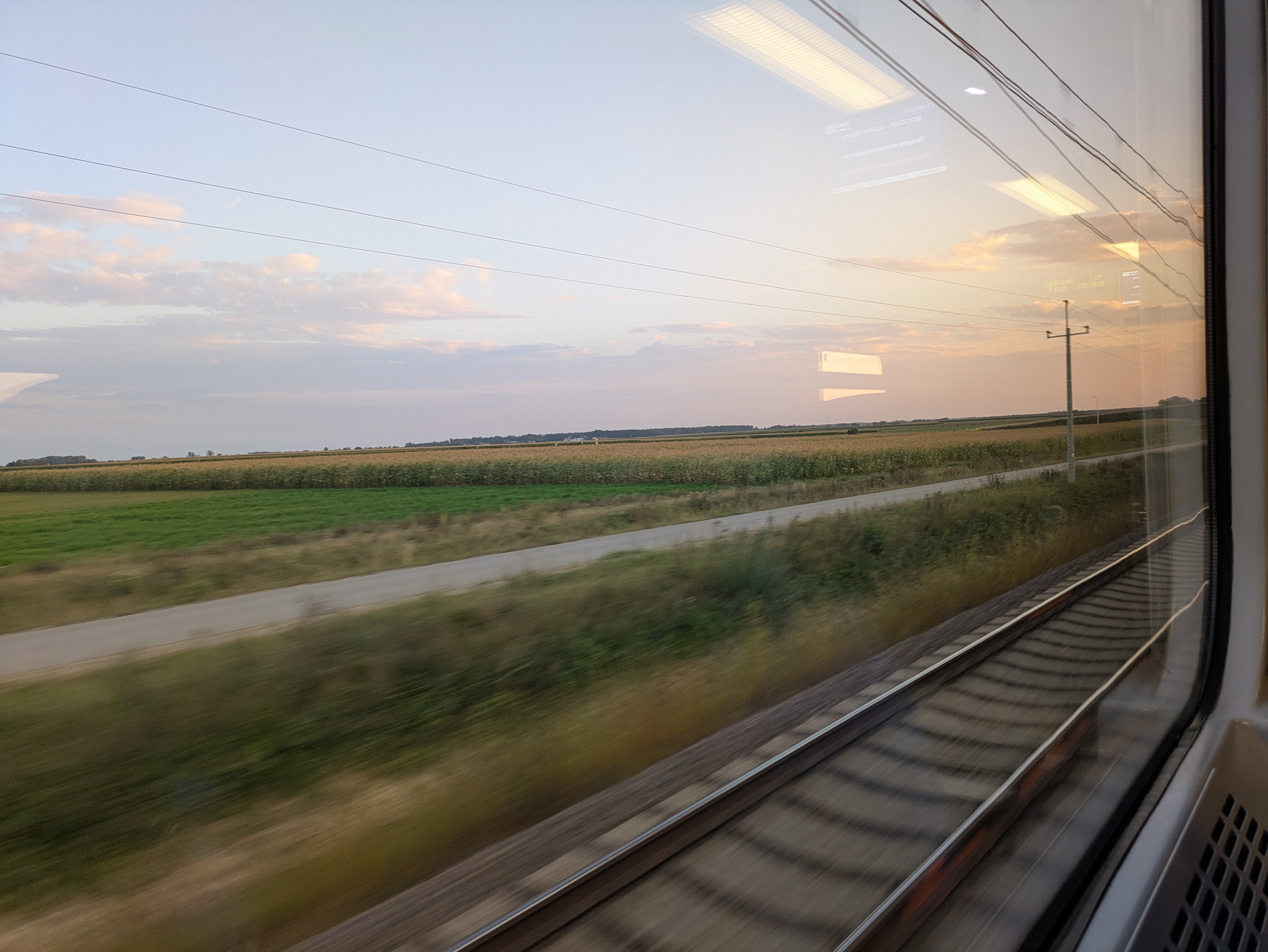
Warszawa Centralna to Białystok Centralny. The carriage’s information screen says we’re travelling at 148kmh. A glance out the window at the pancake flat fields of north-east Poland tells me we can only be going at half that speed. The seats are in a funny order: mine, 36, next to me is 34, then 42 next to 48. The red LED clock above the door is showing 88.00.
Mockava
Suwałki
Augustów
Those anonymous fields of Podlaskie, Masovia, Pomerania, could equally be East Anglia. But the agriculture looks different. Acres of beet, miles of corn.
I begin Heinrich Böll’s ‘The Train Was on Time‘ on the only one of my Lithuanian-Polish journeys that is delayed. German soldiers bicker and cheat each other on their passage across Poland, towards their inevitable deaths in the Bloodlands of their own creation.
Dąbrowa Białostocka
Sokółka
Białystok
Gdańsk Główny back to the capital. The carriage is hot, the passenger opposite sweaty. Sliding open the compartment window to let his odor out only lets in an agricultural funk. Manure at first, then the surprising stink of a potato processing plant. Entering the darkness of a tunnel brings a new smell. Dank. Like a flood in a pet store.
I learn that the pine woodlands that fence off so many Polish and Lithuanian train lines aren’t indigenous. Planted here for timber. Presumably they deflect the sound of diesel locomotives away from the stillness beyond.
A lone figure appears from between the pines, carrying an open box of freshly picked mushrooms, closely followed by a shaggy wolfhound.
A solitary farmhouse stands on a low mound, with no visible path to its freshly painted black door.
A copse of oak and beech stand as if an island in a sea of ploughed fields.
An ancient cemetery is surrounded by long grass. No adjacent church. No road.
The railway links cities, communities remain isolated.
Szepietowo
Małkinia
Tłuszcz
Travelling alone with my thoughts, in comfort, where so many were shunted around in wagons, standing room only, in baking heat or penetrating cold, in sheer fear. Eavesdropping on conversations that I cannot possibly understand, taking notes in my own garbled shorthand, which will eventually become this Ramblelogue.
There is no uniform colour to the buildings here, between cities of red roofs and ochre walls. There is an almost constant green, though. No sign of autumn yet, except for fields of dried up sunflowers, drooping heads of khaki.
Sporadic undulations to the land are like the bits of a rug that have bunched up. Earthen speedbumps. Fields are presided over by murmurations of starlings.
Crossing a lattice of rivers, rarely able to tell which way they’re flowing.
A passport check, at some nondescript station somewhere close to the boarder. Barely a glance at mine. Gazing out the window of carriage C, a blue sky and parting clouds like in the title sequence of the Simpsons.
The countryside here stretches into each city, leafy fingers reaching in towards each station. At home it’s the reverse – an urban creep into the rural. At home the station names are pronounceable. At home the journeys are functional, the destinations must have a purpose.
On my travels, they don’t need a reason, they exist as an opportunity.
Wołomin
Warszawa Wschodnia
Warszawa Centralna
 Tom the Curious: Ramblelogue
Leave a comment