“I am a camera with its shutter open, quite passive, recording, not thinking.” Christopher Isherwood – Goodbye to Berlin
Berlin’s influence through the past two centuries, it’s hardly controversial to note, has rarely been subtle. Similarly, from Berlin emanate the themes which would shadow my travels through that corner of central Europe once hidden behind the eastern fringe of the Iron Curtain: where east met – and stood against – west; where WW2 and the reach of the Third Reich are ever apparent; where counterculture battles establishment; and faded grandeur turns haughtily toward post-war renewal.
Previous visits to Berlin have certainly been more nocturnal than this one, but were still personified by a dichotomy: the futuristic sounds of techno booming out of dilapidated edifices from a bygone era. This time there is a similar hi-tech versus antiquarian contrast when I am served coffee by a robot waiter from the year 2049 in the café of that world-class institute of ancient history, the Pergamon Museum. I’m stumped as to whether it’s a cute novelty or terrifying vision of a future where the entire global hospitality industry has been wiped out by some kind of R2D2-cum-T1000.
It seems, for me, that duality must be the key to understanding Berlin – the feature of so many of the city’s facets.
Berlin is also where I decide to adopt the tactics of the flaneur or dérive (pretentious? Moi?). Bar a pair of U- and S-Bahn journeys from Brandenburg Airport and to Suedkreuz rail station, and my inter-city trains, of course, I resolve to travel only by walking. A personal duality, perhaps: this was an Interrail trip on which I would spend most of my time on foot.
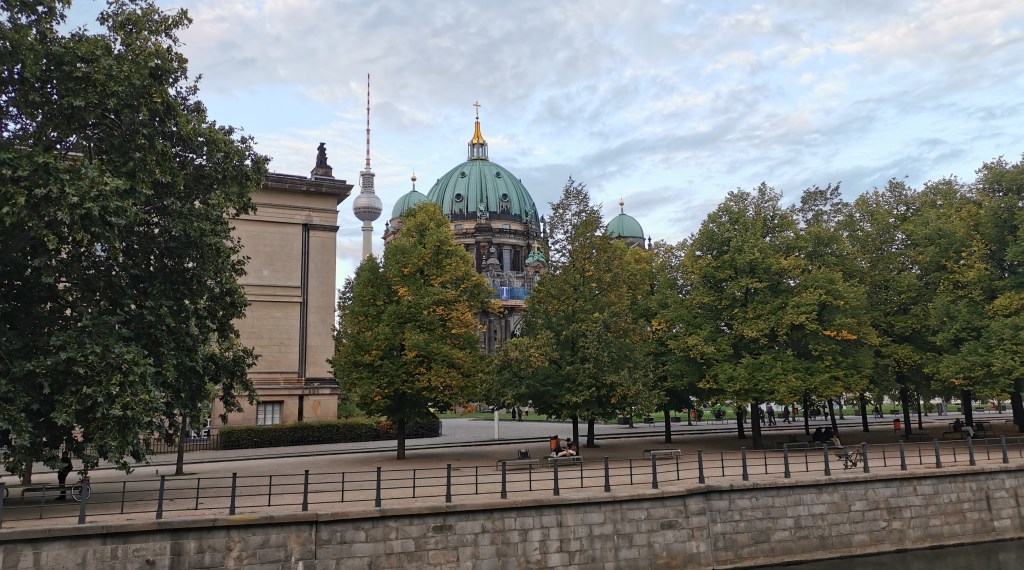
Berlin old and new: the cathedral and TV tower from Museumsinsel
Close to the Pergamon on Museumsinsel stands the (shamefully) hitherto unknown to me Neues Museum – a wonderful way to spend an afternoon, which could happily have lasted days. The undoubted highlight is to stand face-to-face with what must be history’s most beautiful face: the 3,300 year old bust of Nefertiti, described by the archaeologist who unearthed her, Ludwig Borchardt, as “the most alive Egyptian artwork. You cannot describe it with words. You must see it.”. He was right, and for this reason I shan’t attempt to.
My date with Nefertiti leaves me conflicted in the same way that my regular visits to the British Museum do. She is believed to have been sculptured circa 1345BCE by Thutmose, official court sculpture to Egyptian pharaoh Akhenaten, at whose former capital, Amarna, she was unearthed in 1912. The tactics by which Borchardt and his employers, the German Oriental Company, secured Nefertiti for Germany were arcane at best.
From the banks of the Nile to those of the Spree she was spirited away, now standing proud but far from home in her hexagonal chamber in the Neues, alone bar two museum assistants.
We Europeans benefit, of course, but the oft-used argument that more people get to see an artefact in a European city versus one in the developing world doesn’t hold water here, as Berlin receives only slightly more visitors than Cairo (both around 5m annually, according to Euromonitor).
I usually hold the opinion that an object’s origin is only part of its story, and each case needs to be considered in the context of its own journey. In Nefertiti’s case, I find myself strongly in favour of the Egyptian claim that she should return home. Surely AI developments, the use of holograms or 3D printing could be used to produce a replica that could remain in Berlin, allowing Tutankhamun’s step-mother to return to her homeland and an olive branch between Europe and North Africa.
Contrast the fate of Nefertiti’s bust with my experience the following day.
During lunch in the excellent Beba Café where, over an almighty schnitzel, I listen to the babble from neighbouring tables in a half-dozen different languages. Not unusual for a sophisticated eatery in such a cosmopolitan city, of course, but this was my soundtrack after the near silence I encountered visiting the next-door Topographie des Terror.
Located on the former site of the SS and Gestapo headquarters, Topographie des Terror is aptly named, documenting the appalling practices of those criminal organisations masquerading as state police during the twelve years of the Third Reich.
I’m also ‘pleased’ to see a special exhibition on Albert Speer, a character I’ve long held an interest in and whom I suspect we should all know more about, especially given his success in whitewashing his image over the decades following Hitler’s downfall: I’m sure he will have been a role-model for modern equivalents.
Alternative histories are problematic, I think, but as I submit to gluttony over Beba’s gorgeous Jewish cuisine and absorb the accompanying multilingual patter, I can’t help but think how bleakly joyless and plainly stupid we would be had the evils of fascism won out.
My travels will later allow for reflection on monoculture, but for now I can enjoy and be thankful that one of my favourite cities to visit is home to so many faces, tongues and cultures that the Nazis would have destroyed.


Leave a Reply