“All time is time. It does not change. It does not lend itself to warnings or explanations. It simply is. Take it moment by moment, and you will find that we are all, as I’ve said before, bugs in amber.” Kurt Vonnegut – Slaughterhouse-Five

Bruhl’s Terrace, Dresden
Dresden was not on my list. Berlin, Krakow, Prague – they were on my list. Dresden was just a convenient midway point between Berlin and Prague. Having made an albeit brief stopover, I’m glad of it for its location.
Its location, of course, was a contributing factor for Dresden’s most infamous recent entry in the history books. Nestled in the Elbe Valley, in the south-eastern corner of Germany, the capital of Saxony was supposedly out of range for Allied bombers. With apparently no heavy industry or military significance, it existed virtually unprotected throughout WW2.
Then, on 13th-15th February 1945, as the End Game approached for the Nazis, four joint RAF and USAAF bombing raids annihilated Dresden with 3,900 tonnes of explosives, resulting in up to 25,000 deaths. The city was virtually levelled. Photos from the aftermath could be mistaken for Hiroshima.
Debates persist as to whether the air raids constitute war crimes – I’ll not join the debate here. Reconciliation has included twinning Dresden with cities that suffered similar disproportional bombing, including Coventry and Rotterdam.
Fortunately, much of the historic centre of the city has been rebuilt and looks as it would have antebellum. Dresden’s baroque and rococo architecture inspired the nicknames ‘Florence on the Elbe’ and the ‘jewel box’, and wandering through the squares and quiet alleys to the riverside promenade of Brühl’s Terrace I’m quietly impressed.
Having decided to disembark here for 24 hours, it was this renovated ancient architecture that I was most keen to see. My most pleasant surprise, however, was the Albertinum Gallery of New Masters.
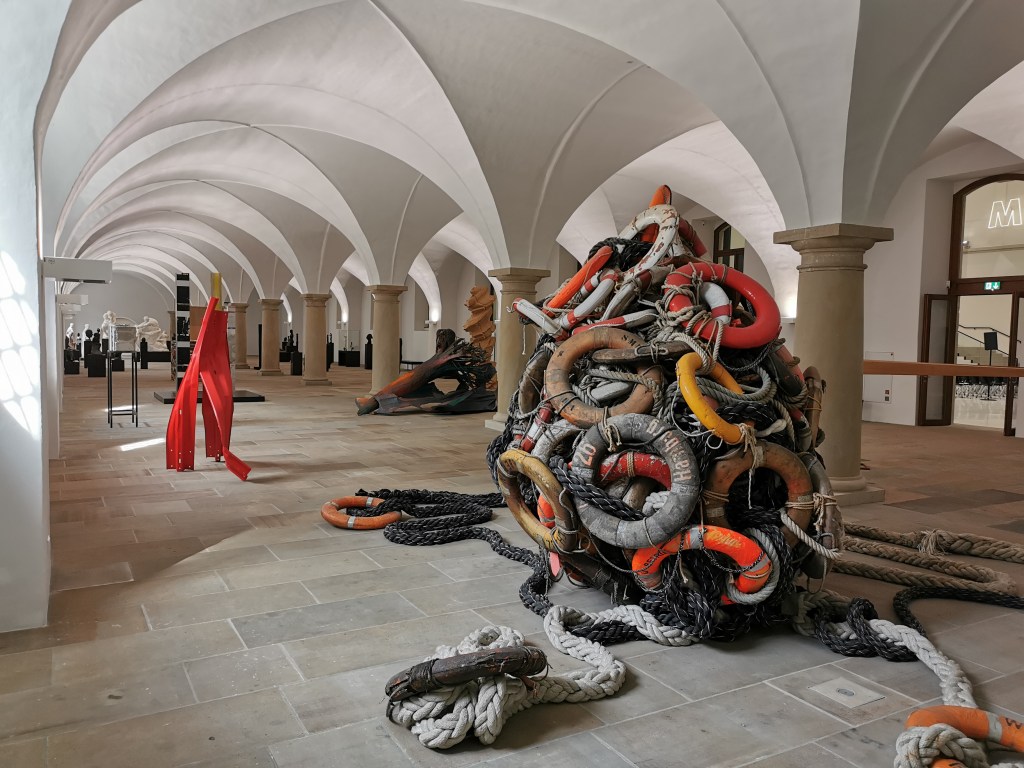
The sculpture hall of the Gallery of New Masters at the Albertinum, Dresden
Perhaps fitting for Dresden, and as the name suggests, the Albertinum is home to a world-class collection of modern art (here defined as 19th century onward) housed in a renaissance revival building. Much of the art on display is of German origin – although it includes pieces from many of the modern European masters – and it’s an exhibition of local lad Oskar Zwintcher that thrills me the most.
Instantly becoming a new favourite, I was previously completely ignorant of Zwintcher and the ‘Jugendstil’ movement to which he belonged. I’m often drawn to symbolism, a key component of art from Zwintcher’s part of the world during his era, and I can see comparisons with two of his contemporaries – also two of my absolute favourites – Egon Schiele and Gustav Klimt. The guy could seriously paint.
As I have a train to catch, I tear myself away from the Albertinum, my spirits high from this unexpected jewel in the jewel box. Inside the Hauptbahnhof I find a noisy mass of yellow and black – Dynamo Dresden have been at home, their fans in even higher spirits than I. The 17.10 to Praha Hlavní Nádraží is ready to depart platform 1…
 Tom the Curious: Ramblelogue
Leave a reply to Tom the Curious – Tom the Curious: Ramblelogue Cancel reply