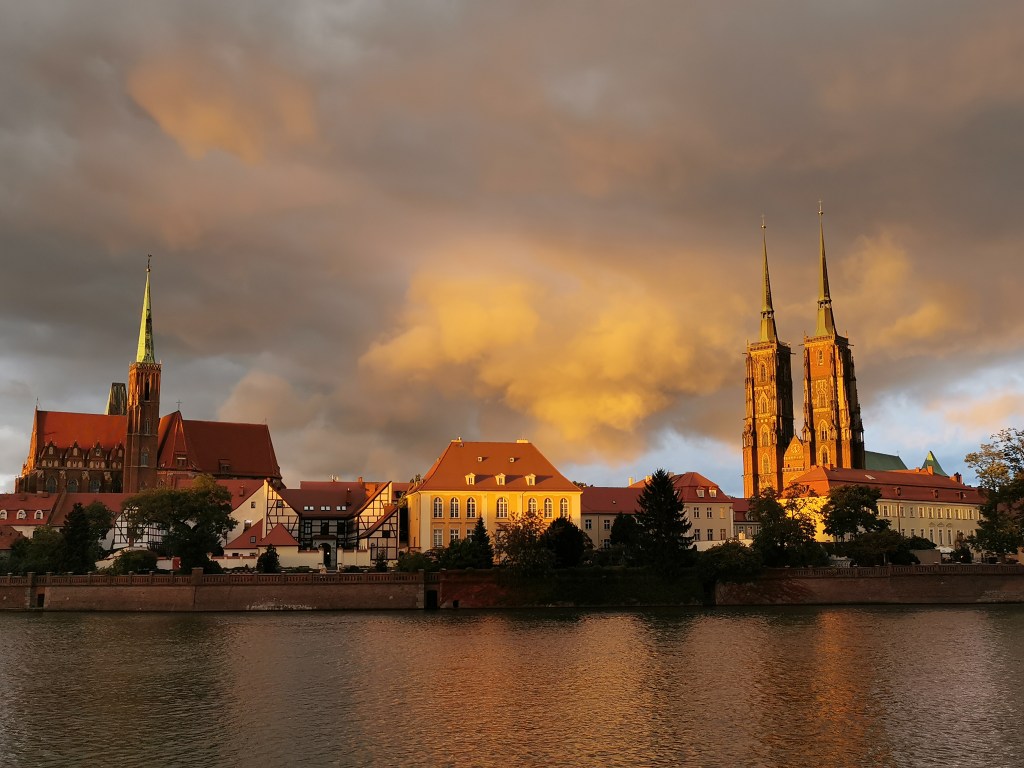
Apocalyptic clouds over Ostrów Tumski, Wrocław
Perhaps it was something about Mitteleuropa Wrocław, crossing bridges between its 12 islands to peals of church bells, the golden glow of sunset radiating from those gilded church fronts, a need to describe the autumnal blizzard of oak leaves along the Oder promenade.
Or perhaps it was something about where I am right now – where my head is – that this just happened to be where I finally start writing. I’ve told myself I should do for years: write about me or my travels, or both. I don’t yet know if I’m writing for myself, just for the heck of it, or for anyone else to actually read.
I did after all take a selfie here, or a selfie of sorts. Highly unusual behaviour for me. Noticing my full-length reflection in the leviathan hall of mirrors that is the Rzeźba Nawa (Sculpture of the Nave), a whale’s rib cage of polished steel on the city’s Daliowa Island. The undulating surface distorts my image sufficiently that I can safely record a version of my own image – and sufficiently distorted to use it on this very blog’s homepage. Rare that I would share self-reflections of any kind.
Wrocław – English speakers should attempt to pronounce this as “Vrotswaf”, which appears beyond me despite two dozen attempts – rounds off a fortnight’s interrail tour of central Europe; a route forming an iron curlicue from Berlin through Dresden, Prague, Kraków, the Tatras, and finishing in Silesia’s largest city.
Formerly Breslau, Wrocław has been subject to something of a tug-of-war between Germany and Poland; returning to Polish territory post-WW2, during which it suffered heavy bombing. As with central Dresden, the restoration of Wrocław’s historic centre, particularly around the Rynek (market square) with its photogenic pastel-facades, is hugely impressive.
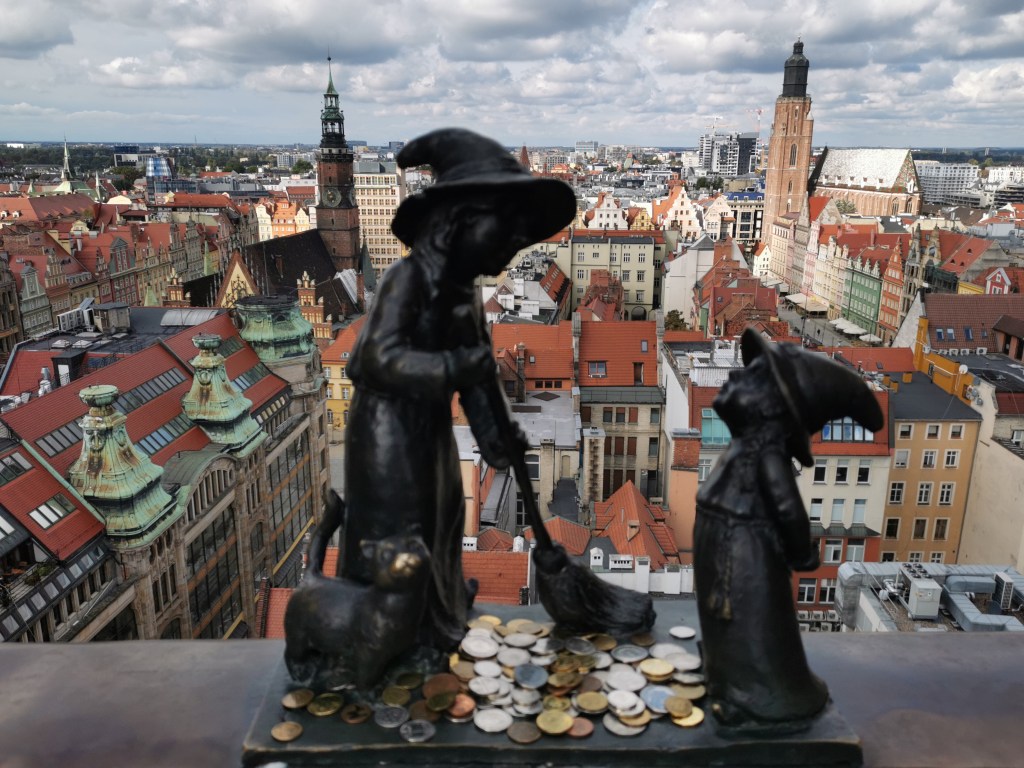
The view over Wrocław from the Bridge of Penitents, Mary Magdalene Church
It was the impact of that skipping-rope national border that intrigued me: would it be a city of pierogi or knödel? Would it look east or face west? And, what happens to a population that has spent so much of its history in transition?
The Ethnographic Museum would help me understand that last question. Having the entire museum to myself was fortunate given how text-heavy the exhibits are. Perhaps that does a disservice to the displays, combining elaborately costumed mannequins with wonderfully prosaic household objects – a comprehensive collection of cheese moulds being the pièce de resistance. The museum provides highly detailed accounts of all the different ethnic groups of Silesia: Poles, Silesians, Germans, Czechs, Moravians, Jews, Lemko, different groups of gypsies, even Greeks (with apologies to the several other groups that I failed to note).
As the museum begins to explore the migrations of these groups, the penny drops that 48 hours in a city and region with such a complex past is never going to be sufficient to do anything beyond scratch the surface.
In fact, Wrocław has not only been part of the respective Kingdoms of Poland and Germany but also Prussia, Hungary, and Bohemia, with the Habsburg Dynasty having laid claim, Mongol hoards having swept through, and to then be cloaked behind the Iron Curtain. Perhaps this should be unsurprising given its location close to where some calculations suggest to be the geographic centre of Europe. The River Oder provided trade routes to the Baltic and beyond – an obvious strategic target.
Like Wrocław, the Panorama of the Battle of Racławice, commemorating the 1794 Polish insurgency against Russia, has traversed national borders – this time having been transported from Lviv, Ukraine (where it had resided since its completion on the 100th anniversary of the battle) at the end of WW2. Standing in its purpose-built rotunda, complete with artificial terrain and battlefield paraphernalia, this 5m x 114m epic was painted by Jan Styka, Wojciech Kossak and a team of collaborators.
Incredibly, during Poland’s communist years, the piece – being ostensibly anti-Russian – was deemed too politically sensitive, and so was kept behind closed doors until 1985. Public collections funded the building of its current home.
Racławice is described more than once as “Poland’s Waterloo”, and I wonder inconclusively about the affect that censoring culture related to an event so key to nationhood and national identity might have had on the Polish self-image.
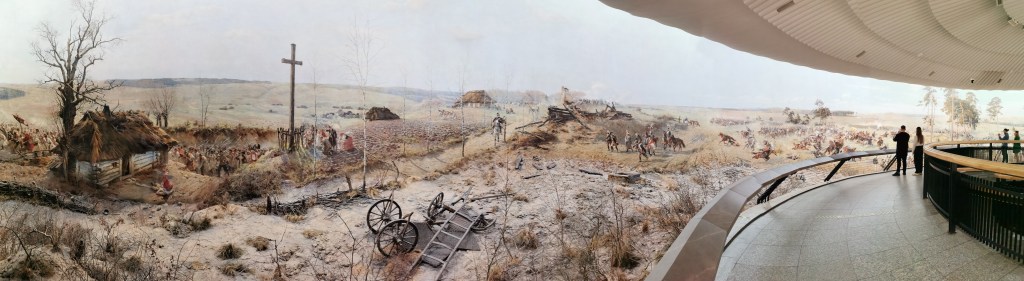
Panorama of the Battle of Racławice
I’ve loved my visit to Poland. I’ll be back. Ideas of a circuit of the north start to form. The south has been all I had hoped – culture, history, physical and man-made beauty, welcoming hosts.
Perhaps that moment of calm looking across the Oder to the spires of Ostrów Tumski, whilst the maelstrom of leaves swept around me on autumnal gusts, allowed me to briefly find my own centre. Despite being on the constant move, a fortnight’s break from London has delivered me a level of stillness.
Dziękuję Polsko.


 Tom the Curious: Ramblelogue
Leave a reply to Chris Cancel reply