“Niedźwiedź?“ the concerned looking lady a few yards ahead of me gasps, brow furrowed, as she turns her head towards her walking partner. I make a mental note to check whether ‘niedźwiedź‘ is Polish for ‘bear’ (it is), as I too had heard what I took for several deep growls projecting from the other side of the steep pine-clad Rybi Potok Valley.
In fact, not knowing how alone I would be on the hike up to the mountain lake of Morskie Oko (literally ‘sea eye’), I had precautionarily looked up brown bear populations in the High Tatras branch of the Carpathians of Lesser Poland. Numbers are low – apparently, they increase on the Slovakian side of the range – but they are out there, patrolling the forests below the snow-cap jagged peaks of close to 2,500m, and I’m wary that the discernible low moan could be one of them. It’s definitely on the opposite side of the valley, across a fairly rapid river, and I take confidence from the safety in numbers of my fellow walkers, for I am not alone after all.
The moderate and well-maintained walk up to Morskie Oko is immensely popular with walkers of all abilities, most of whom have caught one of the many shuttle buses up to the park entrance from Zakopane, where I am also staying. Every 20 metres or so along the route there is another small group. So, I reason, as long as I can run faster than the nearest group to me then I’m safe from any hungry bear that might sniff out our route.
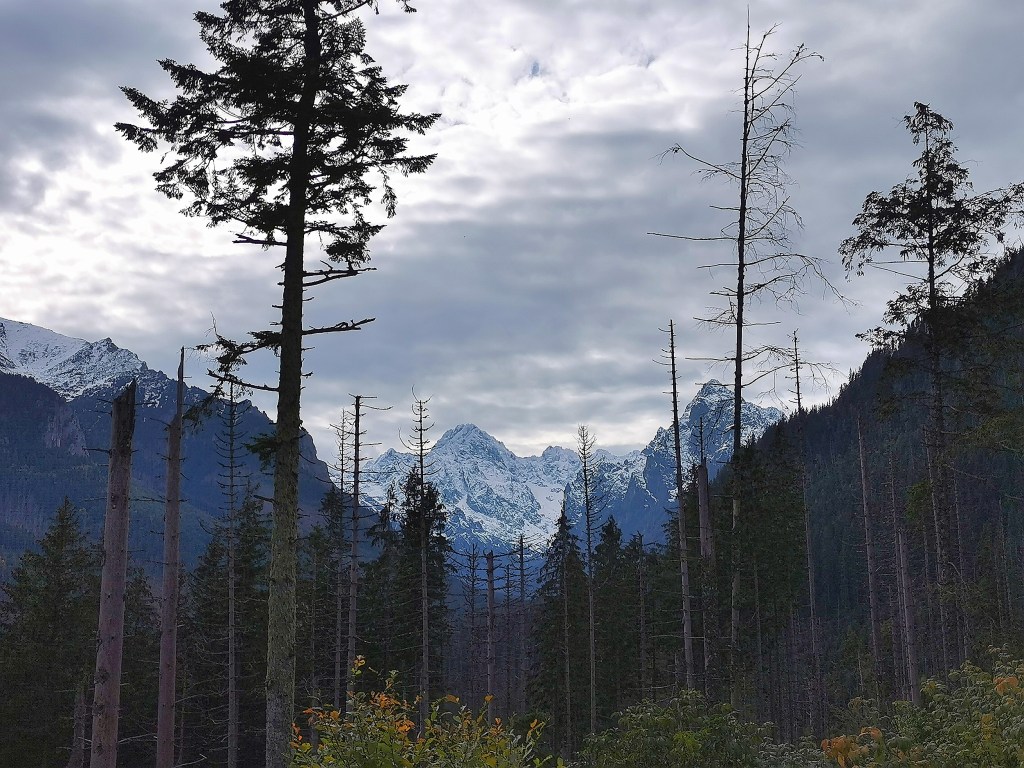
Rybi Potok Valley, High Tatras, Poland
Of course, that low moan could in fact be the lamenting nay of one of the many horses lugging heavy carts packed full of heavy tourists up the steady incline. Driven by men in traditional Górale dress – white shirt, beige woollen trousers, waistcoat embroidered with floral design, brown leather (Tyrolean-looking) hat – these poor beasts of burden don’t look like they are enjoying their exhausting work. Strange as it might seem to confuse the call of ursa with equus, the effort these poor horses are exerting must put extra strain on their vocal cords: by this point I’m 80% sure it’s horse crying out, not bear.
My own exertion is far less extreme, and the two-hour hike (with only occasional shortness of breath despite my dicky ticker) allows ample opportunity to enjoy the vistas and clean air. In fact, despite the presence of Swiss Pine and occasional wiff of horse shit, the air is so clean that my nose cannot detect a scent beyond the freshness itself.
Aside from that occasional bear/horse call, there is only the happy chatter of fellow walkers and the frequent rush of mountain streams to be heard. Despite the numbers of tourists, which must run into the low thousands on a busy day, I feel at peace here.
Perhaps finding that peace is easier when the air and the views are this clear; where we can see further and are reminded to inhale and exhale fully; where emptying the mind of toxins and filling our lungs with oxygen is a pleasure.
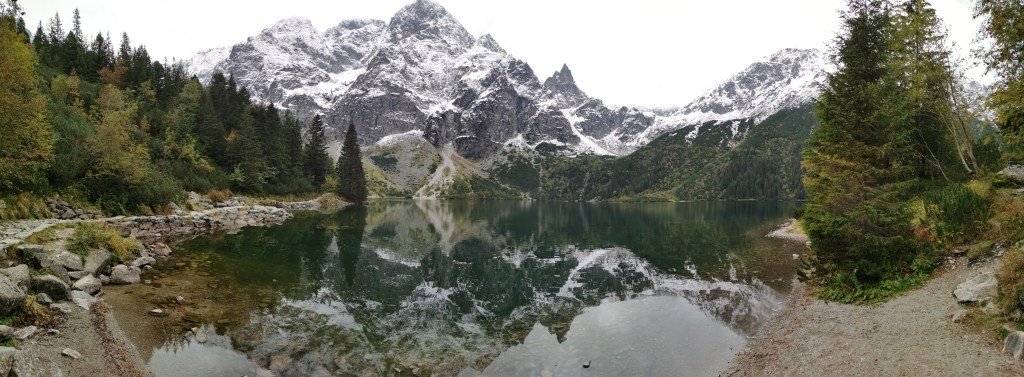
Upon arriving at the Sea Eye, Morskie Oko, I’m met with an oracular feast. The lake itself – the largest in the Tatras at around half a mile in length – is an eye-shaped mirror to a once-blue-now-greying sky, taking on the greener side of turquoise thanks to its verdant surroundings. Barely a ripple, even though overhead the duvet of cloud cover is now moving at increasing speed.
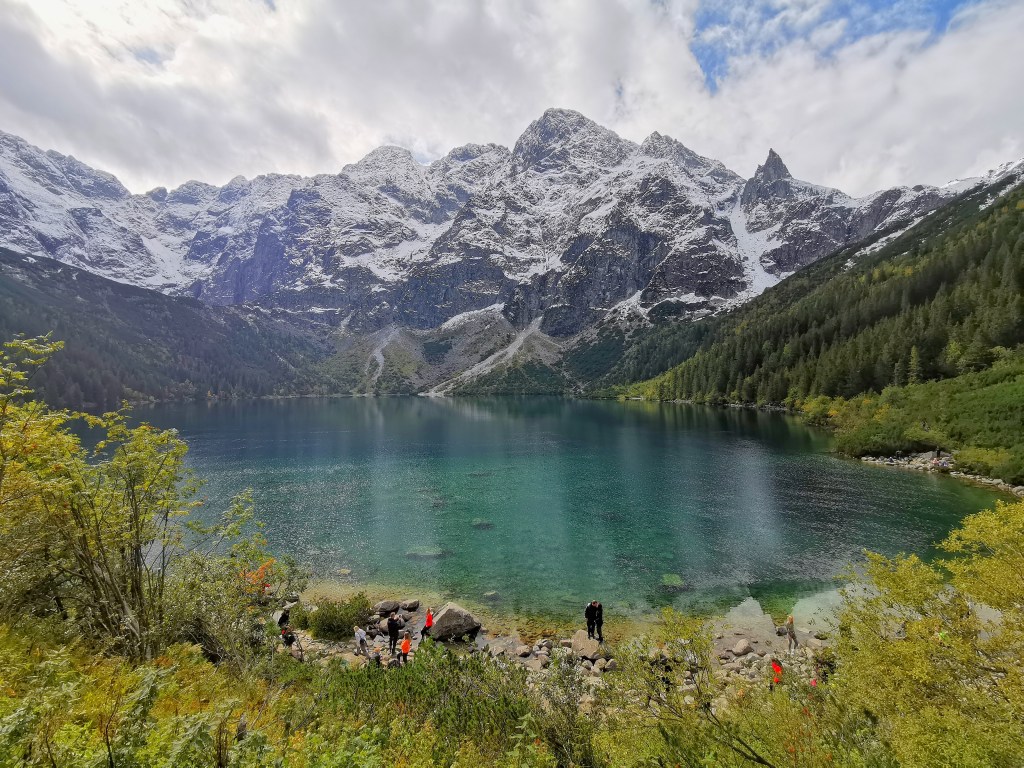
Arriving at Morskie Oko
The gun-metal pyramids of rock gilded with pure white fields of ice and snow that tower above the pines are the mounts of Rysy (the highest peak in the Polish Tatras at 2,499m), Mięguszowiecki Szczyt Wielki, and Mnich (‘Monk’). They hem in Morskie Oko, providing shelter for my circumnavigation of the lake along its photogenic perimeter trail. It’s rocky, but my battered, old running shoes are adequate enough.
It surprises me that more of those who have made the trek haven’t joined me in completing the loop of the lake, with the vast majority opting instead to cram into the large wooden lakeside chalet to fill up on what smells like hot chocolate and cake. Even fewer follow the additional more challenging trails onward and upwards between the peaks.
Completing the loop, it’s still standing room only in the chalet – again, surprising given how pleasantly mild it is – so rather then perch on the end of an already over-burdened wooden bench I keep on the move, beginning the march back the way I came; variety comes in the array of off-piste (but well-marked) trails through unfurling ferns. A satisfying five-hours after setting out I’m back at the shuttle stop for the 20-minute drive back to Zakopane.
Billed as Poland’s ‘winter capital’, Zakopane’s surroundings inspire me more than the town itself, though pleasant enough it is. They do serve mighty fine fare here, however – suitable sustenance for mountain hikes and ski sports – and true to the fact that I’ve only heard Polish voices since being in town, I encounter just one restaurant with an English translation. As helpful as the waiting staff are, I’m always up for a game of menu roulette (the carnivore’s privilege), and bountiful plates of unctuous pork and potato are my prize. Mulled beer warms the cockles.
Less pleasing is the next day’s weather. My plans of conquering Gubałówka or one of its neighbouring mountains, with the potential for a walk into Slovakia and back, are in tatters thanks to a dense layer of fog. I’m told that there is zero visibility from much above the tree-tops and that the clingy drizzle is set in for the next two days.
My disappointment doesn’t last – the silver lining to these especially dense clouds being that they provide an excuse to cut short my alpine excursion and jump onto a Kraków-bound bus (quicker and more frequent than the train). Quite the tonic the Tatras have been, even for such a short visit, but I can’t wait for more of that Cracovian nectar.
 Tom the Curious: Ramblelogue
Leave a reply to Tom the Curious – Tom the Curious: Ramblelogue Cancel reply