Waking up in a city and country that are entirely new to me and realising that I’ve barely researched the place, let alone made any plans for my time there, brings the gift of a blank canvas. As blank, that is, as is possible given westernised preconceived notions of ex-Soviet countries being cold and bleak.
So it was that under a warm blue sky, dabbed with dry, white painterly clouds, I would step through Ausros Vartai – Vilnius’s ‘Gate of Dawn’ – to find a bright and lively city full of colour.
Vilnius in pink
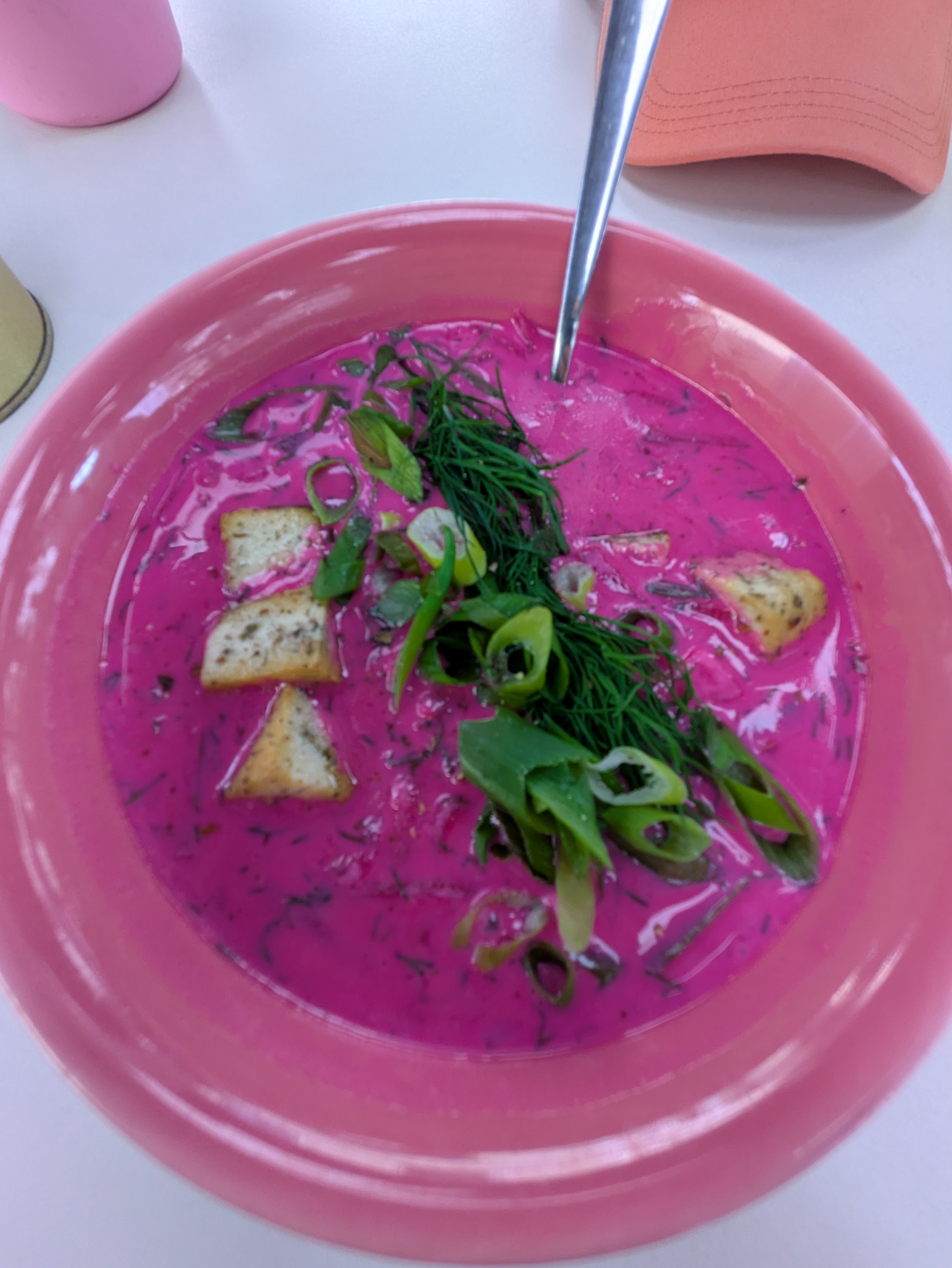
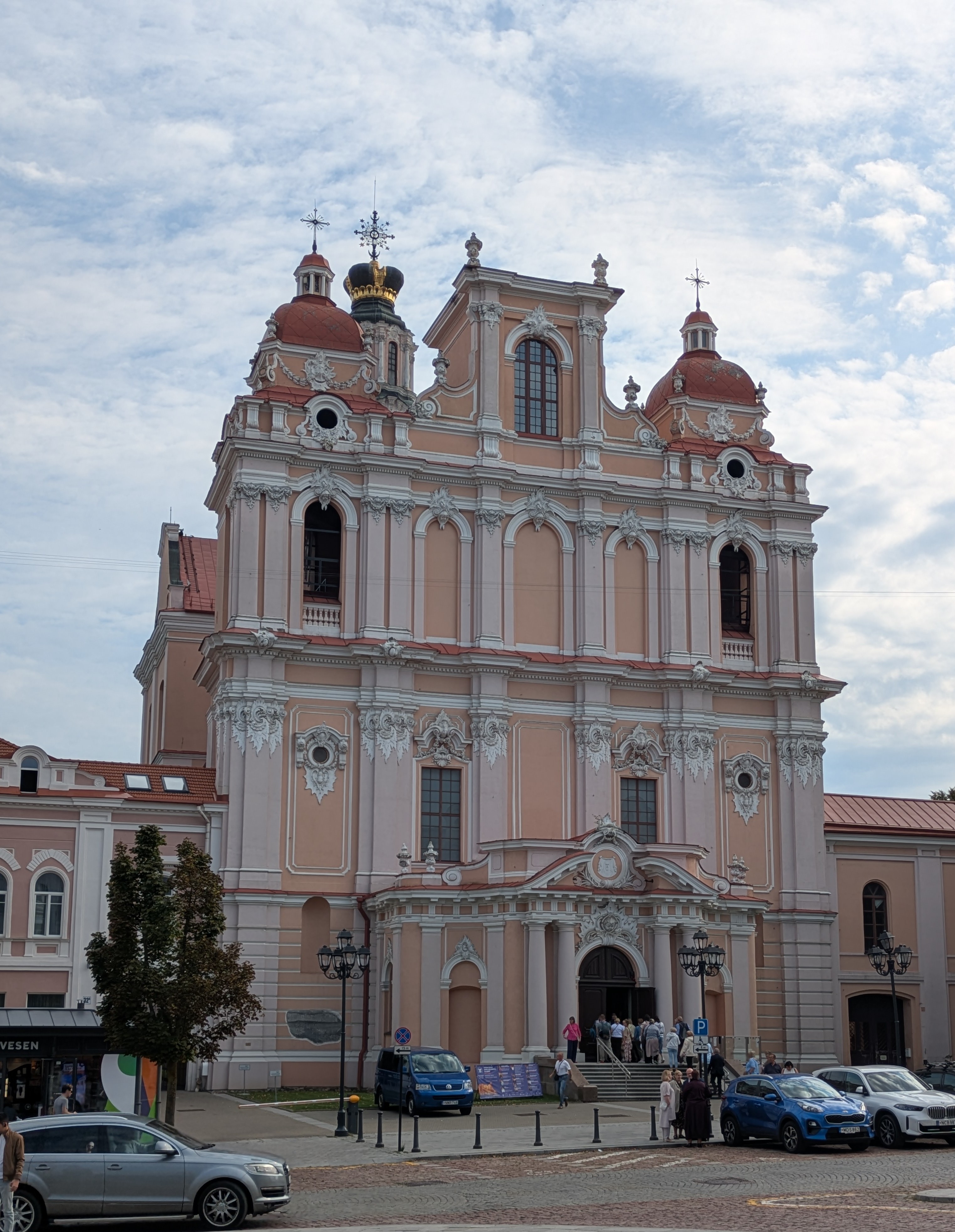
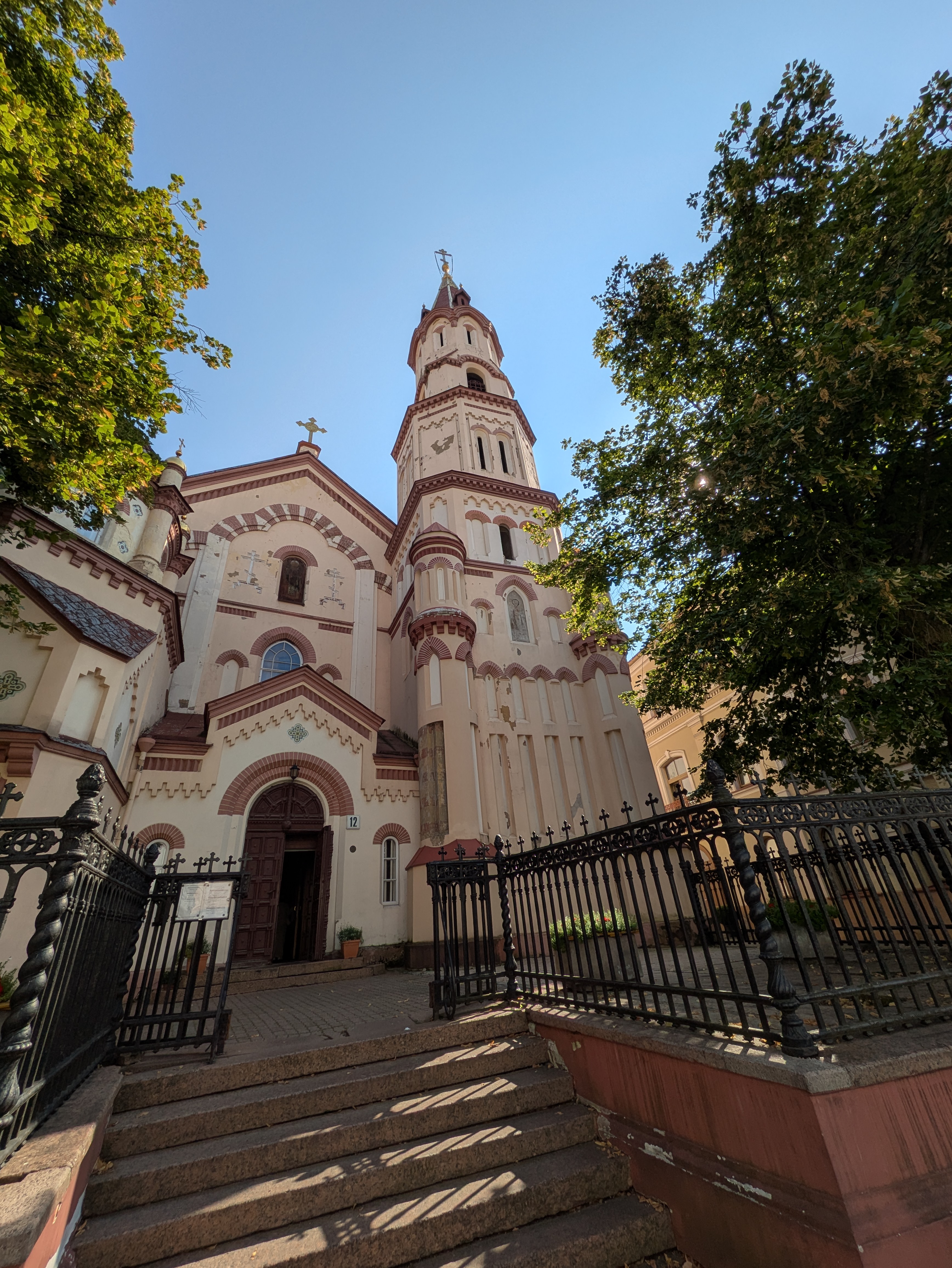
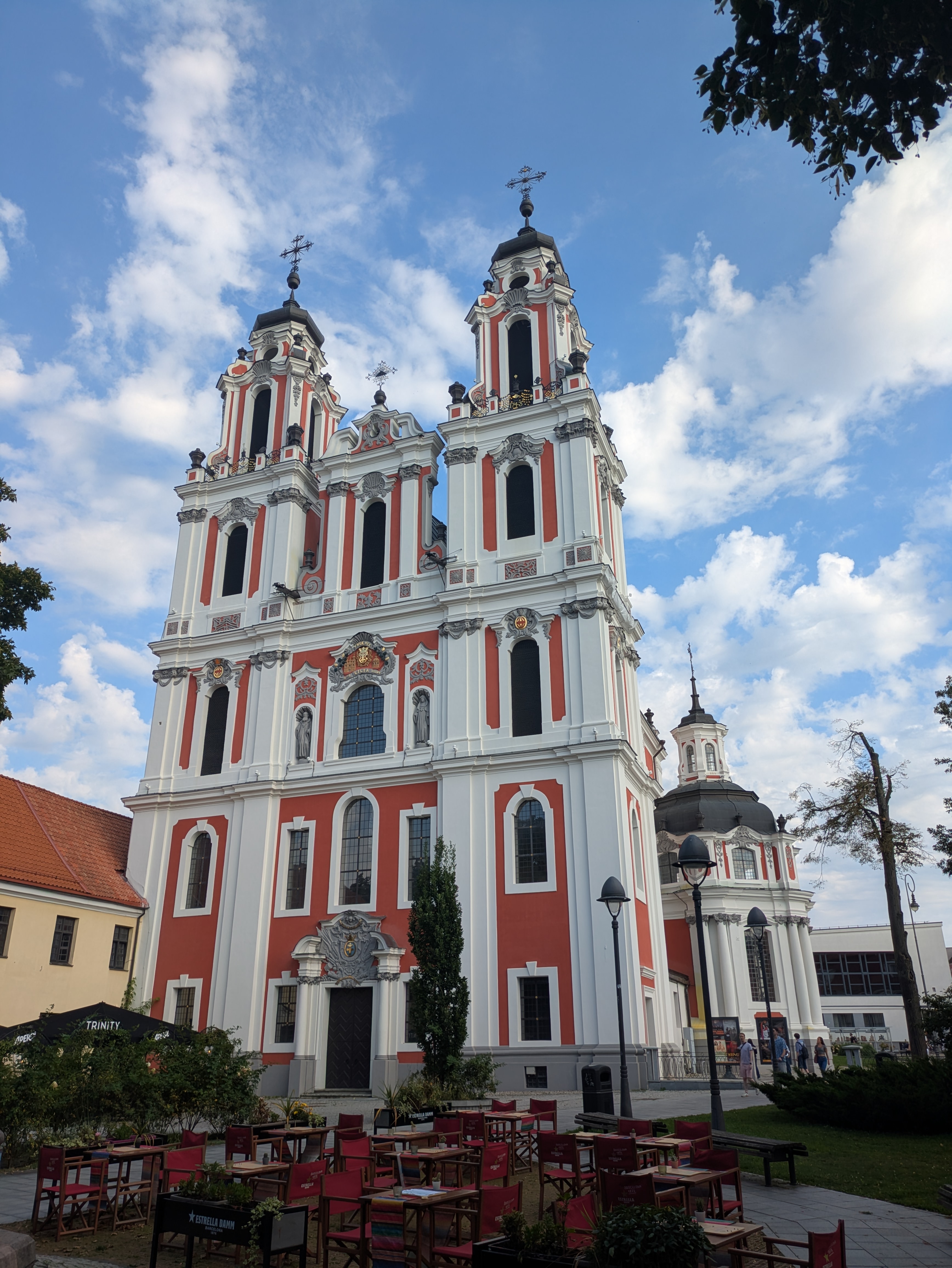
(Above: delicious šaltibarščiai cold soup at RoseHip vegan restaurant; St Theresa, St Nicholas (Orthodox), and St Catherine’s churches.)
If the baroque churches of Vilnius were to be sliced into portions, I’m sure we’d find them to be filled with pink sponge cake and cream. Blushed with shades of salmon, rose and coral, framed with white pillars, and full of light, these beacons of Catholicism were built to contrast with the austerity of the growing Protestant movement that was sweeping across the northern half of Europe in the 16th and 17th centuries.
They also stand in contrast to the city’s Orthodox churches; fewer in number and often set back behind gates, as if in deference to their ostentatious Catholic neighbours. Stepping into St Nicholas’ Orthodox church (Šv. Mikalojaus) on Didžioji Gatvė, I’m struck by the dimness of the compact, square interior, dissected by a single shaft of light beaming through one of the small windows. Even more striking is the warm, spicy odor of incense, heavy in the air as if it’s been hanging there for centuries.
Quite the contrast to the huge, light and airy Basilica of St Stanislaus and St Ladislaus, which stands close to the Neris River and from which the Old Town of Vilnius spirals outwards. Whereas at St Nicholas I was met with monastic silence, I time my arrival at the Basilica to be greeted by an angelic voice from on high by the (spectacular) organ, signalling the start of the midday service for which a small congregation, taking up fewer than a third of the pews, has gathered. It wasn’t always possible for worship to take place here. Disturbingly, during the 1940-1991 Soviet occupation of Lithuania (including the period it was occupied by the Nazis), services were not allowed to be held in the Basilica, which was converted into a warehouse. Restoration to return it to its current glory began as recently as 2006.
Vilnius saw even more crushing religious suppression during the Holocaust. At the time of the 1939 Nazi-Soviet invasions of Poland – which Vilnius was then part of – the city’s Jewish population was so significant that it was nicknamed the ‘Jerusalem of the North’. Yiddish was the second most commonly spoken language behind Polish, with only 6% speaking Lithuanian (more on that anon), and the Jewish population standing at an estimated 60,000-80,000 out of a total of 195,000. Over 95% of Lithuania’s Jewish population were murdered in the Holocaust; fewer than a thousand of those from Vilnius survived, often by hiding out in the forests surrounding the city. Significantly, many of the victims were handed over to the Einsatzkommando by members of the minority Lithuanian community in a bid to win favour with the Nazis over the majority Polish population, whom the Germans despised. Those Lithuanian ‘grasses’ were known as ‘hapunes’ in Yiddish, meaning ‘snatchers’.
The Nazis established the Vilnia Ghetto in 1941, imprisoning around 40,000 Jews into two small areas of the Old Town. It’s easily walkable today, and highly attractive, the array of good restaurants with tables out on the pretty cobbled streets disguising the genocide that was committed here 80 years ago. Bar the occasional reference or memorial, any remnant of a Jewish presence feels long erased.
Vilnius in green
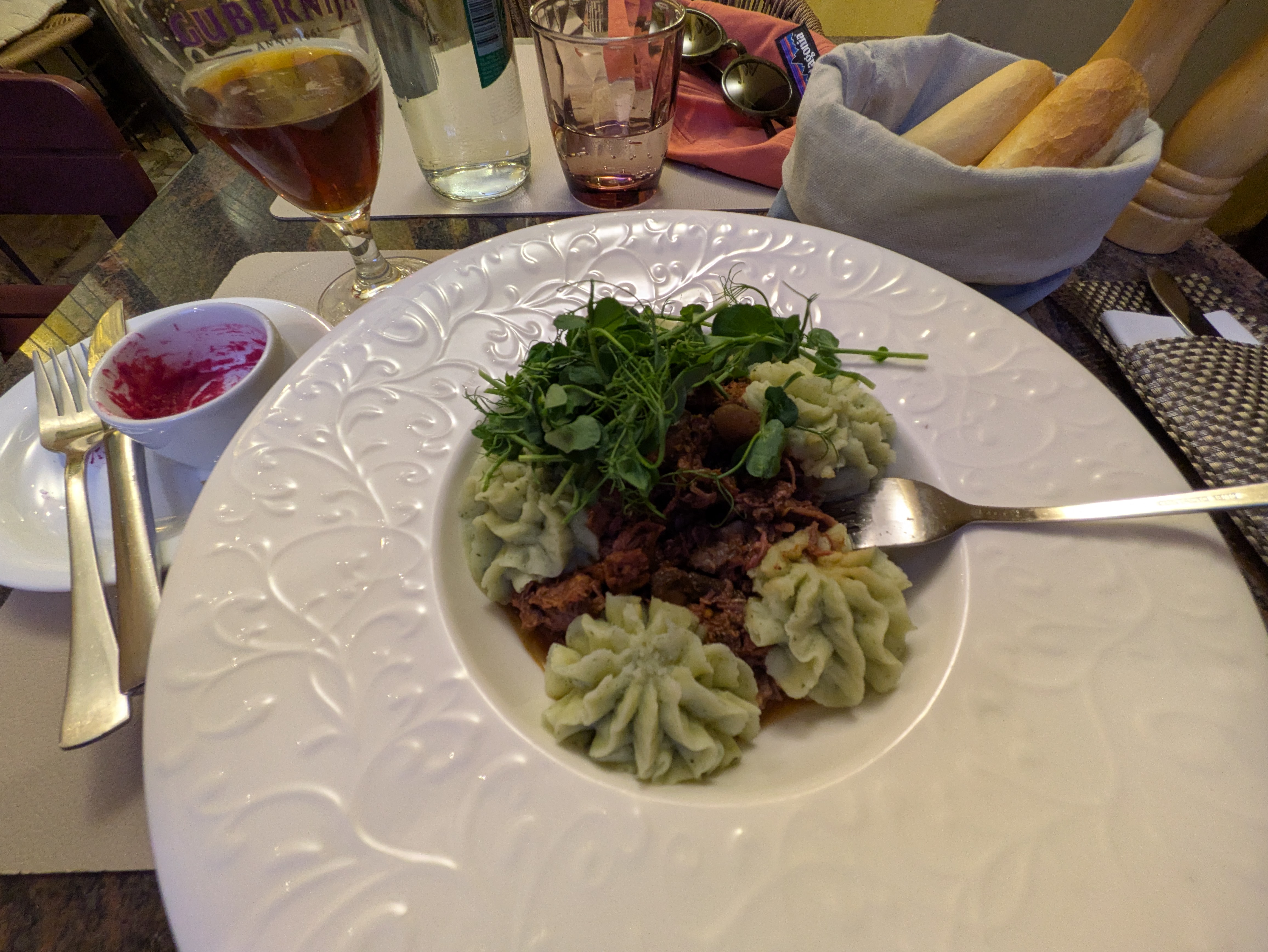
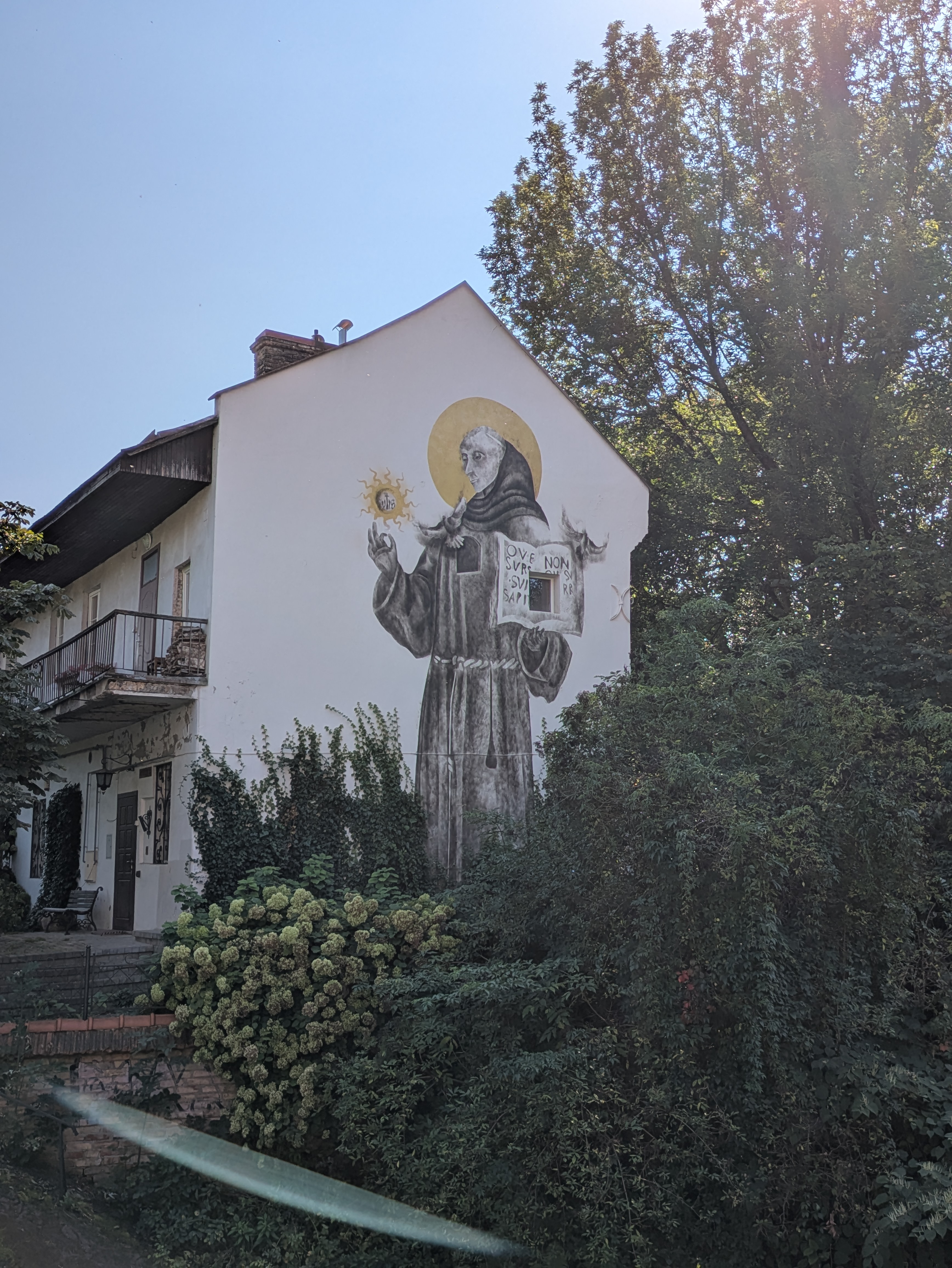
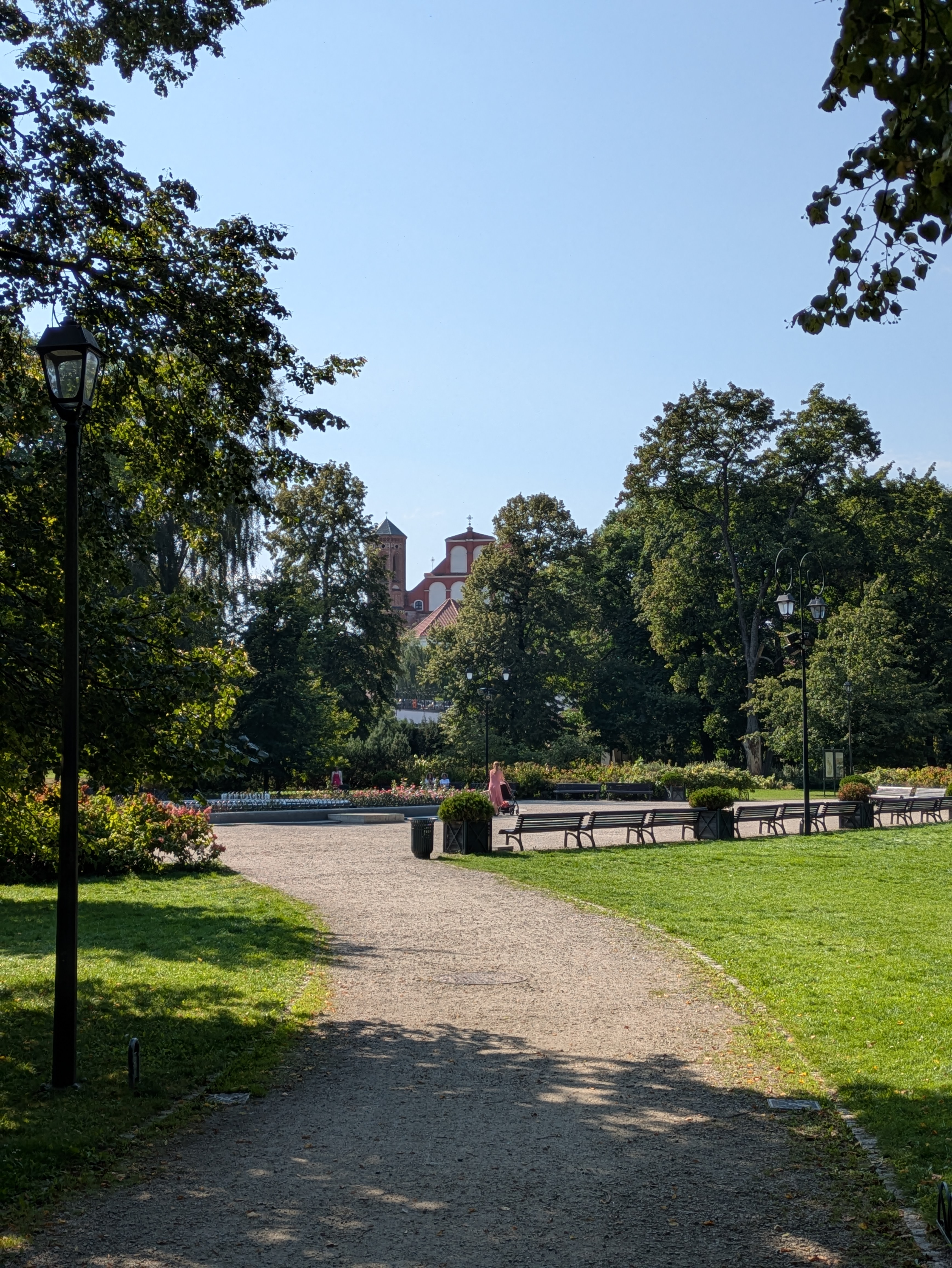
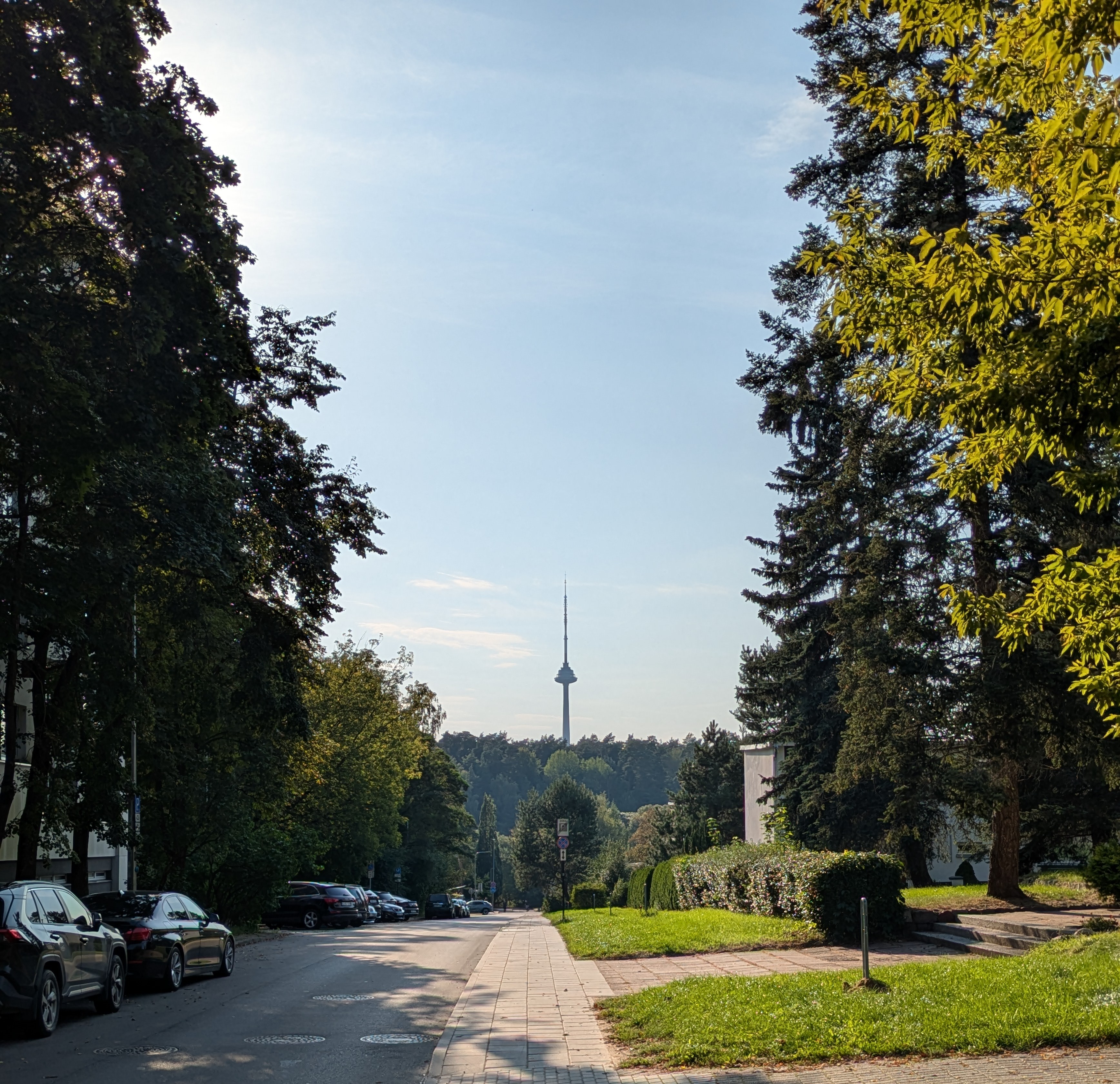
(Above: beaver stew at Lokys; saintly street art in Uzupis; Bernardinu Sodas; Vingio Park)
On the fringes of the Old Town, Vilnius changes from cobbled streets and gothic architecture to green space and a more modern aesthetic, all sewn together by the Neris and Vilnia rivers.
The neighbourhood of Uzupis protrudes out into the Vilnia. I’m surprised to find that it’s designated a UNESCO World Heritage Site, as there doesn’t seem to be a huge amount going on for a supposedly creative quarter, whilst architecturally it is not as impressive as the Old Town. Where it does stand out is that in 1997 Uzupis declared itself an independent republic with, wry enough to avoid piousness, its own constitution, which visitors can find displayed in over a dozen languages on metal plates fixed to a wall on Paupio Gatvė. Personal constitutional highlights include #3 ‘Everyone has the right to die, but this is not an obligation’, #9 ‘Everyone has the right to be idle’, #12 ‘A dog has the right to be a dog’, and #34 ‘Everyone has the right to be misunderstood’. Perhaps it’s unsurprising that Uzupis celebrates its independence day on April 1st.
Just north of Uzupis and nestled inside a long, graceful bend of the Vilnia, Bernardinu Sodas is a suitably elegant park, trees and shrubs looking full and lush in the sunshine, though not overly manicured. The river gently flows by, only a foot or two deep, a haven for ducks and Vilnians looking to cool off with a paddle in the midday sun.
A steep climb up to Gedimino Tower provides an almost 360 panorama. From here it occurs to me that there is nothing in-your-face about Vilnius: it’s beauty is undeniable, but simple, colourful, but modest. Less simple is the nearby crane that I sit and watch at work. It must be operating at over 60m high, well over my head despite me being sat atop Vilnius’s highest point. I don’t recall ever properly paying attention to one before, and certainly hadn’t realised how much they sway in the wind – the cab must be oscillating by 2-3m. How on earth do all those counter-weights and cables work? The Grand Dukes of Lithuania clearly got by without one when they originally built Gedimino as part of their castle complex in the 15th century.
Dropping back down into the Old Town, an open-air stage has been set up next to the Basilica where a free festival is just starting up. A pretty decent post-rock band are playing to a sparse crowd (sadly, I didn’t catch their name). Only a few yards away a book fair is taking place with a larger crowd sat attempting to listen to a talk, the soundclash with the band’s crunching guitars apparently only amusing to me.
Opposite, Gedimino Prospektas has been turned into a pedestrianised market, full of stalls selling local beers and hearty-looking meat and potato dishes. A cue to sample a quite excellent local white beer whilst watching a brass band on a stage erected at the far end of the avenue. The band is playing brass covers of cheesy latin R&B hits, but the crowd is full of all sorts of Vilnians having a good time in the sunshine.
Slipping away from the crowd, I head back into what was once Vilnia Ghetto to find an al fresco table at Lokys, a restaurant set in a 15th Century merchant’s house and specialising in traditional Lithuanian ‘forest dishes’: think game-heavy and lots of mushrooms. Immediately jumping out from the menu is ‘beaver stew’. For pure novelty and comedy value, it’s the obvious choice. It’s pleasant enough, if a little plain, and I’m left unsurprised that it isn’t a dish that’s taken the world by storm.
Vilnius goes orange
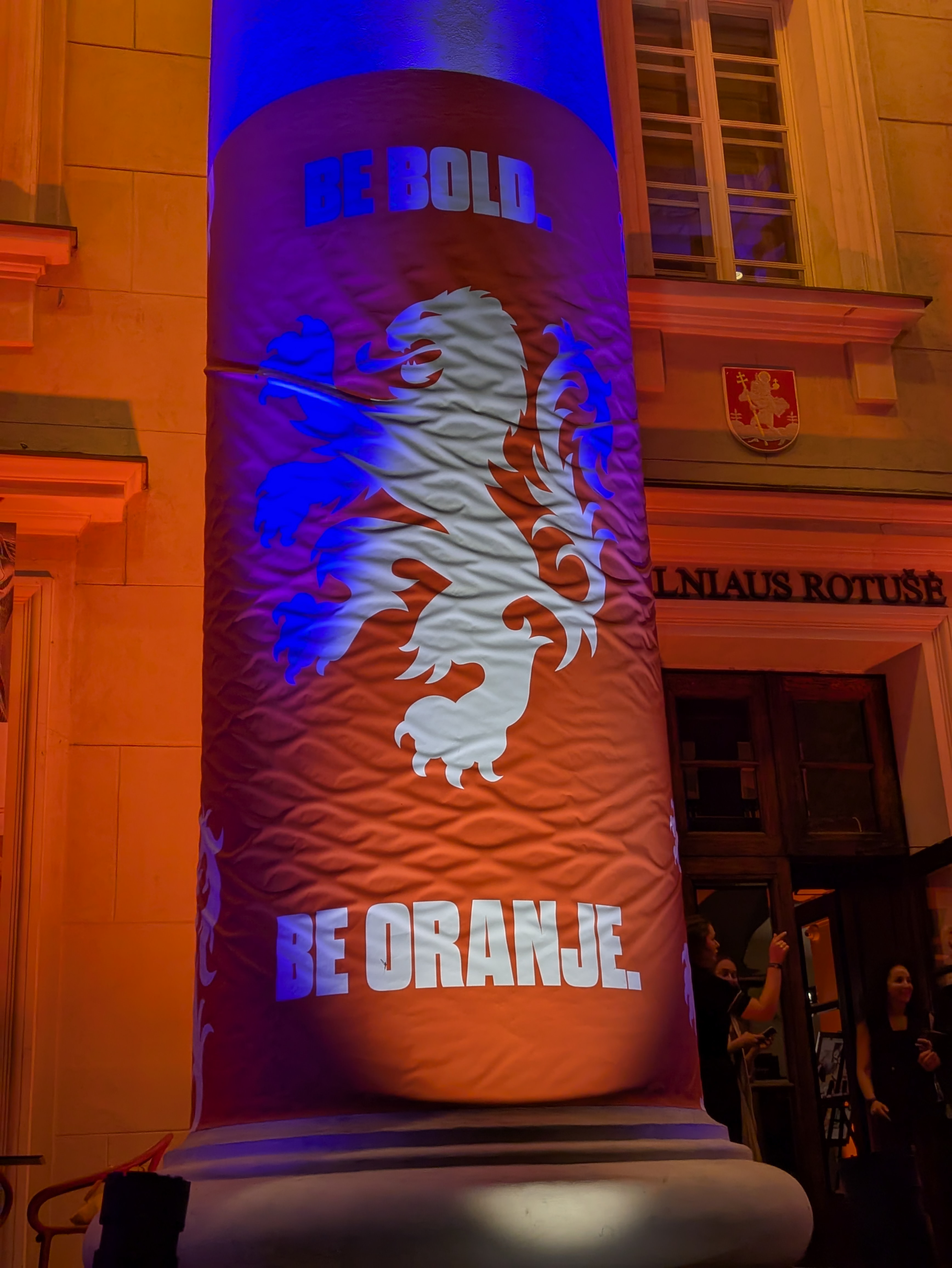
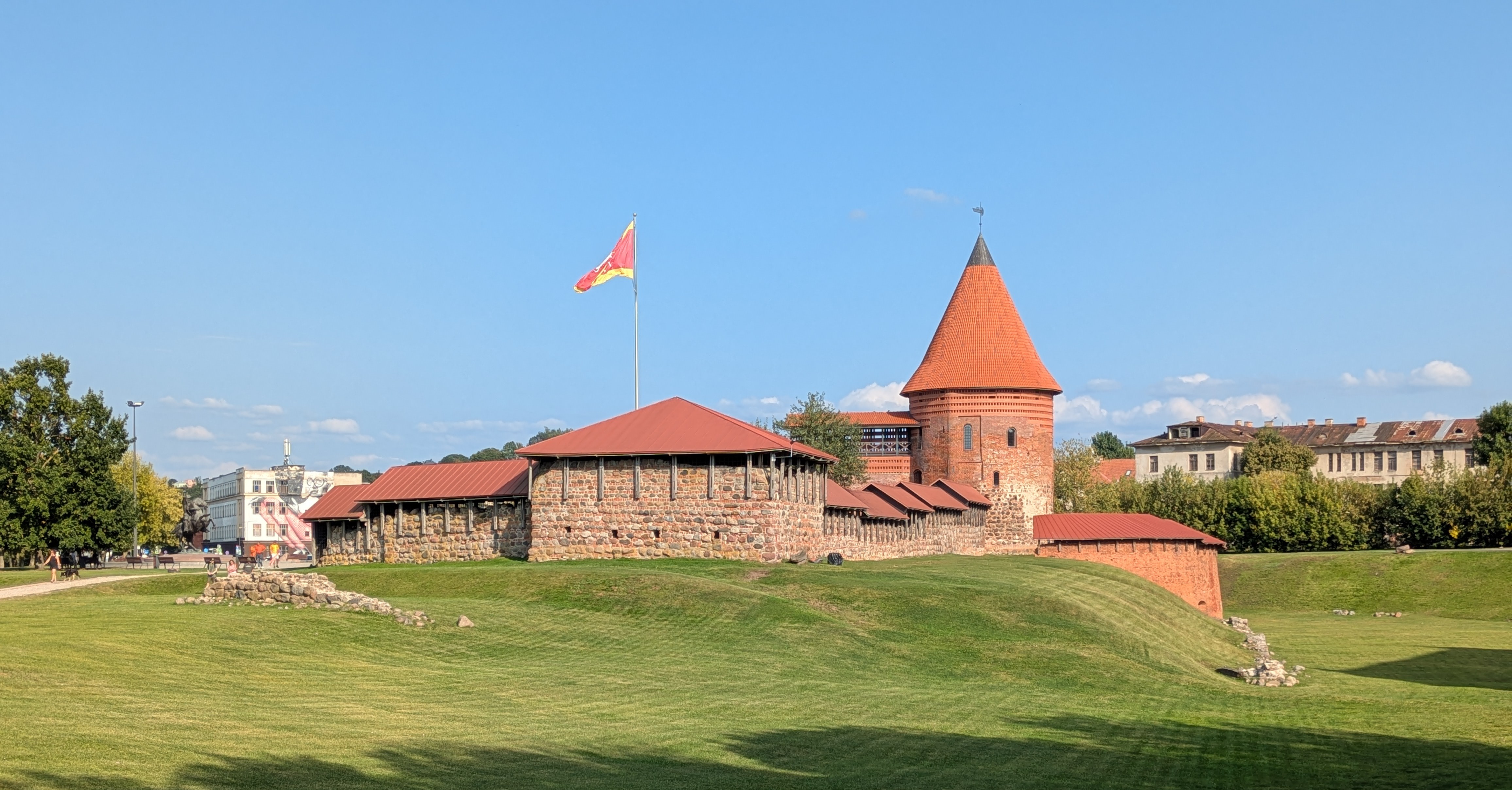
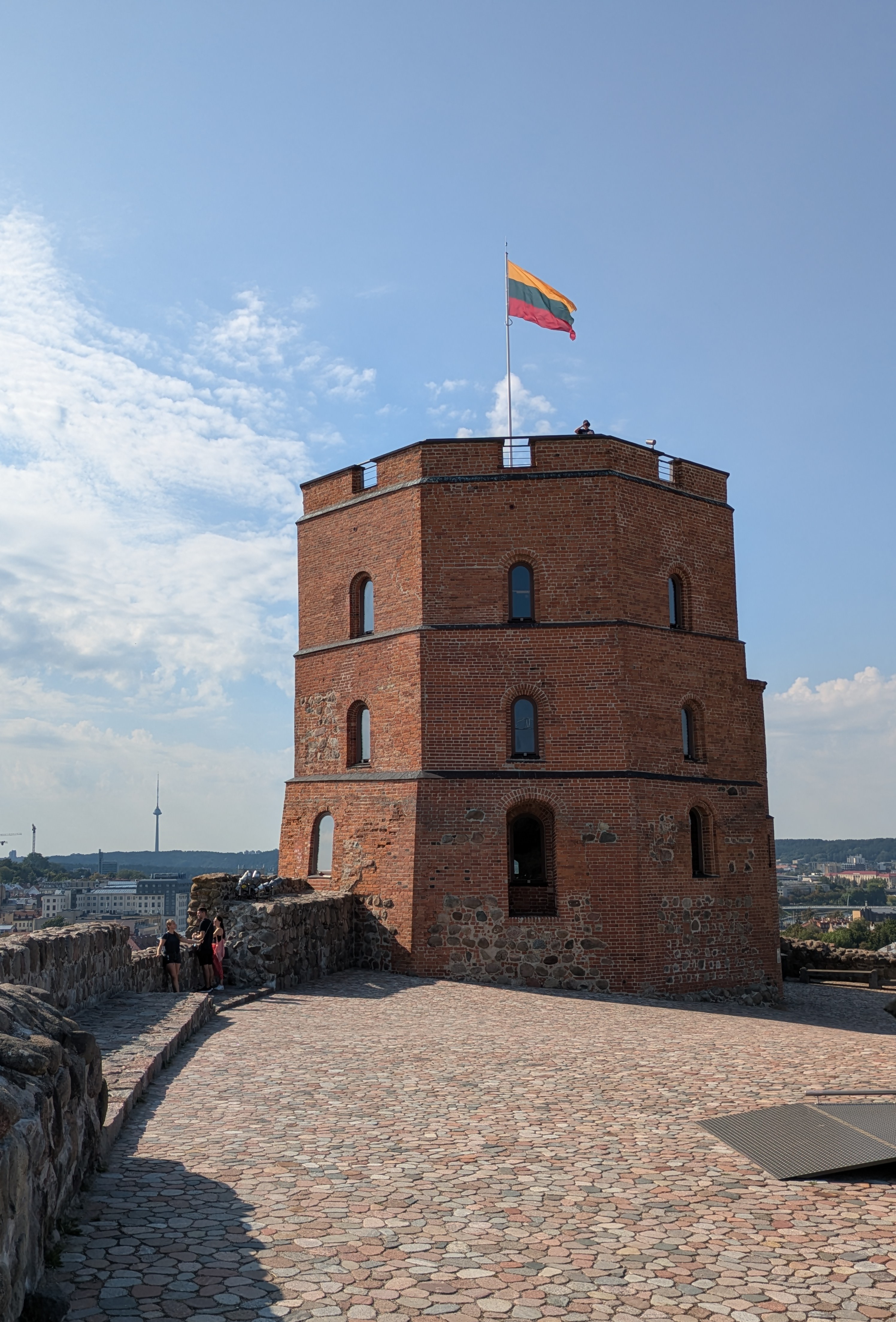
(Above: the Dutch decorate Vilnius town hall; Kaunas Castle; Gedimino Tower)
The Dutch are in town. Good humoured, well-behaved and colourful (well, orange), the Netherlands fans are here for their World Cup qualifier against Lithuania, which will end for the hosts in a 3-2 defeat. It adds another layer of colour to the palette of Vilnius’s gothic architecture. Probably for the best, for as much as I love Vilnius (and like Kaunas), I don’t fall for their art offer.
The Pilies Gallery has potential, but ultimately leaves me with barely anything to scrawl in my notebook. The MO Museum looks like it could have been airdropped in from Manhattan, but the art on display is nowhere near as impressive as the building itself, a clean-lined white cube with an angular wedge cut out of the bottom corner. The Radvila Palace is Lithuania’s national museum of art, but the only works that stand out are a couple by the Italian Caracci (the snob in me notes that there’s a reason none of its contents are hanging in Paris or London).
So it’s back out into the sun for a long walk northwest of the old town to Zverynas, a residential peninsula in another river bend, this time of the Neris. Zverynas is nice. Nice. Sedate and middle-class. Older wooden houses, characterful but scruffy, have been joined by well-heeled urbane neighbours, sleek but subtle. There’s money here, but it would be gauche to show it.
Crossing the suspension bridge at Vingio Park into a vast area of woodland is to escape from a neighbourhood and a city that don’t need escaping from. Vilnius is hardly a bustling city, but this is especially quiet, with the only noise the rustle of trees and panting of the occasional passing jogger. Vingio is all pine woodland compared to botanical Bernadinu.
Arriving at a large sports ground in the centre of the park, I’m perplexed to find a cricket match taking place between two teams of South Asian guys kitted out in reds and blacks. The standard is high, but the batsmen are hardly helped by the shockingly bad pitch, with full-length deliveries popping up like bouncers. I take a seat in the grandstand to watch the wickets fall. Two dozen locals have done the same, bemused by a sport they clearly no nothing about.
The 12.08 train pulls out of Vilnius in a northwesterly direction towards Kaunas, passing endless pine and silver birch. The edge of Lithuanian cities look so different to their British counterparts. None of the endless light-industry or retail parks, not one bloody golf course in sight. A reminder that land in the UK is always owned by someone, and that someone will always want to monetise it. Here it seems, the land has been allowed to retain its original beauty. No doubt Lithuanian land use was helped by seven decades of communism.
My short, red train rumbles along a brown, rusted line, passing red brick stations and brown wooden houses. Dutch and Lithuanian fans are travelling with me to their match in Kaunas, their orange and green shirts reflecting on the inside of the carriage window.
Kaunas into darkness
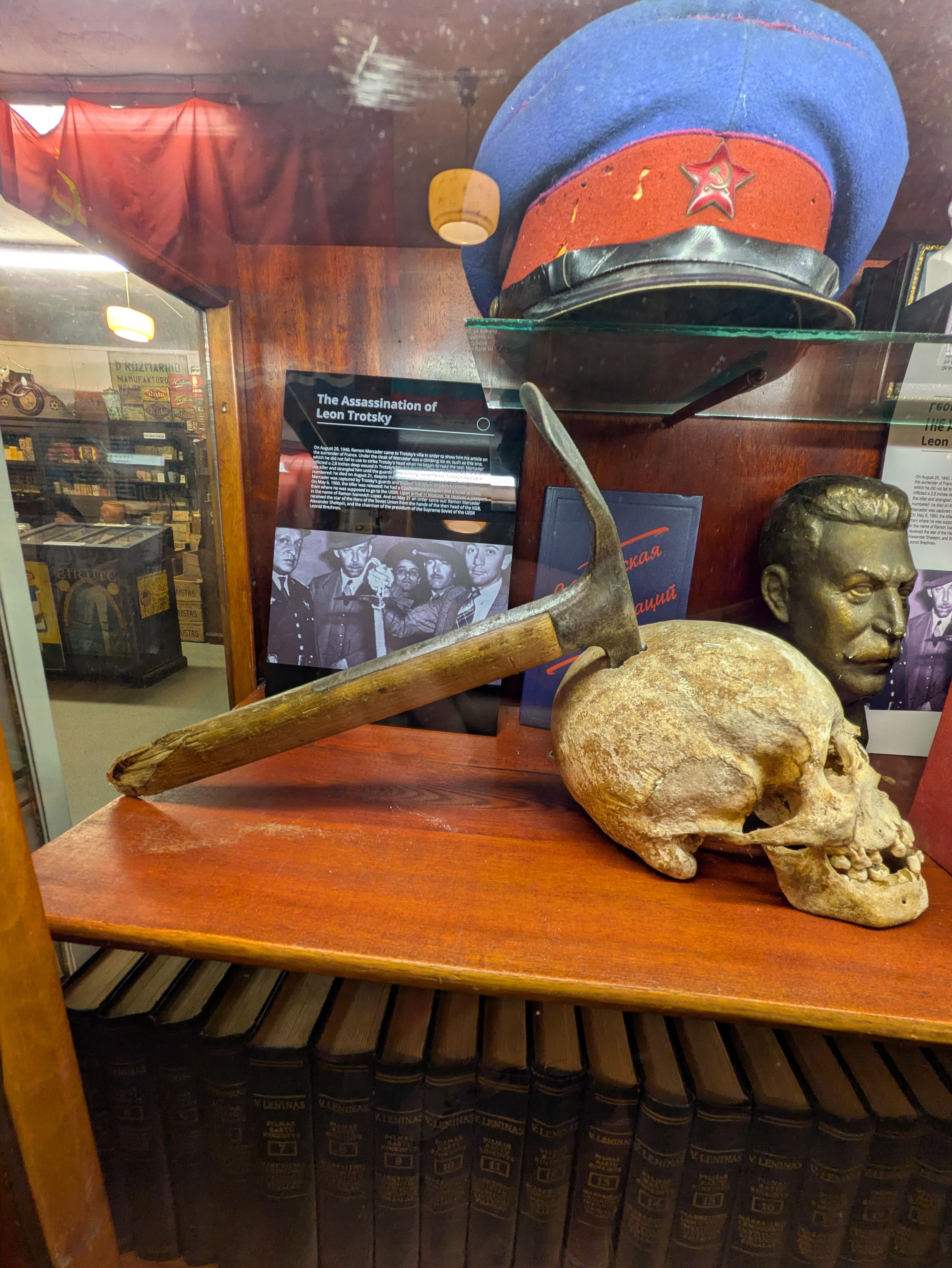
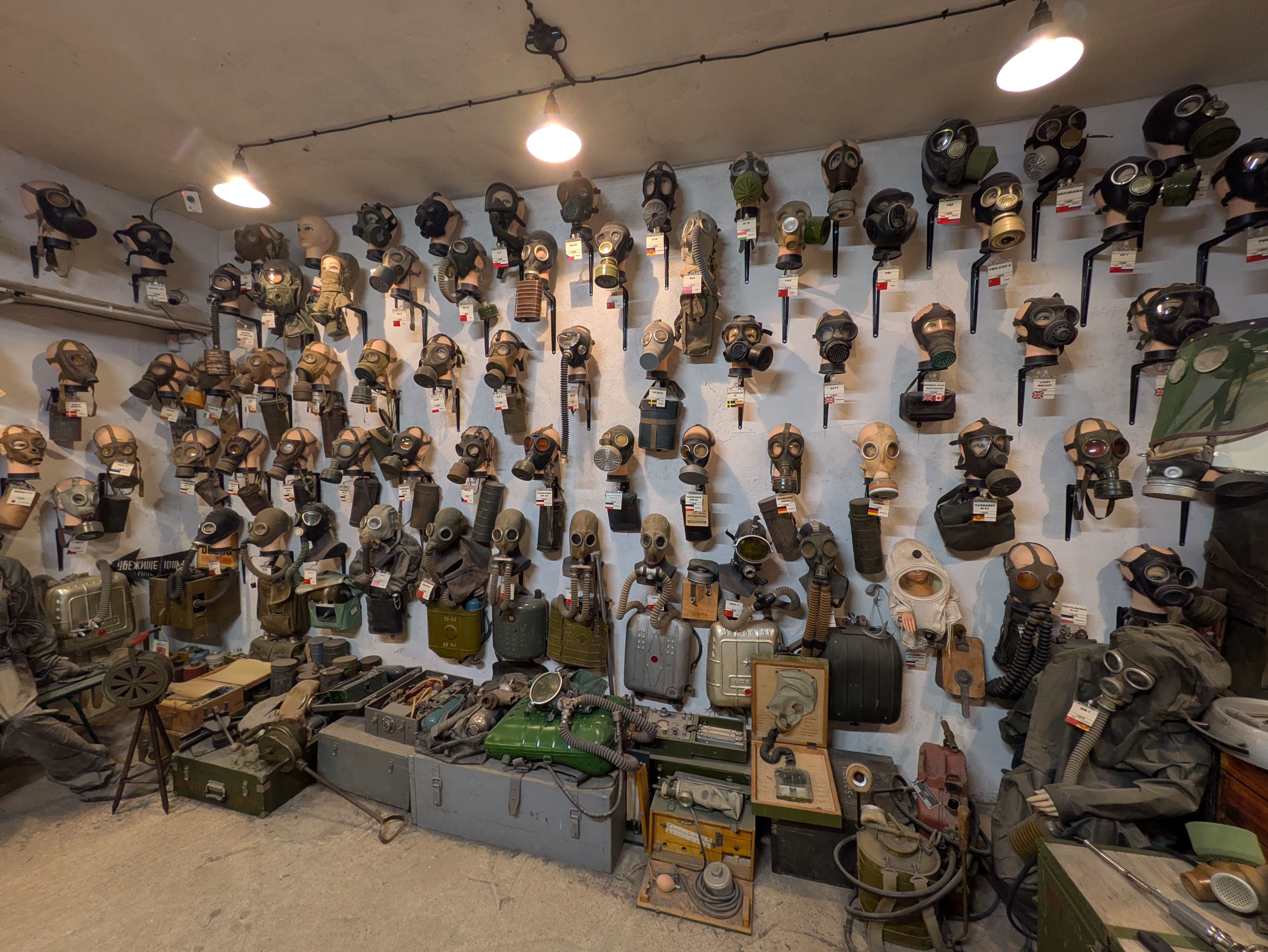
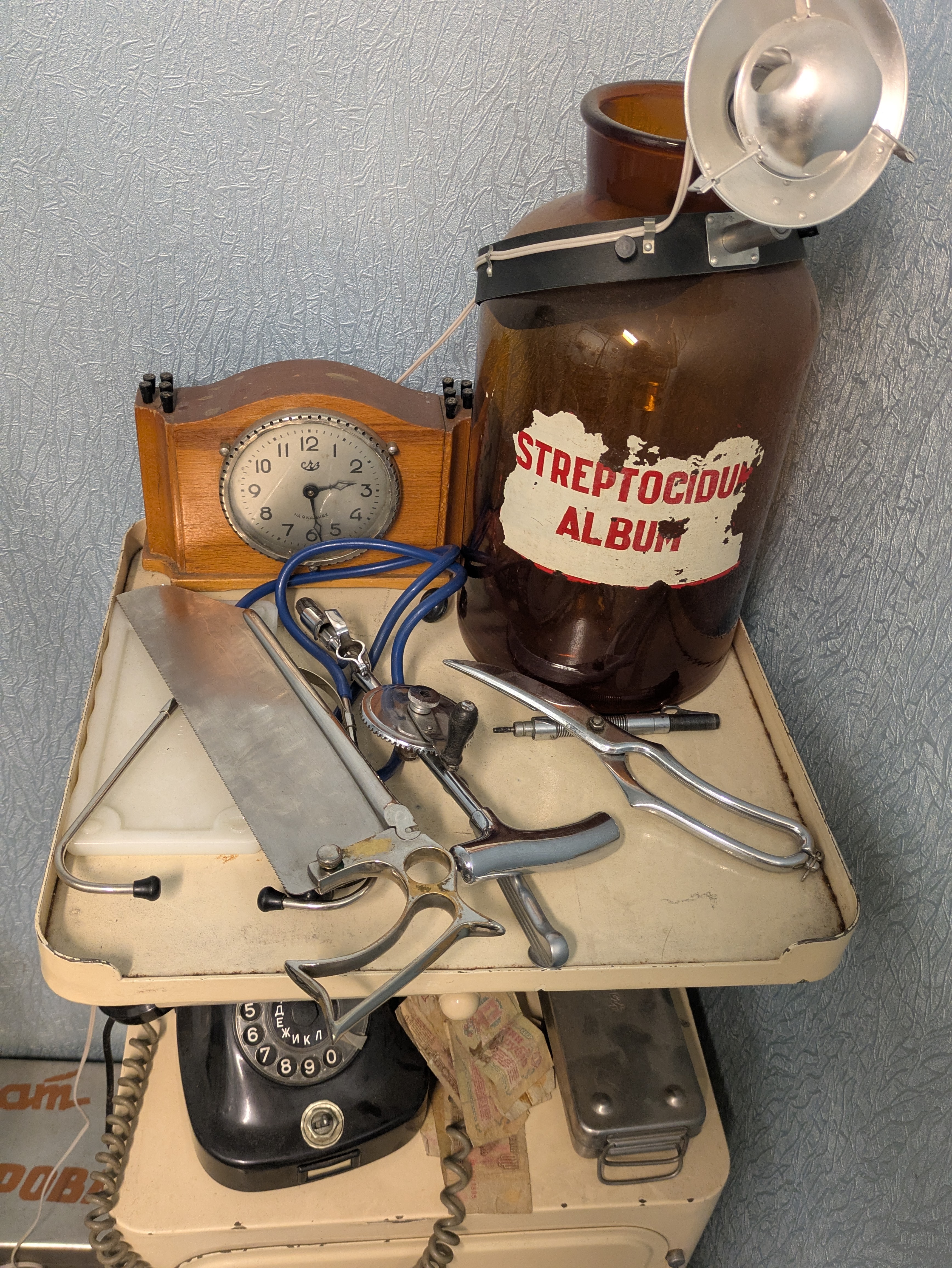
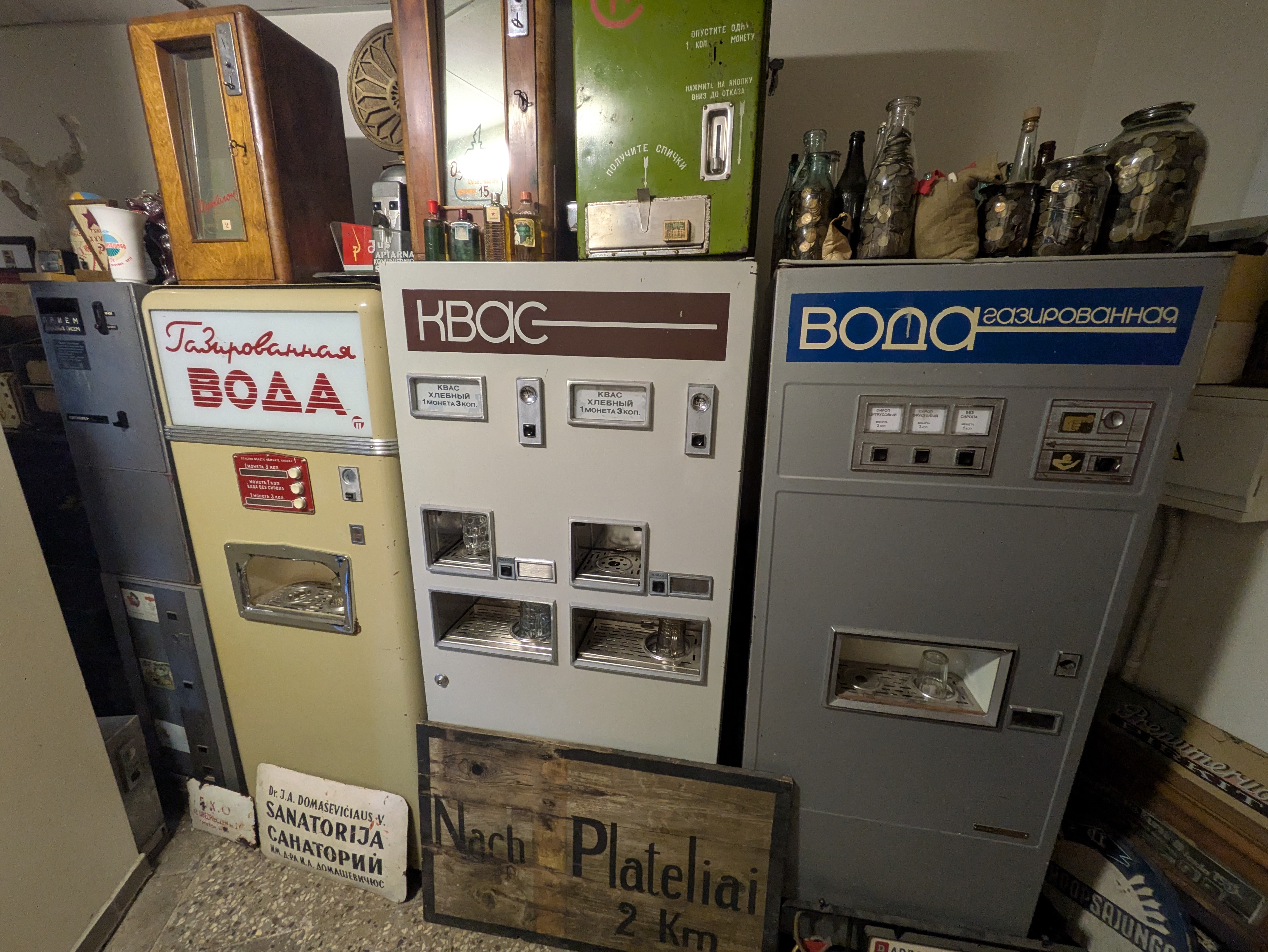
(Above: exhibits from the KGB Atomic Bunker Museum, Kaunas, including (second left) the gas mask collection and (right) Soviet-era vending machines)
Who knew that Soviet vending machines would be so damn fascinating?
I’m standing inside the KGB Atomic Bunker Museum listening to our excellent guide Monika relaying stories her grandmother would tell of life in the USSR. Apparently, vending machines were a prominent feature of most streets, which perhaps speaks to their functionality and communal nature. We’re introduced to one that would provide salted water to factory workers to replace salts lost through sweat in hot conditions, with only one glass that would have been used by everyone (according to Monika’s grandmother, it was common to find lipstick marks around the rim of the communal glass). Another which, maintaining stereotypes, dispensed vodka. And even one that would spray a gender-neutral perfume for Stalin-era Lithuanians en route to a date. Monika passes around a green perfume bottle, which smells exactly like my own grandmothers’ bathrooms.
The museum really is inside a former nuclear bunker, 20ft below a nondescript strip of small business warehouses. In its day, it sat below a factory producing harmonicas and flashlights (an odd combination) where 1200 staff worked. The bunker, however, had space for only 500, meaning that if the apocalypse really had arrived, only those on the Party’s list (i.e. those in favour or who’d bribed their way in) would have been let through the huge blast-proof doors.
I can barely believe that 500 people would have fit in this space anyway, which can only be about the size of three tennis courts. But there is room for thousands of items here, including “the Baltic region’s largest collection of gas masks”, which includes those for children, some for snipers (the filter could be moved depending on which side the rifle would be held), and even some for horses (less for animal welfare, more for ensuring the horses weren’t contaminated should they later need to be eaten). A reminder of just how dark Cold War paranoia was.
After enjoying my fill of torture weapons, KGB spyware and propaganda material, I hop on the bus back to the centre of Kaunas. Noticing Monika is on the same bus, I take the opportunity to ask why all Lithuanians seem so friendly except for the bus drivers, who are so miserable they look like they’ve been forced to continue using salt water vending machines. “But that’s exactly why. It’s because they’re old and grew up under communism, so they don’t have any of the skills they need to do anything else. It’s like they’re jealous of anyone born after the 80s”. She goes on to explain that much of this is to do with language, in that most people over 50 only speak Lithuanian with a little bit of Russian, whilst everyone under 50 speaks at least one other language. It’s true, I observe, everyone I’ve met who isn’t a bus driver is both young and fluent in English. “They all think everyone should speak Lithuanian, even tourists”.
An interesting take, given that stat about only 6% of the country speaking Lithuanian in the 1930s and that only about 3m people speak it now (Lithuania’s population is 2.9m, the remaining speakers mainly living in neighbouring Belarus). I begin to notice how often Lithuanian apps, signs and food packaging are in English, which must create a clear social divide between dynamic modern Lithuania and those left behind.
For the record, my attempts at Lithuanian are pathetic.
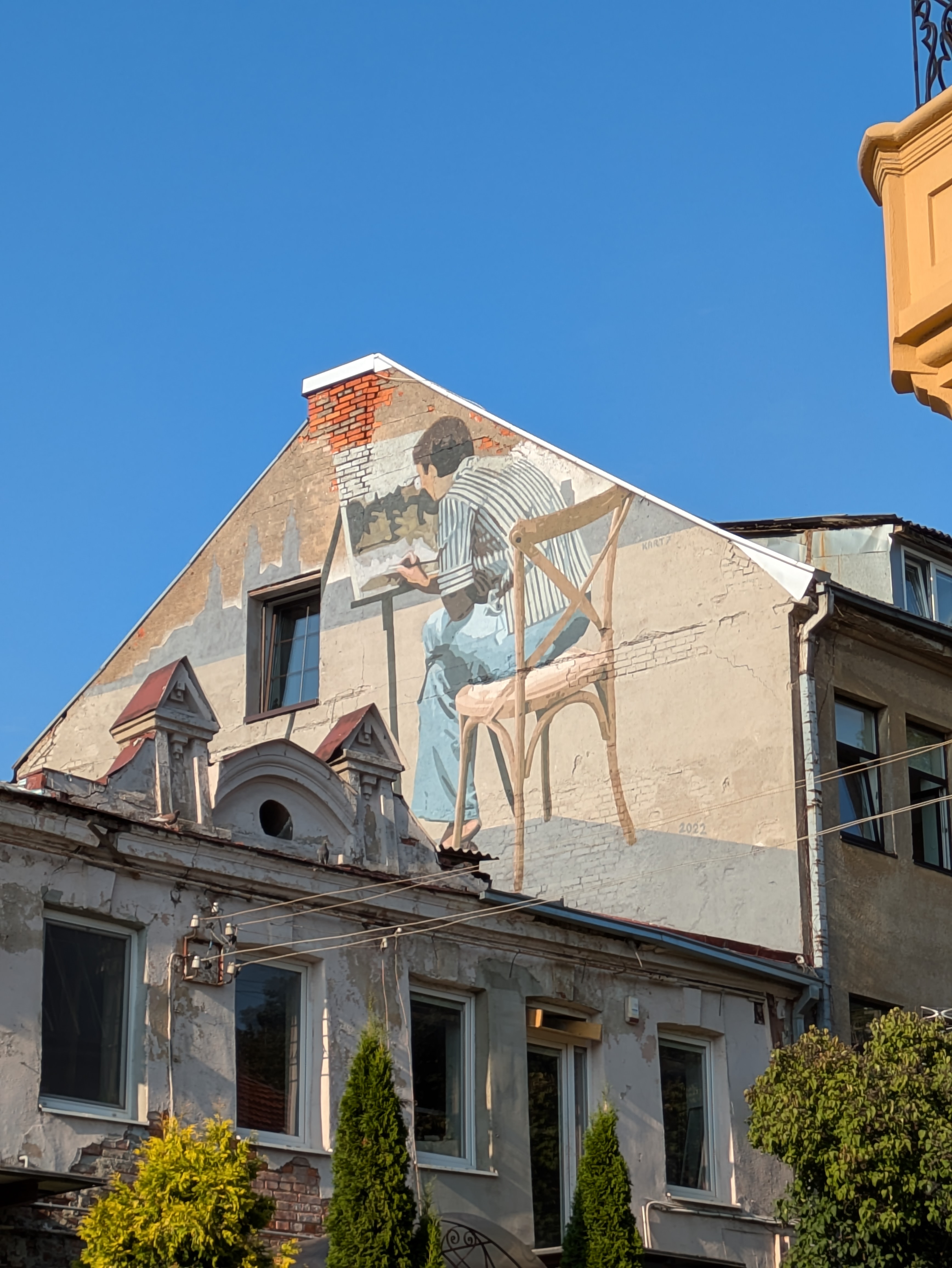
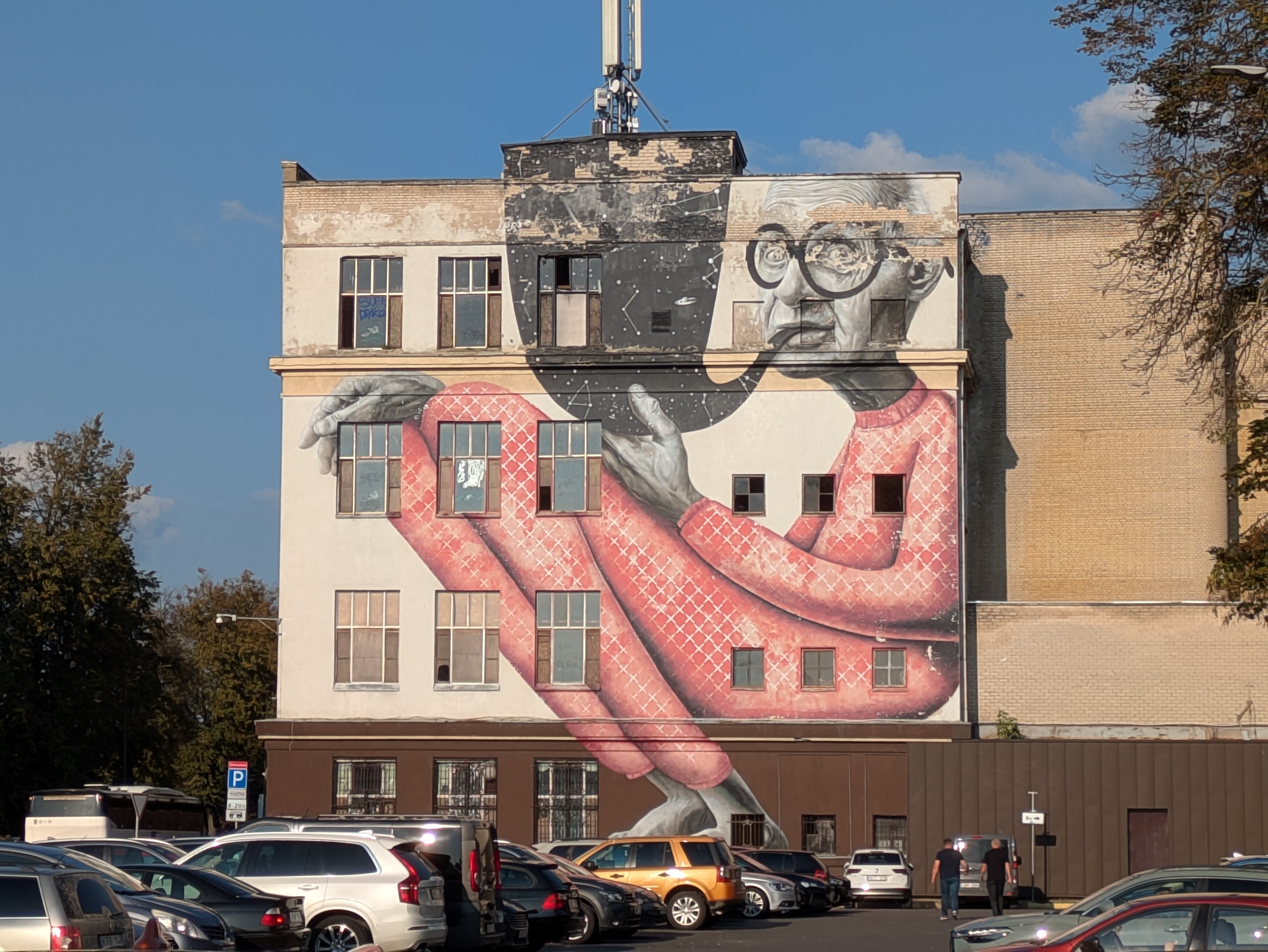
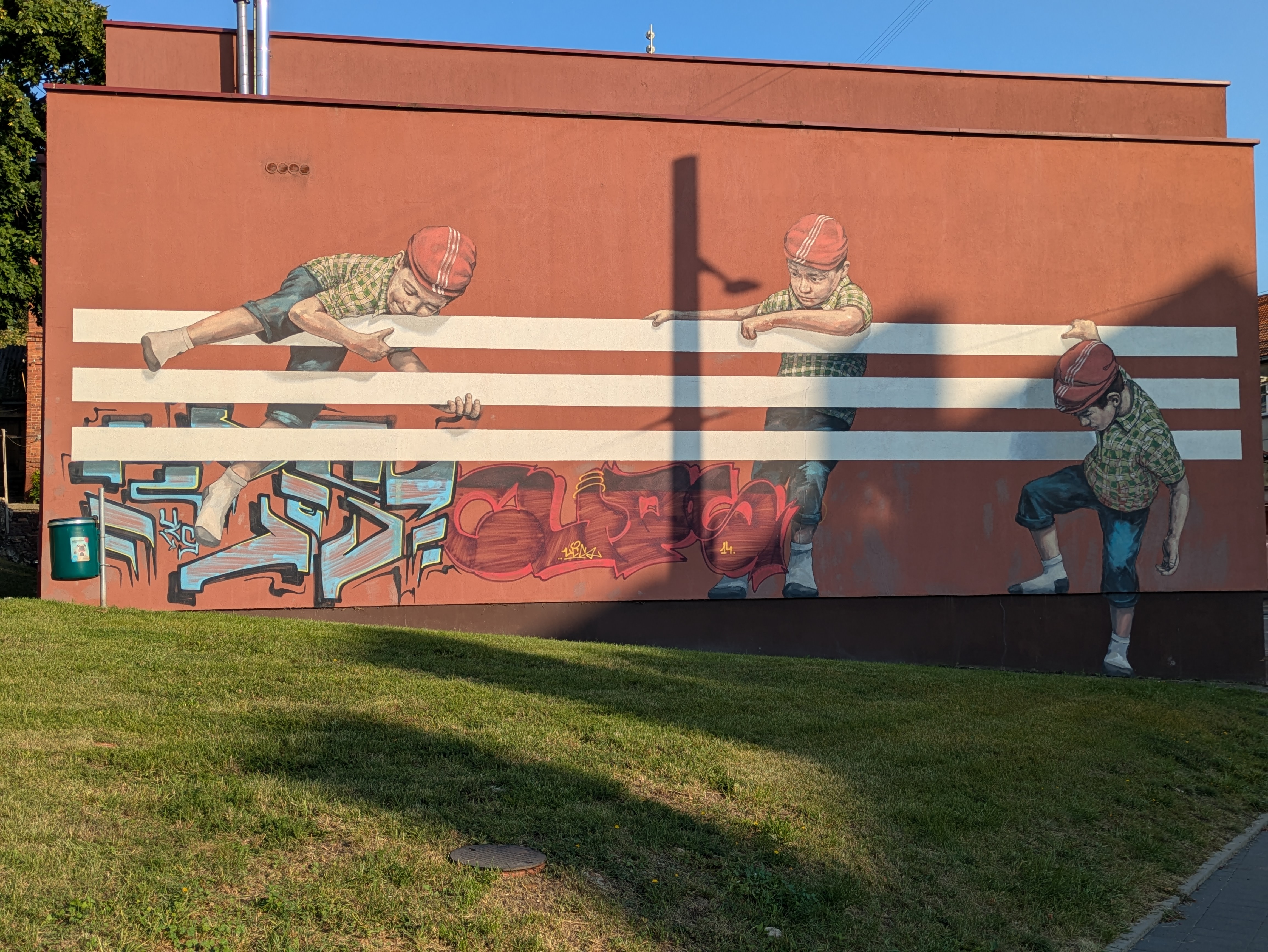
Kaunas itself, Lithuania’s second city, follows much of the same style as Vilnius, but without that vibrant pop of colour. The Neris makes a reappearance and is joined by the Nemunas. The architecture of the Old and New Towns is subtle but appealing, occasionally brought to life by the surreal imagination of street art. The food scene is decent. It’s a leafy city. But my lasting image will always be those gas masks.
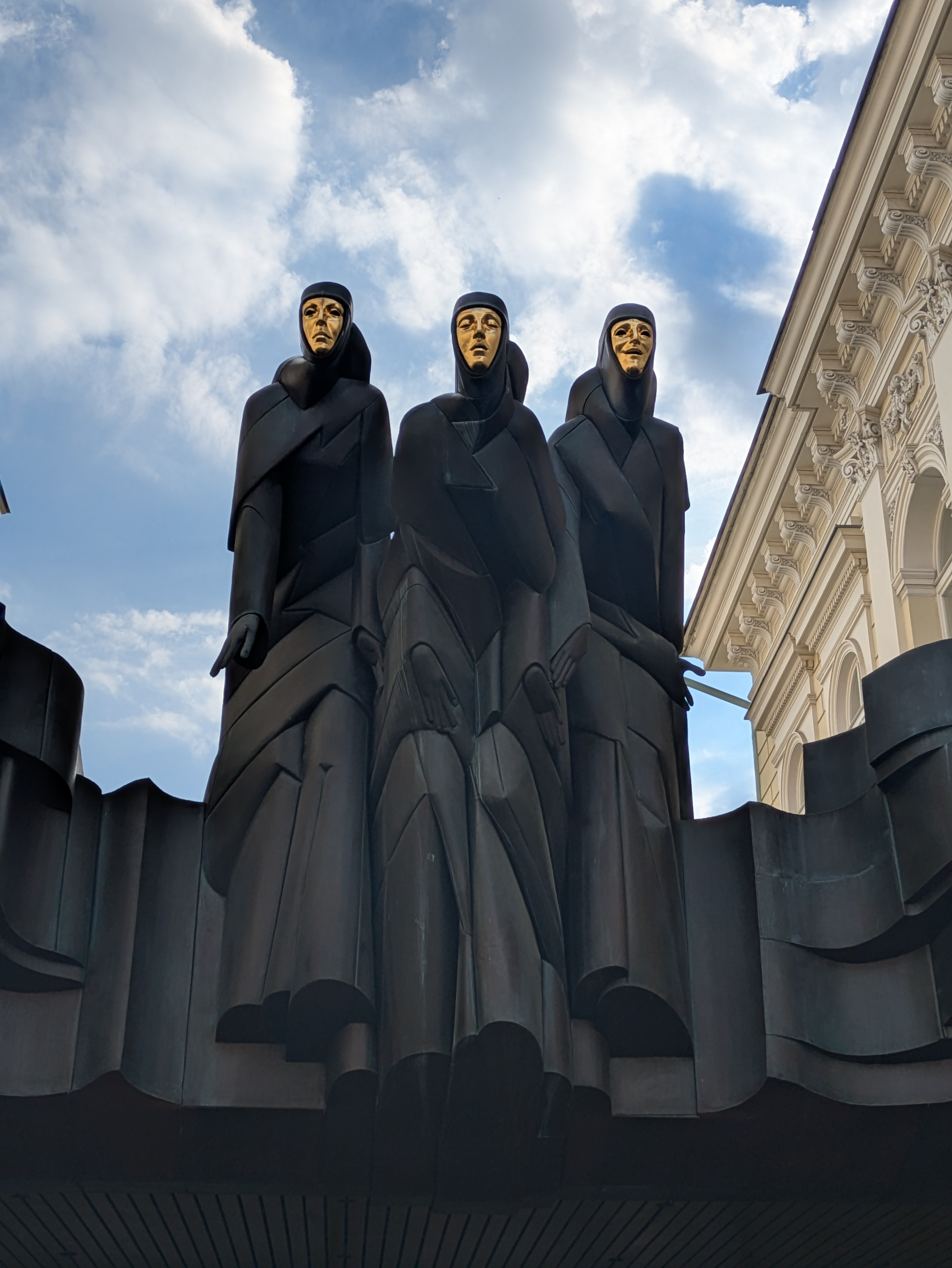
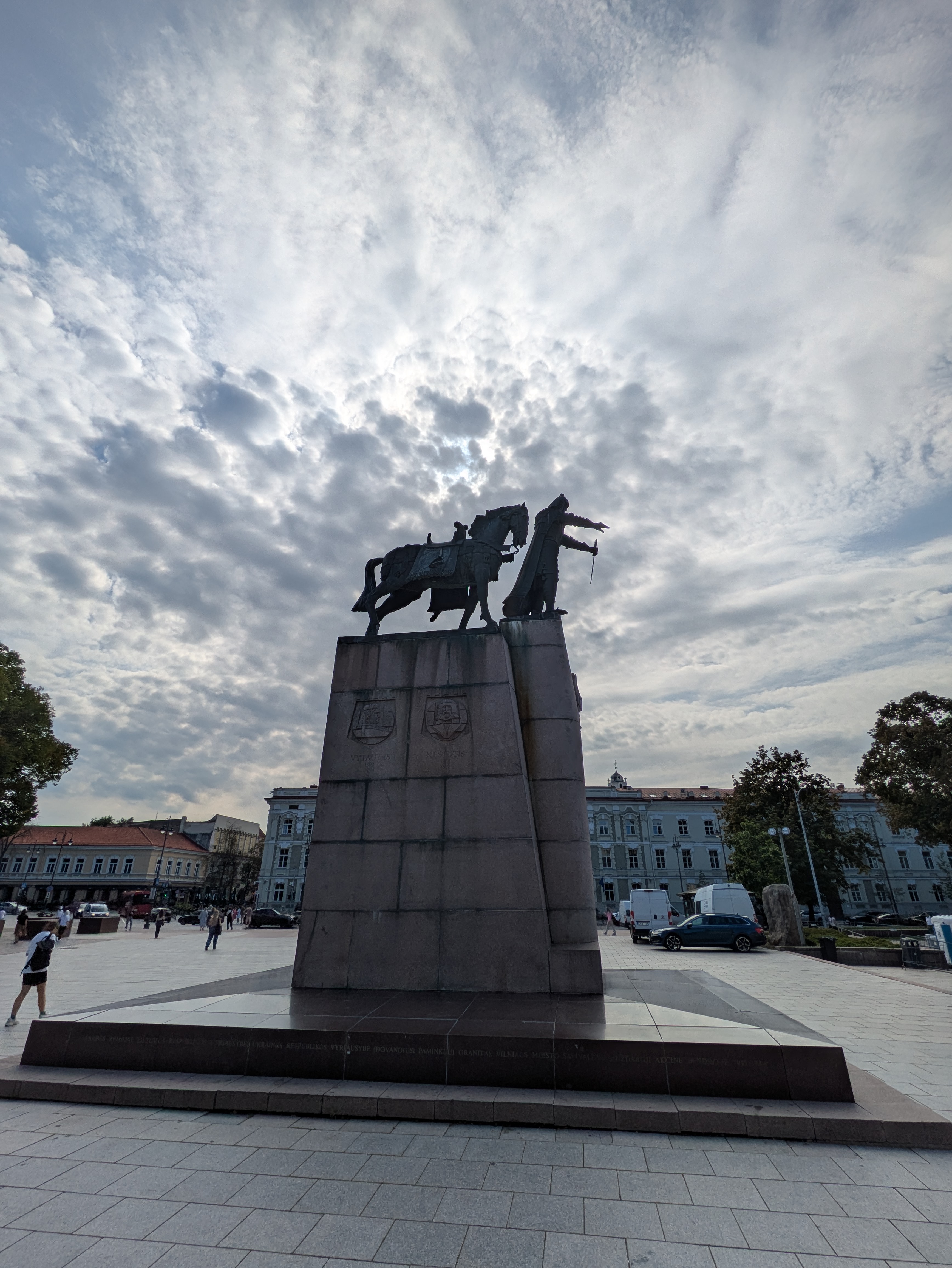
(Below: dramatic statues in Vilnius; a selection of street art in Kaunas)
 Tom the Curious: Ramblelogue
Leave a comment