“Ah, look! Scratch marks from a wolf! They’re fresh, too.” Joana, my guide, points to a fallen branch, across which are clearly visible lacerations. Paw prints create a pattern in the surrounding mud, which even to my untrained eyes looks to be only recently made. From the paw prints, my eyes follow a trail up through the undergrowth, disappearing into the tangled mass of Białowieza Forest.
Visiting Białowieza had been a long-held dream, ever since seeing a photo essay on it many years ago, possibly in the Guardian or National Geographic, where the majestic silhouettes of European bison seemed to magically appear from the forest fog.
I dreamt of seeing those bison, silently wandering through their ancient homeland. I also wanted to search for something else, long since disappeared from daily life. In this corner of Poland, in a forest 12,000 years old and fenced off from human interference, I would surely find a moment of silence. No humming of a fridge, no squabbling of a neighbour’s children, no phone ping, no distant train hurtling by. Just silence.
I meet Joana at 7am on an overcast day by the orthodox church in Białowieza, the village that sits in a clearing within the forest of the same name. 50-something, 5ft-and-a-bit, and dressed for a long hike, she’s naturally warm and chatty, and intimately knowledgeable of the forest, having lived her entire life here. She exudes pride in her homeland without ever having to explicitly state it.
A guide is a requirement for entry to the Białowieza ‘strict reserve’, the cordoned-off section of the forest’s 547 square miles, designated a UNESCO World Heritage Site, which straddles the Poland-Belarus border. This is to protect this pristine primeval forest, but is unquestionably to the visitor’s benefit, such is Joana’s encyclopedic knowledge and her innate ability to spot things that a non-native would otherwise miss.
I lose count of the times she stops mid-sentence to identify fungi, plants, birds, an animal call. The fungi fascinates. This one perspires the water it absorbs from its home on a fallen trunk. That one, “‘death cap’ – avoid!”. This is “‘chicken of the forest’ – delicious”. “And look at this. Mycelium”. A web of blackened veins is visible through the crack in a rotting beam. Joana reaches in to lift it with the palm of her hand, the strands falling between her fingers look like some sort of complex seaweed. “There are examples of this that are the largest, heaviest organisms on earth”. Again, fungi fascinates.
One such moment is, frankly, miraculous, so microscopic is what Joana sees. Crouching down, she points to a tiny sprig of green sticking up from a long-dead limb. It’s the height of a blade of grass, as thin as a coriander stalk, with half a dozen green hairs sprouting from it. This is a baby Norwegian spruce, days into a lifetime that could last centuries. Joana puts its chances of survival to 1%, such is its competition here, but if it makes it and we were to return in 45 years – my own lifespan – then it would be 45m tall with a trunk 1m in diameter. Right now though, it looks more like something to garnish a salad with than a future titan of the forest. So in awe of this minuscule being am I that I find myself shaking my head and laughing in disbelief. Pure wonder.
Being wowed by something so small almost made me forget it had been a beast so huge that had originally drawn me here. There are 800 European bison roaming the Polish half of Białowieza. A success story, having been reintroduced as a small herd of just four in 1929, a decade after they had been wiped out from the area by hunting. But that dream of seeing them appear ghost-like among the trees remained a dream – not one bison was to be seen.
Still, wildlife was plentiful. A white-tailed eagle stands sentry on a stump at the forest perimeter. A pine marten scurries along a log on a hunt, pausing, back arched, then shooting along again. A buzzard takes off under the canopy, its bow-shaped wings beating with real endeavor to get it off the ground. We stand to watch a white-backed woodpecker, hammering away on the standing remains of a lightening-struck oak. All soundtracked by the nearby low-roar of red deer, almost like whale song, as they prepare for rutting season.
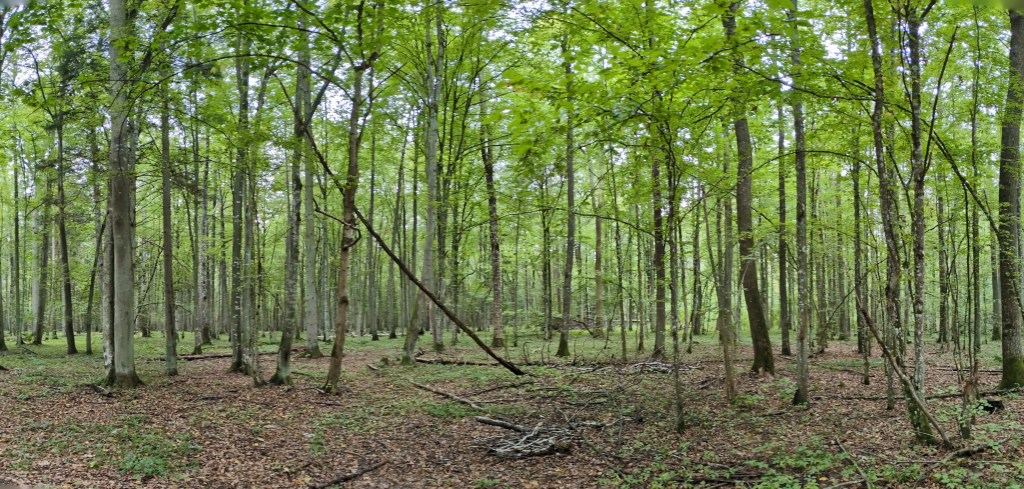
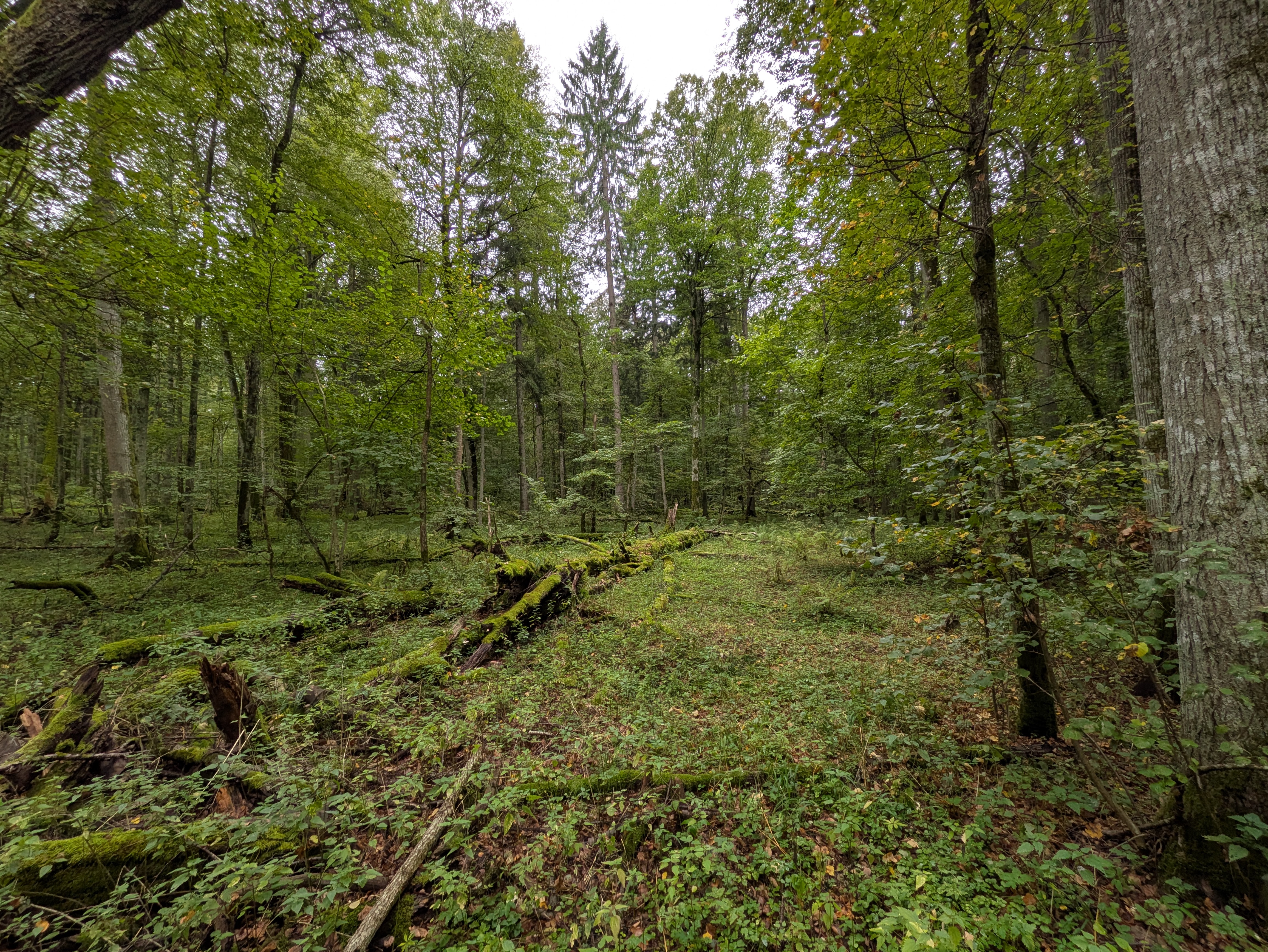
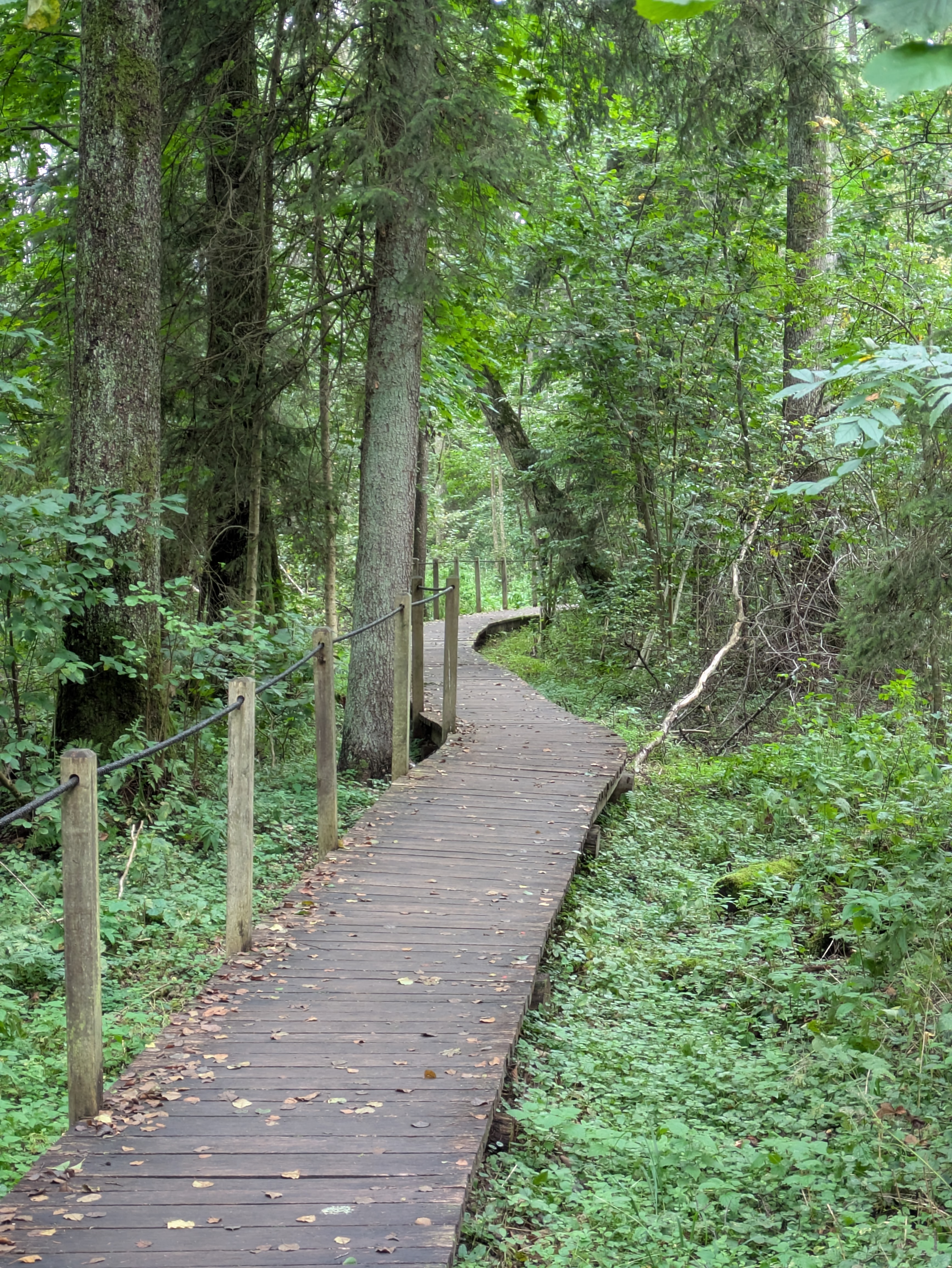
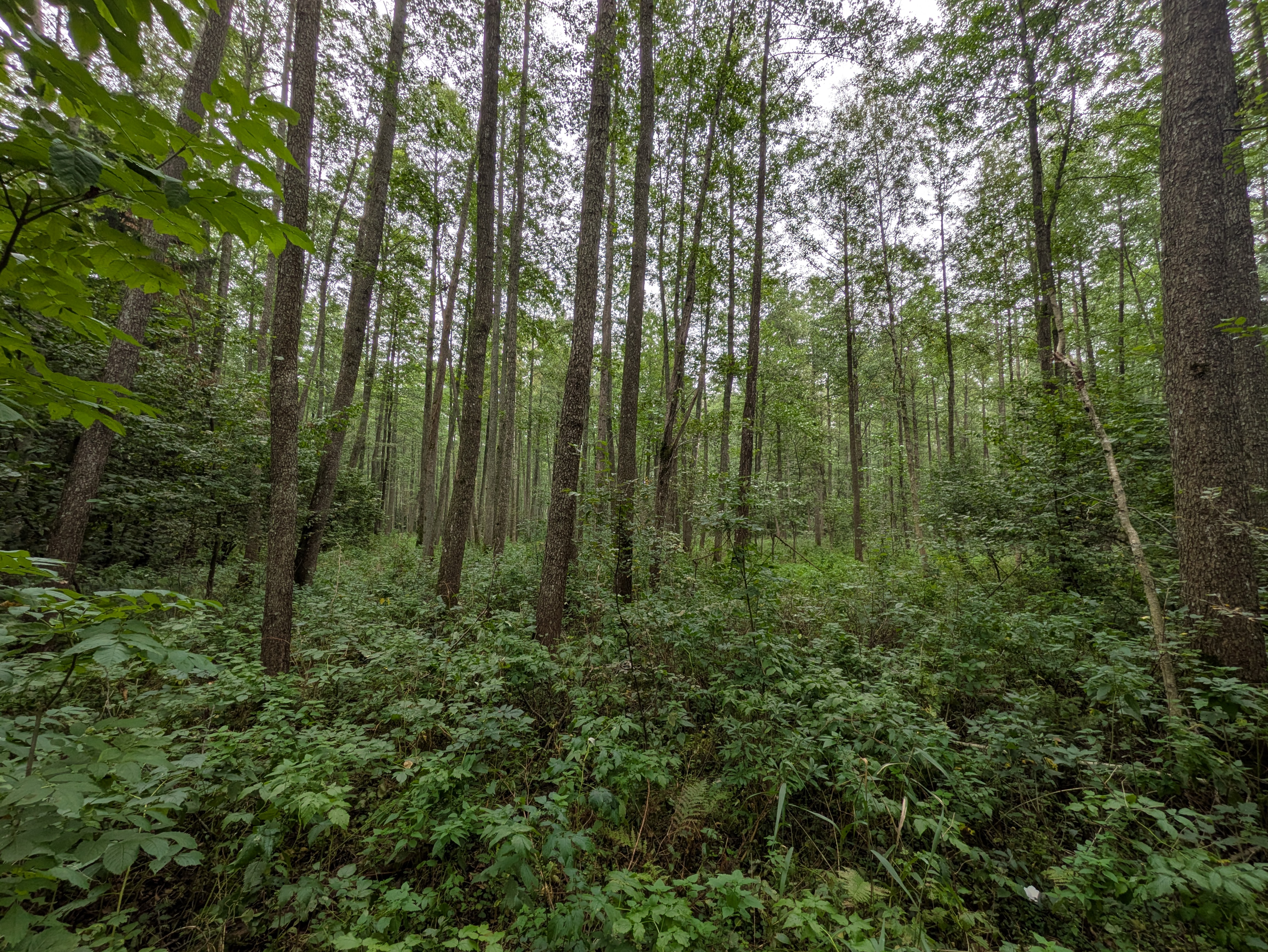
The forest is a saturation of green. Emerald turns to bottle in the shade, then goes lime when back-lit by the white spikes of light that break through the overgrowth, itself held aloft by a wall of elephant legs. Despite the boardwalk that leads our way, it would be easy to get lost here. That moss only grows on the north face of those elephant legs is the only clue to direction.
Joana introduces me to two new ominous-sounding terms. The ‘zone of death’, she describes as the dark, empty space between the canopy and undergrowth, where prey are exposed to predators. The ‘landscape of fear’ as the way animals interact with their environment in relation to the risk to their safety.
But what of that other concept I wanted to find: silence? I cannot remember the last time I was completely free of even the faintest man-made noise. I was desperate for just that one moment where I would only experience the sound of the natural world, or nothing at all.
Even out here, in this ancient forest on the edge of nowhere, I was still reachable, my phone buzzing to alert me that it had switched over to a Belarusian network (damn it – the charges), soon to be followed by live updates on the Arsenal line-up for a lunchtime kick-off 1,000 miles away.
Then, finally. Joana, almost instinctively stops walking, stops talking, raises a finger. I freeze perfectly still in anticipation, silence my breath. And just for one perfect timeless moment, I hear it. Nothing.
There it is.
Joana dips her head in reverence, and slowly we step away again, with only the soft swish of the trees and a warm sense of fulfillment about us.
Noise resurfaces as we approach the entrance gate to the strict reserve, with groups of smiling visitors entering as we leave, all nodding a friendly “cześć” as we pass.
Joana drops me back in Białowieza village and recommends that I fill my rumbling stomach in the Fenaberia restaurant. It’s a top-tip, with an excellent and satisfyingly calorific Polish breakfast of eggs, cheese, sausage, salads, toast and jams. Superb coffee too – something they do well in this corner of Europe.
Hunger sated and still determined to see those elusive bison, I take the two mile walk through the unprotected part of the forest – the distant hum of traffic from the main road just audible – along the ‘zebra zubr’ boardwalk to the European Bison Show Reserve. This educational and well-maintained centre is home to wolves, lynx, wild boar, elk, deer, wild cat, and, at last, lazing in the grass, a small herd of bison.
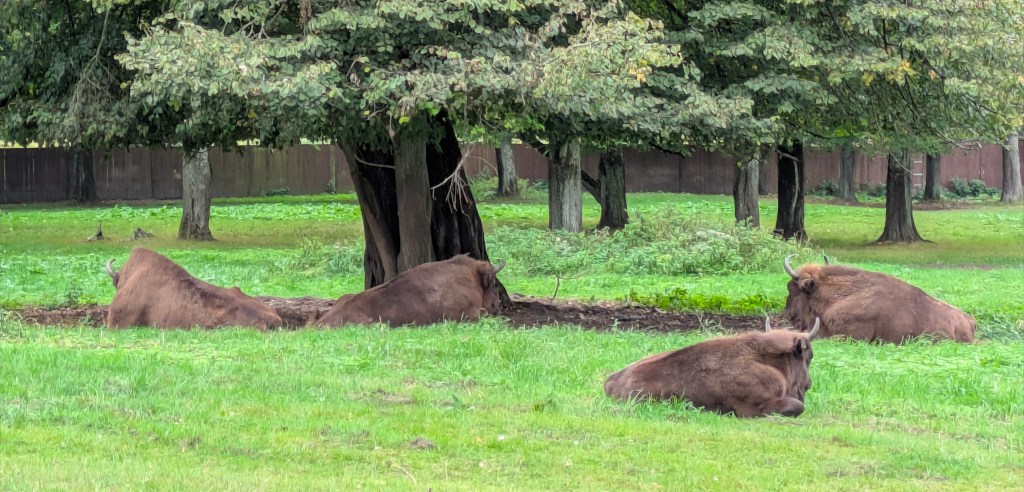
(Above: finally tracking down European bison at the European Bison Show Reserve, Białowieza)
For my visit to Białowieza I stayed in the nearby town of Hajnowka. I’m glad I did, for it gave a glimpse into everyday, non-touristy Poland. The only site of note is the Holy Trinity Orthodox church, which looks like something from the set of a 1970s sci-fi series. A roadside plaque explains how the town’s foundation was related directly to the neighbouring forest. It’s an unassuming, middle-income town, with no real clue as to modern local commerce, leaving me to presume that the forest itself continues to provide employment through its (limited) logging industry.
Food options are decent (Smaki Podlasia was superb); there are supermarkets and camping stores should you need supplies; as with the rest of Poland, it’s very safe; the town is reachable by train from Warsaw or Białystok; and a minibus will take you to Białowieza in time for the dawn chorus.

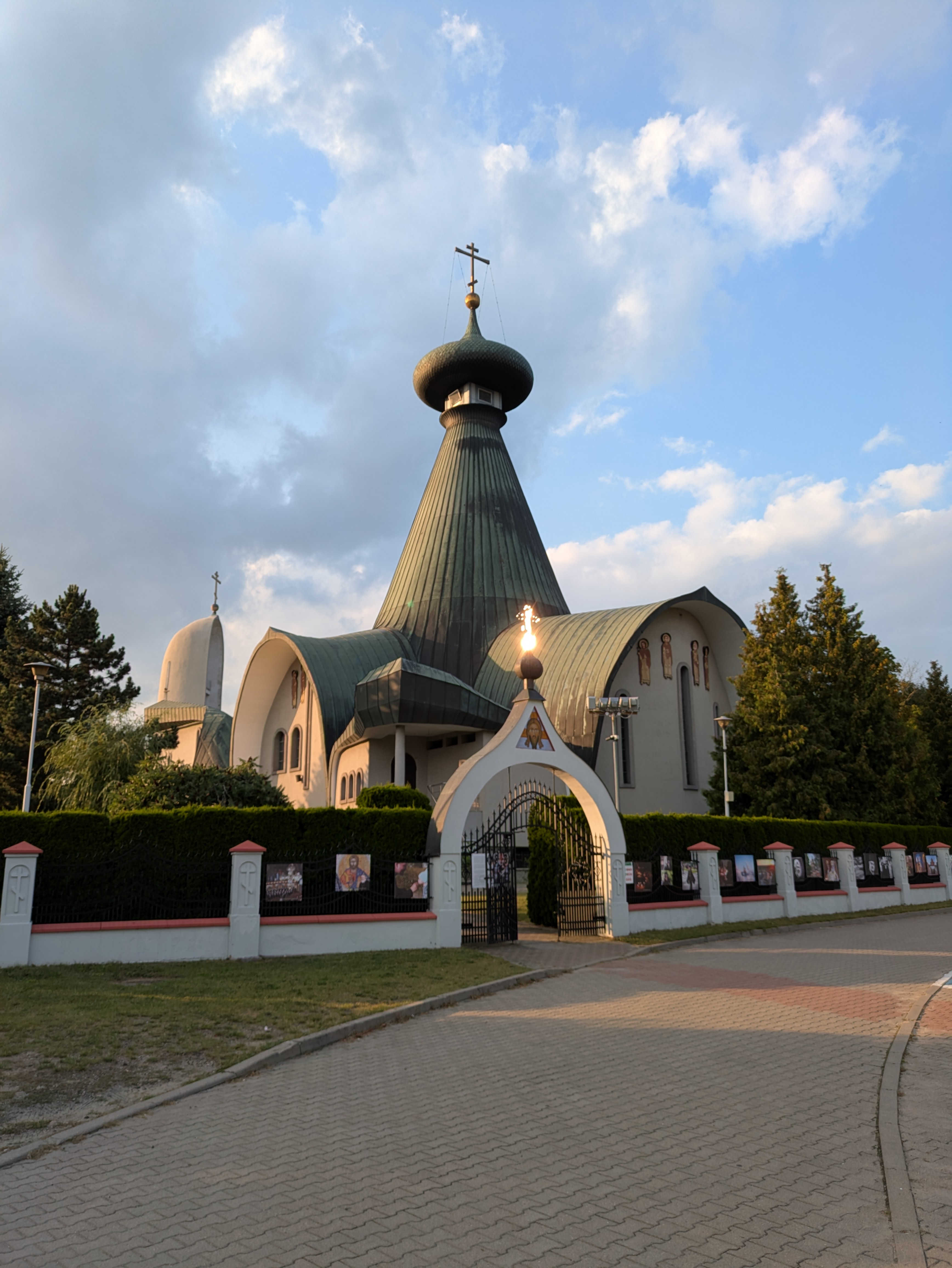
(Above: left – the St Nicholas Orthodox church in Białowieza; right – the Holy Trinity Orthodox church in Hajnowka)
 Tom the Curious: Ramblelogue
Leave a comment