Five days of food and art in Madrid, plus a day trip to Toledo.
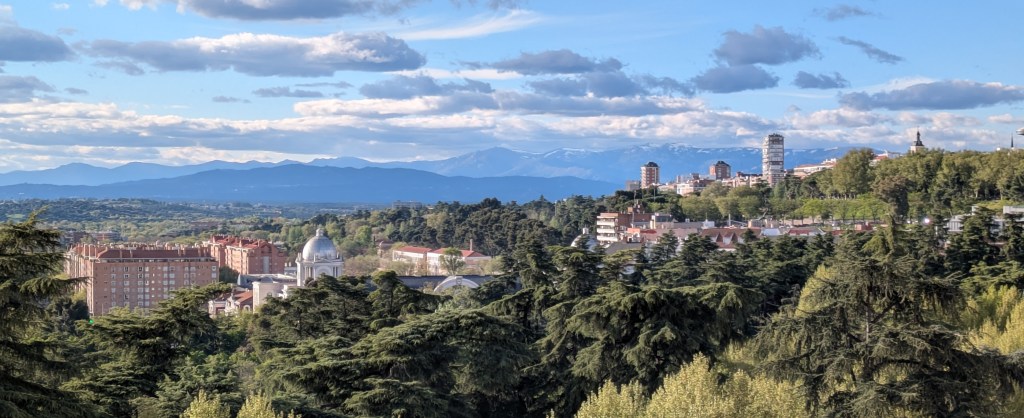
(Above: the view north-west from Palacio Real, Madrid)
Lunes
Pigs die well in Spain. Allow me to correct that: carnivores are likely to enjoy the porky afterlife of pigs in Spain. For pigs, see also octopi, prawns, chickens, etc. This much I learnt from chancing upon Mercado San Miguel, a block west of Madrid’s central hub, Plaza Mayor, and my first stop in the Spanish capital. It’s a classy joint – a century old, all glass and iron-framed, with communal tables and maybe two dozen stalls vending every cured meat, fried crustacean and aged cheese imaginable. It’s a heaven not only for dead pig, but also booze. On a Monday afternoon, it’s busy with Madrileños and tourists tucking into pink hams and white riojas, and it’s where I’m happy to establish that langoustine burger and runny fried egg is a match made in, well, heaven.
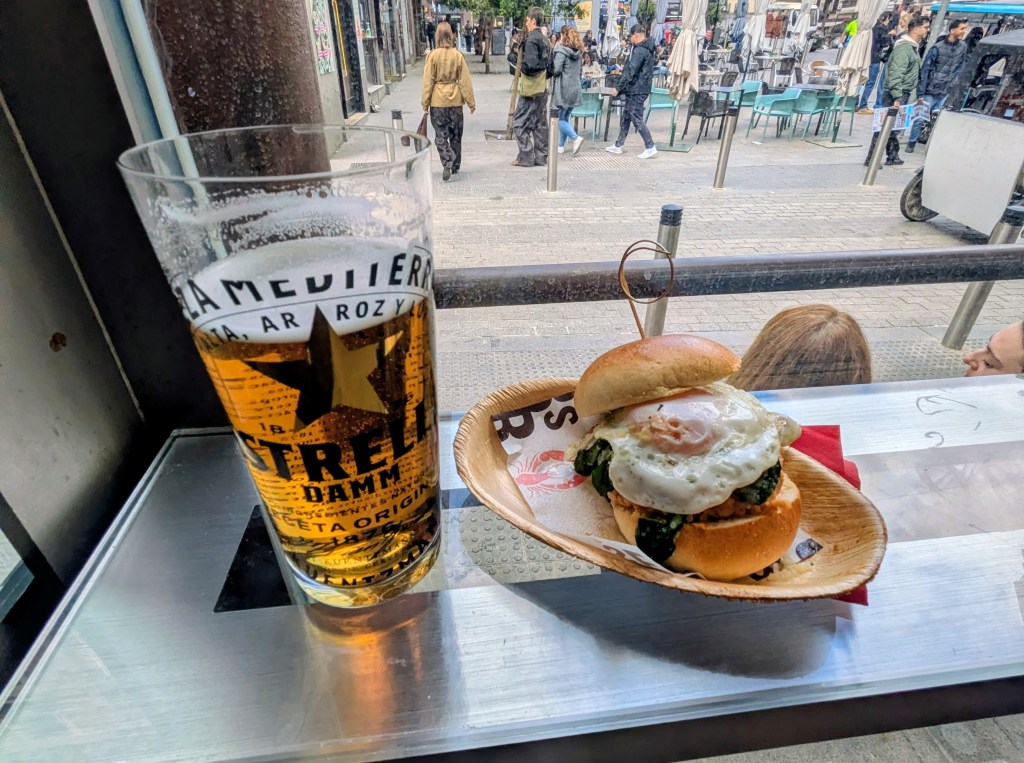
(Above: ¡Salud! Mercado San Miguel)
My digs in Madrid are in La Latina, the barrio (neighbourhood to you and I) immediately south of the Mercado, touted as one of the city’s oldest and most traditional. It’s what I expected Madrid to look like. Readers of previous Ramblelogue posts will know of my love for networks of narrow streets and soulful character, and La Latina ticks those boxes. Spanish cuisine is clearly central to the area’s identity too, and the dozens of restaurants lining Calle de la Cava Baja knowingly lean into this for the sake of what seems to be a 50% tourist clientele.
La Latina is a lovely barrio to mooch around, as is the neighbouring Lavapiés, which translates as ‘wash feet’, apparently taken from a now-gone local fountain, but which I initially assumed to be a biblical reference, what with Madrid being one of the hotbeds from whence Catholicism was sent out to the four corners of the world. Lavapiés is the more multicultural and slightly more downtrodden of the two, which arguably gives it more character. It’s a challenge to avoid the ‘labyrinthine’ cliche when thinking about its slopes, corners and winding alleys.
Talking of character, Madrileños are a fun, friendly and sociable lot, as is apparent on almost every street where they are always stopping to chat, often in large but unintimidating groups, or constantly babbling down their phones instead of miserably doomscrolling on their screens.
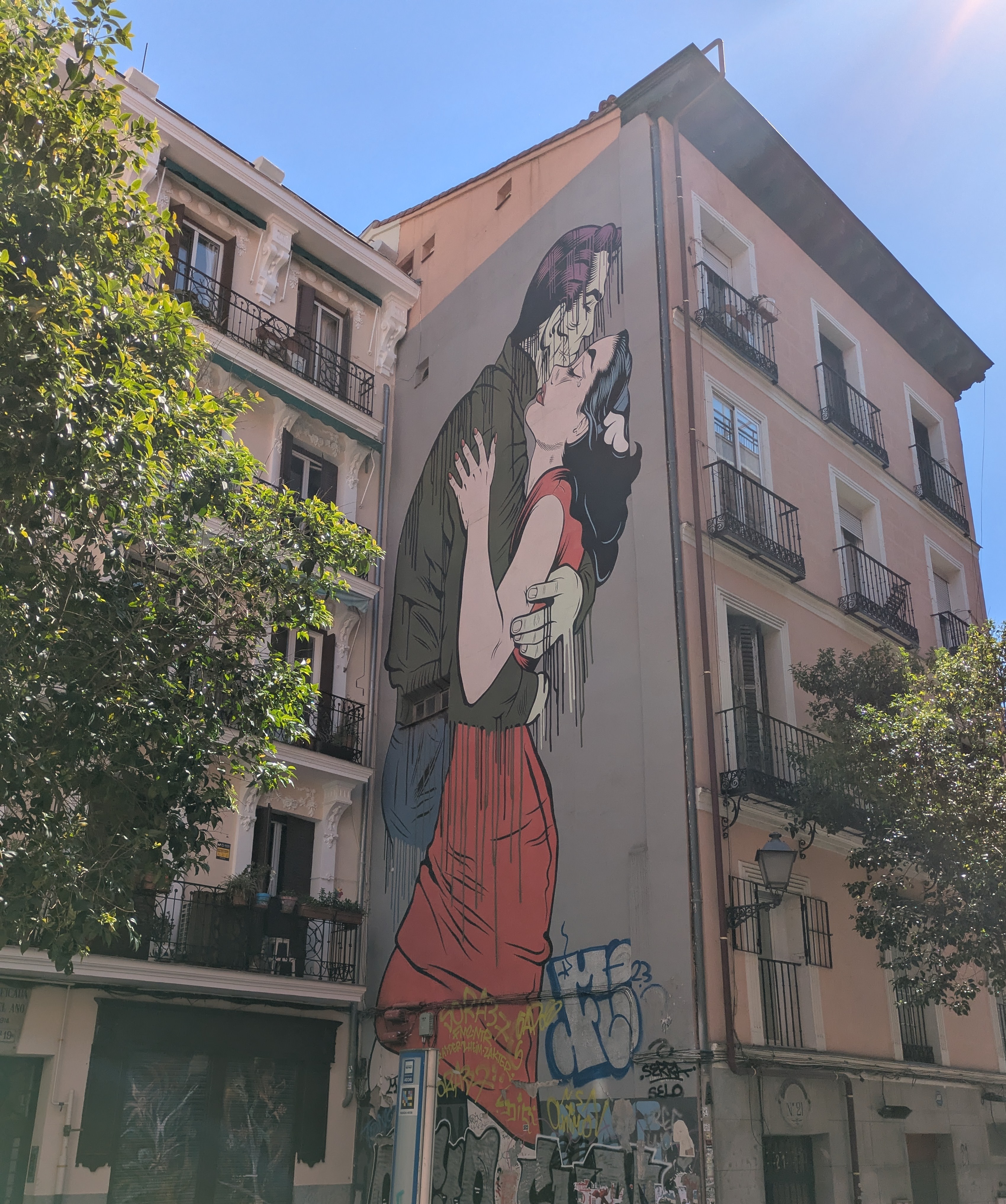
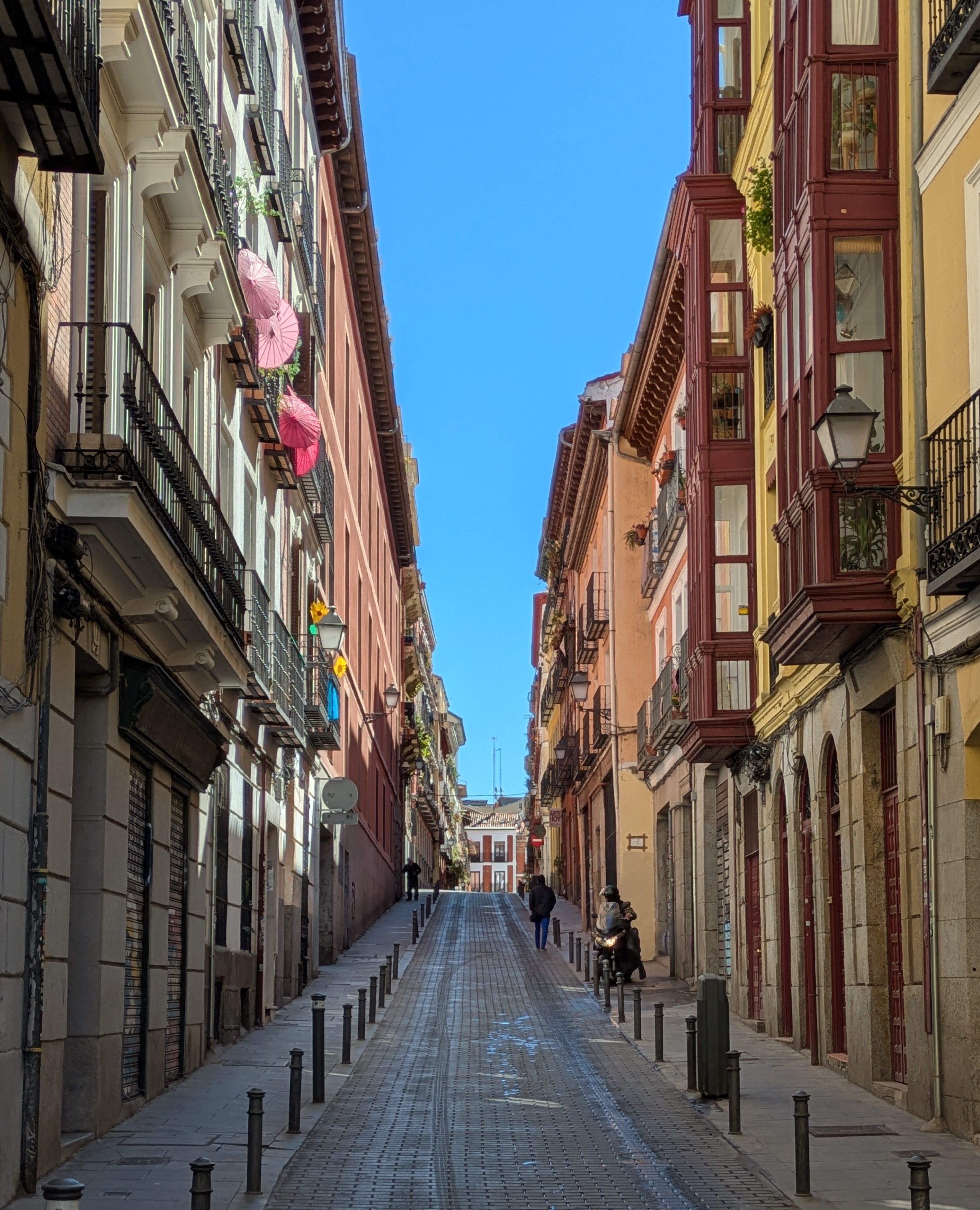
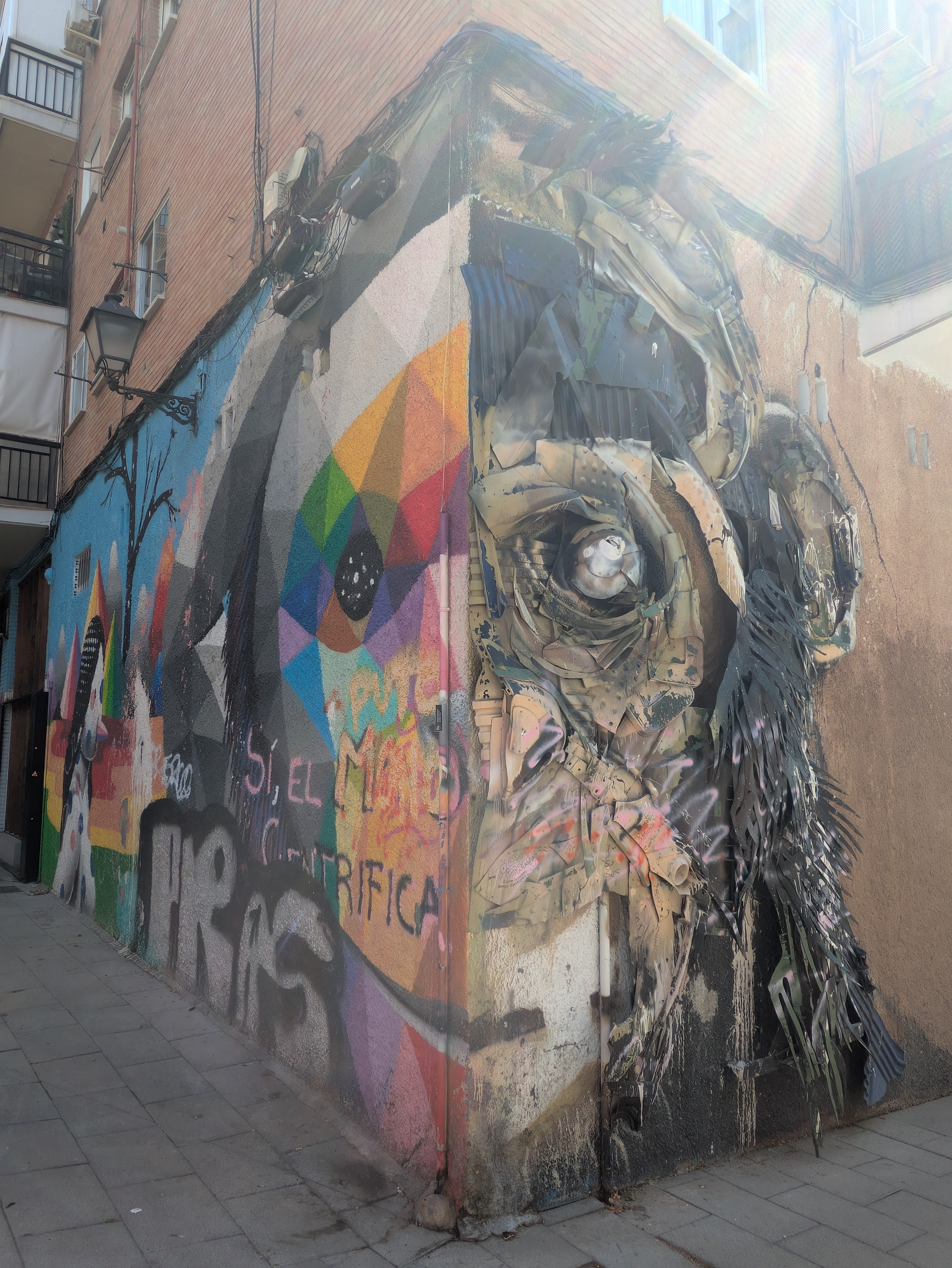
(Above: Lavapiés street scenes, including art by D*Face (L) and Okuda & Bordalo (R))
Constantly testing myself to translate what I see and read puts my head in a spin, but it does does help me empathise with the central character in my holiday reading, Ben Lerner’s Leaving the Atocha Station, where much of the humour stems from what is lost in translation for an English speaker in Madrid. Me gusta.
A short walk north-west of La Latina stands Palacio Real, ceremonial home to the Spanish royal family, the ostentatiousness of its size and golden ornamentation contrasting with the austere grey of its stonework. It makes a grander statement about imperial Spain than the British monarchy ever did with Buckingham Palace, and as a result is more impressive. The palace boasts great views west over what looks like miles of forest but must actually be Madrid’s western suburbs and north towards the still snow-capped sierra. Sadly, whilst finding a perch from which to enjoy said view, an out of tune violinist pitches up and starts to murder Imagine (never my favourite anyway) and then the Four Seasons (obviously), so I meander on.
A five minute stroll away is Templo de Debod, a 2,000 year old Nubian temple that was moved stone-by-stone from its original site near Aswan, to here in central Madrid as a thank you for the work of Spanish archaeologists in Egypt. Quite the generosity. I had been told to time my arrival for sunset, which was sound advice. The temple is aligned with the setting sun and sits close to a ledge with the same views as Palacio Real. Dozens of young folk have gathered here to watch the sun say ‘hasta mañana’, which stokes a mini festival vibe. Alas, that also means the arrival of a busker painfully massacring the generic Spanish guitar repertoire. No me gusta.
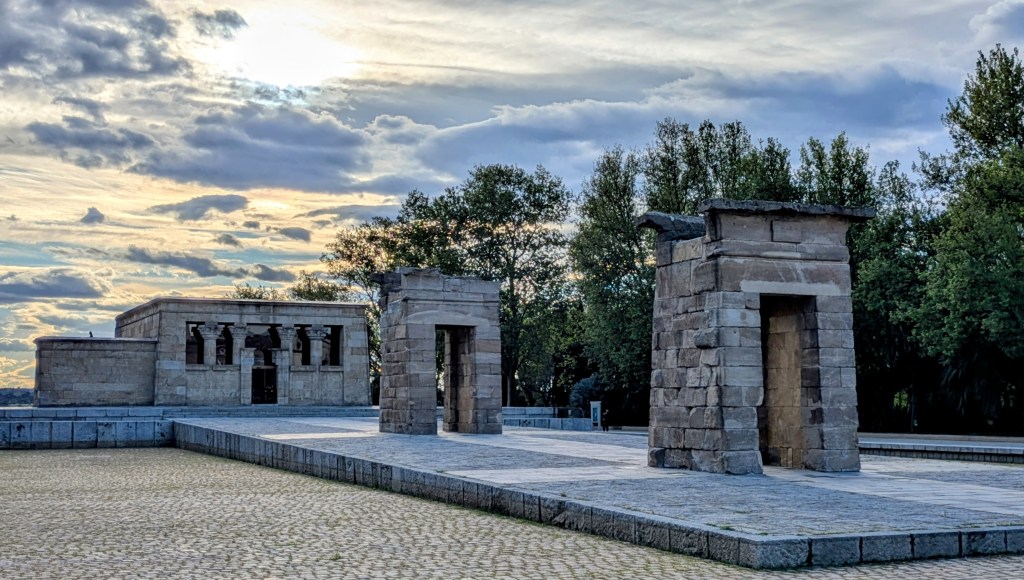
(Above: Templo de Debod, a 2,000 year old gift from Egypt)
Martes
Tuesday kicks off with a brunch as superb as the lunch that had got Monday underway, although a curious pattern begins at Cinco Hileras, my tastefully hip choice of café . Over the course of the week, I notice that male waiting staff tend to immediately switch to speaking with me in English – always friendly, but perhaps impatient at my Spanish – whereas on every occasion their female colleagues indulge my terrible pronunciation and limited vocab. Male one-upmanship or the female instinct to nurture? You decide.
Madrid’s vibrant green lung is the aptly named Parque del Buen Retiro, or ‘Good Retreat Park’. 350 gorgeous acres to escape to on the site that had previously been the original royal palace when Spain’s capital was moved here from Toledo in 1561. The sun is in full blaze for my visit, bringing out every shade of green to compete in the colour saturation stakes with the blueness of the sky. It would be the perfect spot to bring out my book, were it not for the inescapable din of the reconstruction of the park’s crystal palace, apparently modelled on London’s fire-destroyed original.
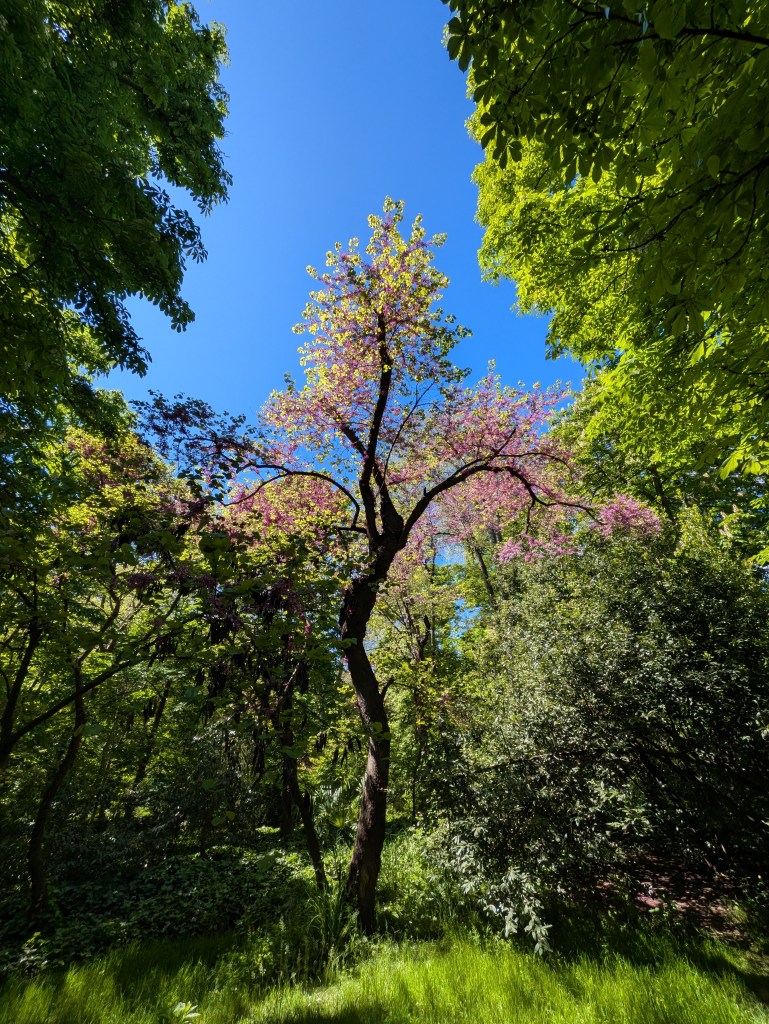
(Above: blues, greens and pink in Retiro Park)
Retiro spreads itself out on the east of the city centre, adjacent to Madrid’s trio of world-class art meccas: the Reina Sophia, Thyssen-Bornemisza, and del Prado. The latter is my destination for the afternoon and is one of the primary reasons for my excursion to Madrid. It is unquestionably an embarrassment of riches.
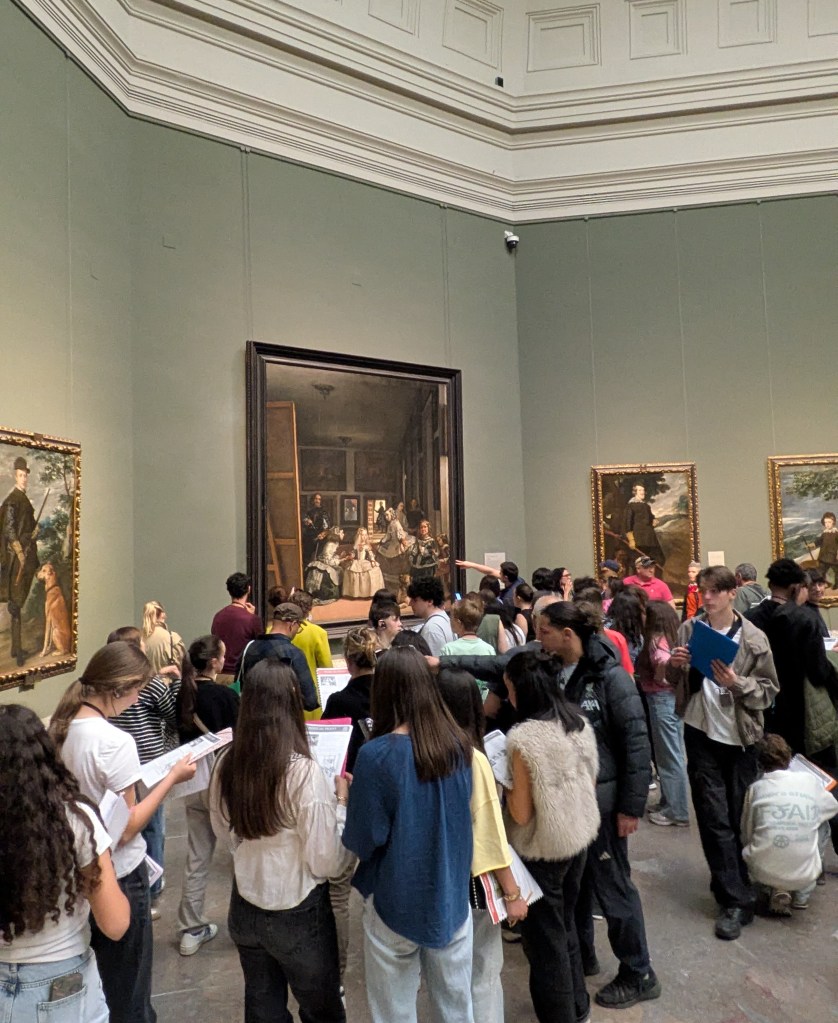
(Above: Las Meninas and fan club)
Despite more Rubens and Van Dycks than I can recall seeing in one place – all roly-poly flesh and pointed moustaches – the star attractions are Velázquez’s 1656 masterpiece Las Meninas and the sheer batshittery of Bosch’s Garden of Earthly Delights. I had wanted to see Las Meninas for years, and taking my time to enjoy it confirmed it as one of my favourite paintings. It is pure genius, with so many clever components, including the mirrored reflection of King Philip vi and Queen Mariana, and the audacity of Velázquez to include himself at work, as if to say “just look at what I can do!”.
The Garden of Earthly Delights is even more mind-blowing in real life than any of the thousand times I had seen it reproduced on screen. Bosch must have been on acid, and it was one dark trip. It draws a similar sized crowd to Las Meninas, but the expressions on every face in front of it range from disturbed to baffled.
Lesser known gems are the several works of Joaquin Sorolla. There often seems to be a glint of something in his subject’s eye, typified by one of my favourites back home at the National Gallery.
And then, from out of nowhere to steal the show, enter Goya and the appropriately dimly-lit room dedicated solely to his black paintings. I wasn’t expecting this. My notes sum this series up as: “Weird, nightmare, gothic, beyond description, ingenious, disfigured plasticine faces, bodies contorted, sardonic smiles”. After the initial ‘wtf’ shock, I catch myself grinning at the retarded expressions of these characters and realise there’s a sense of very dark humour at play here. Dare yourself to get up close to the black paintings and you’ll see fast, loose brush strokes – Goya didn’t seem to need precision but still managed to capture exactly what he needed to, whatever that was. There’s a direct line from his work to two later Spanish visionaries: Pablo Picasso and Guillermo del Toro.
Post-gallery, and a walk through Chueca to find somewhere to eat. This lively barrio was apparently once downtrodden and overlooked until Madrid’s gay community moved in during the 1990s, spruced it up, and began spending the pink peseta. It’s now home to countless places to eat and hipster stores, so it’s incredible to think that such a central residential area – literally just north of the Gran Via – had been previously forgotten about. The only comparison in a European capital that comes to mind is Berlin’s Kruezberg, and that had a very obvious wall-shaped reason for not undergoing gentrification sooner.
My route from Chueca back to La Latina takes me along Gran Via before dropping down to Puerta del Sol. Madrid certainly has a look, especially with all those muted cream and brown five-story blocks with their wrought-iron Juliet balconies, but the architecture is often simple rather than stunning. It reminds me of some of the better-kept areas of central Buenos Aires, so is perhaps an aesthetic in which the significance is found in how it was exported around an empire rather than as an emblem of identity at home, such as with Paris or Rome, for example.
Miercoles – Toledo
Feeling mildly self-conscious to be reading Leaving the Atocha Station whilst sat on a train that literally is leaving the Atocha Station, I put down my book and watch Madrid’s unremarkable southern suburbs disappear. Central Spain flashes by at quite a lick, a dustiness taking some of the colour out of the landscape of Castilla-La Mancha, leaving it with a matte finish. Again, everyone in my carriage is deep in conversation, either with their travel buddy or the person at the other end of their phone. I can only conclude that the Spanish are in a permanent state of chatter.
Toledo is lovely immediately upon arrival; its station’s stylish entrance hall reminds me of that in Malbork, Poland, except here the masonry is Castillian limestone rather than Teutonic brick. During the five minute walk from the station to the city proper, the ancient citadel towers up in front of the visitor, an impressive welcome to Spain’s former capital. In fact, Toledo has formerly been lots of things across its storied history: Celtic, Roman, Visigoth, Islamic (Umayyad), and then ‘properly’ Spanish following the ‘reconquista’.
A highlight is undoubtably Toledo’s cathedral. Celebrating its 800th anniversary this year, Santa María de la Asunción is a gothic masterpiece with deeply impressive stonework and over a dozen chapels spiralling off its nave. The Sacristía Mayor, built as a 16th Century extension, houses the cathedral’s priceless art collection, including works by El Greco with their typically insipid, jaundiced characters. Not a fan. Fortunately, my new friend Goya saves the day with his Prendimiento de Cristo. There are works by Van Dyck, Caravaggio, and Titian, and taking a pew to watch the light beaming through the rose window I start to wonder about the wealth of the Catholic Church – this cathedral and its contents alone must be worth north of a billion. So much for the difficulty of rich men to enter heaven.
On a hot day such as today, shade can easily be found while mooching about around the backstreets. Toledo is a bit of a tourist trap though, with half a dozen walking tours and several school trips clogging up the pedestrianised centre. Just as I think I’ve found a quiet spot to sit and enjoy an ice cream, a busker turns up and starts playing Take That hits on sax. If there’s a decent busker in Spain, they have yet to find me.
Luckily for me, I’d committed to memory what might be a tonic should I need to escape the sun or crowds. My climb up to the city had taken me past the Santa Fe Hall, home to the Roberto Polo collection of modern art. Much to my astonishment, I find that I have the entirety of this beautiful and free gallery to myself. The building, a former convent which has been sensitively refurbished, keeping many original features (that beamed ceiling!), would be worth a visit in its own right. The collection is a delight, much of it spanning the first half of the 20th century, with several pieces looking like they’d been lifted straight out of the Bauhaus. To think that most visitors will have missed it.
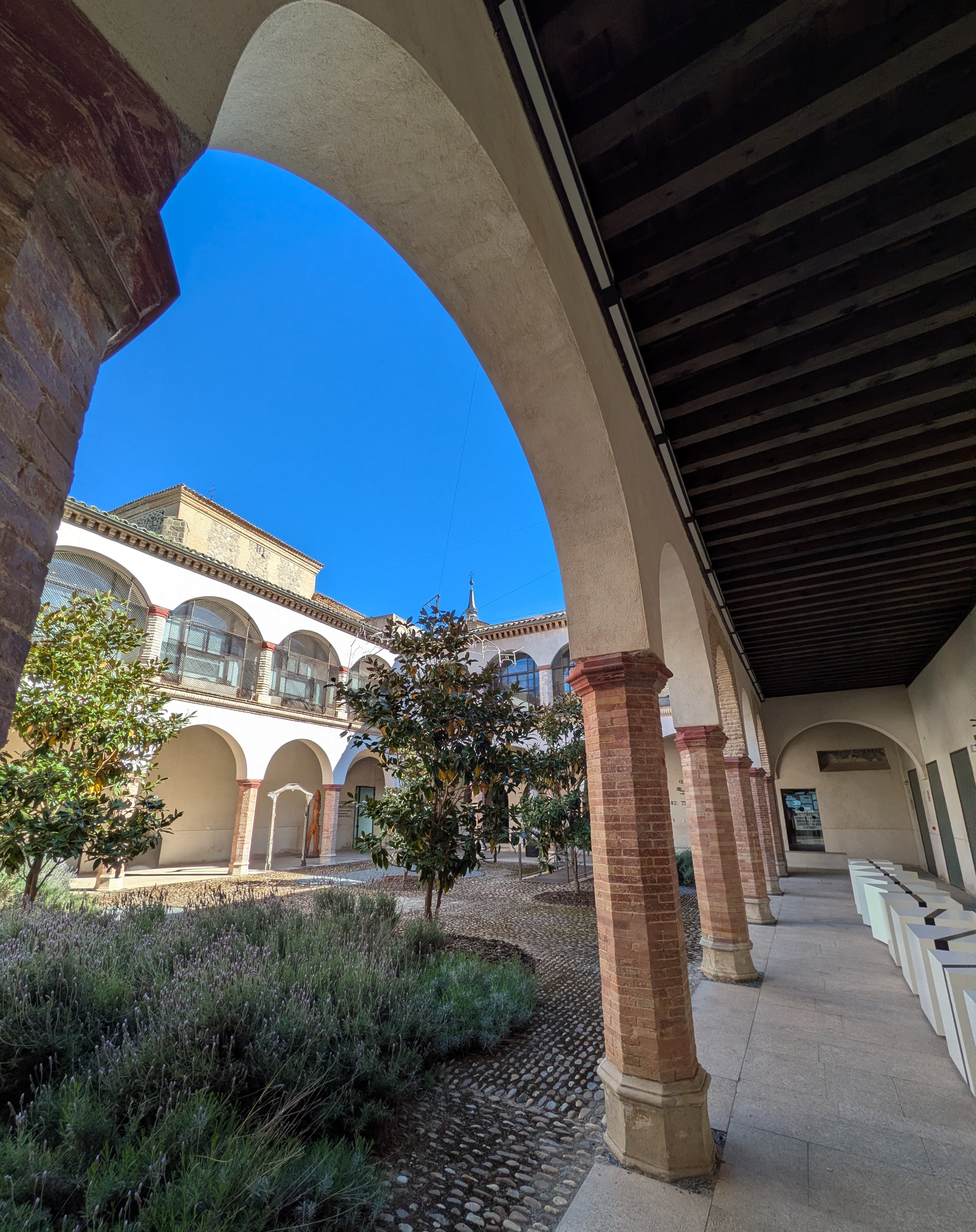
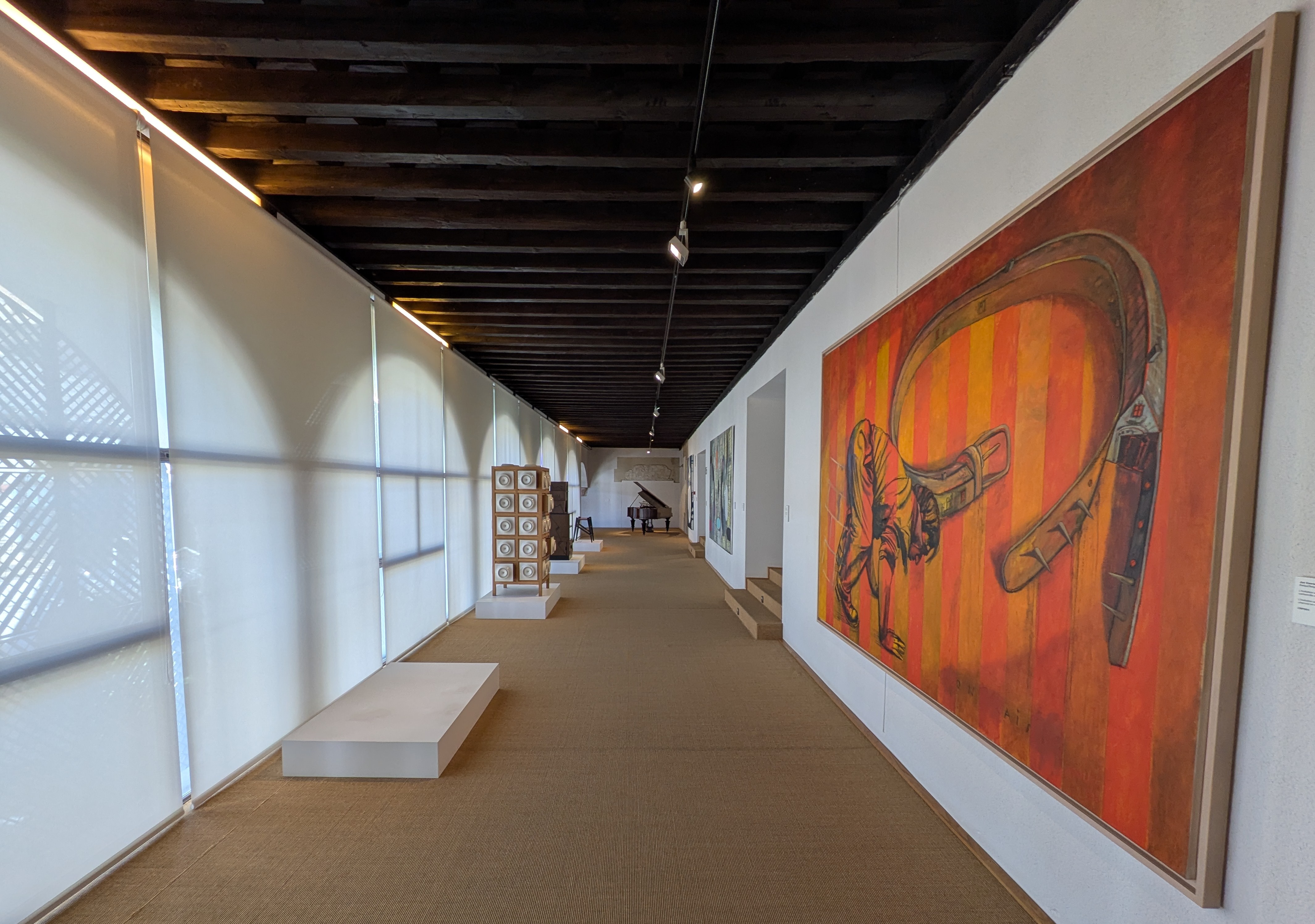
(Above: the Roberto Polo Collection at Santa Fe, Toledo)
Toledo’s other must-see is the view of the city itself from the Mirador del Valle, a 20 minute march up a gentle gradient from the Roman-built Puente de Alcántara. The view of the Tagus River wrapping itself around Toledo is worth the walk, even in the warm spring sun. It’s a picture postcard spot.
On the train back to Madrid I enjoy eavesdropping on the conversation between a Chilean couple and a Chinese lady, explaining to each other in quite impressive English aspects of their own languages and cultures. For all the art and good food, it strikes me that language and other people’s conversations are emerging themes of my trip. Oh, and bad buskers.
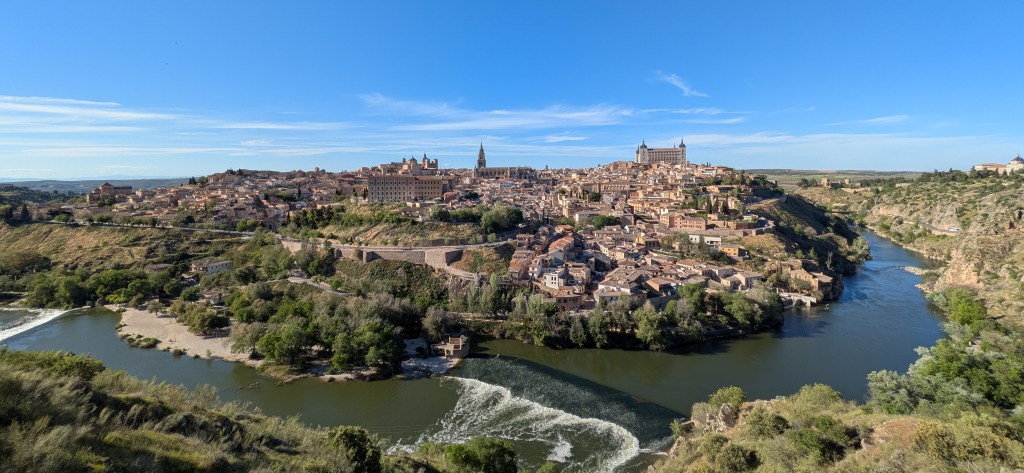
(Above: the Tagus wraps itself around Toledo, from the Mirador del Valle)
Sitting in my window seat on the train back to the Atocha Station, I had developed a thirst, and so followed a lead to Bodega Rosell. Rosell is your classic Madrileño bodega, a timeless drinking den, and a pint there leads me to conclude that a nation that serves its guests a plate of tapas on the house with every drink must be a civilised one. It’s an opinion that is reinforced after spending a thoroughly pleasant few hours sat reading at the zinc-topped bar in Café Pavon; every bar the world over should serve vermouth on tap.
Jueves
I had booked entry to the Museo Reina Sofia for its 10am opening, had mapped out my route to room 205.10, and headed there first so to beat the crowds. Clocking that others were doing the same, I upped my pace, eschewed the lift knowing the stairs would be quicker, trotted along corridors, and skipped past other works with barely a glance. Reaching room 206, I slowed to a more natural pace. Play it cool.
And then, there it is. “Je-sus“, I stutter aloud as Guernica comes into view.
Clearly, I had built up my expectations for Picasso’s most famous work, but for once those expectations weren’t set anywhere near too high. Wow. It’s a stunner, genuinely jaw-dropping. It is brilliant and it is terrifying, and it is art at its absolute best: a vital work when it was first shown at the 1937 Paris International Exposition which has gathered significance and meaning over the following nine decades. There is so much going on across this vast canvas of greys. We all know that it tells the story, or rather, exposes the horror, of the first instance of the deliberate aerial bombing of a civilian population in history, yet the painting doesn’t actually depict any known scenes from that event. What we do see among the melee is a dying soldier, a screaming baby, flailing limbs and contorted mouths, and injured animals, including that most Spanish of emblems, the bull. I don’t know if I’ve ever stood in front of a single painting for so long.
I enjoyed the Reina Sofia, but few other works grabbed me, despite the presence of so many works by other greats of Spanish modern art; it’s striking at how many of whom relocated to France during the Franco years. Remember, if you want a culture to celebrate, the far-right is never going to nurture it.
For a late lunch I luck out by stumbling into the superb SAU Taberna Entre Aguas, just a 5 minute walk from the Reina Sofia. Salty pintxos of calamari and anchovies on an airy brioche bring the Basque coast to the capital, washed down with something red and lovely. But it’s the postre that is the real jewel: who knew that a sprinkling of ground seaweed would elevate an already perfect chocolate mousse into one of the finest things I’ve ever tasted? Calle de Santa Isabella is lined with many inviting-looking restaurants, but my tip is that you make a bee-line for SAU.
Later, sipping a light and grapefruity glass of albarino outside a bar in the small square by San Pedro el Viejo, I decide that the Spanish are surely the best at art and food – please don’t tell the French or the Italians of my blasphemy. I think it’s because the Spanish know how to take risks and are more likely to reject conservatism. Think of Velazquez’s audacity with the composition of Las Meninas or Goya’s inexplicable, surreal characters or the way Picasso deconstructed and then reconstructed his subjects – the Spanish take risks with art and so reveal something unconventional.
They do the same with food. Where the Italians are hyper-regional and the French obsessed with there being a certain way of doing things, the Spaniards are more likely to take dishes from across the Iberian peninsula and add new, creative twists. A simplistic take, maybe, but I think I’m onto something.
As I mull this over, the leitmotif that is the friendly hum of the locals chatting away whilst drinking al fresco leads me to wonder if there’s a quiet spot in all of Madrid.
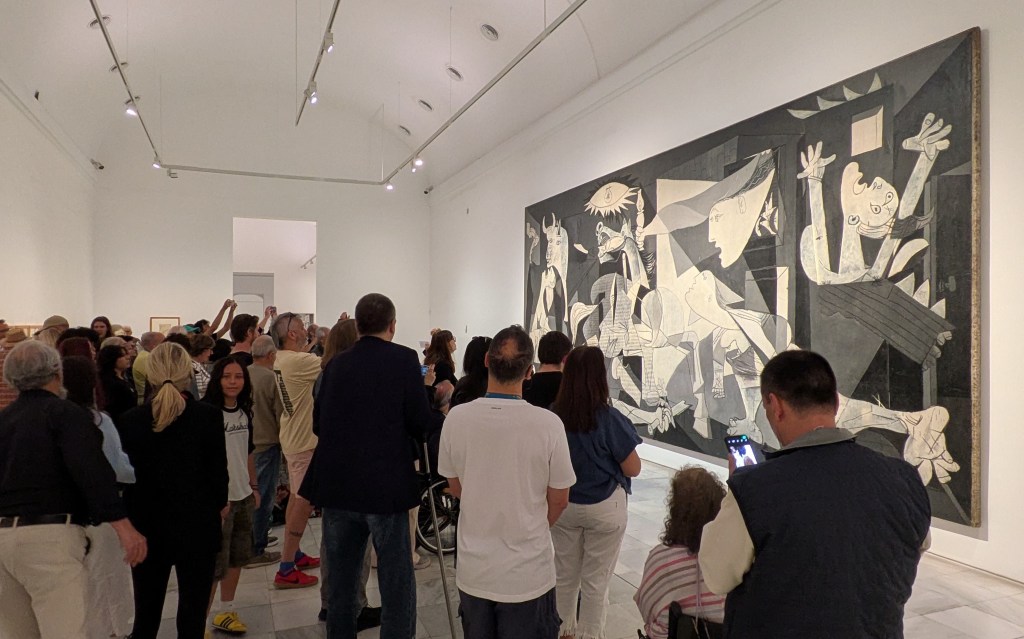
(Above: Guernica and fan club)
Viernes
A Friday morning stroll around Barrio Las Letras – so named for its literary connections – and back out onto Gran Via. Two final observations on Madrid. One, that Madrid must be the only major capital I have visited where no one ever seems to be in a rush. Two, much to Madrid’s benefit, there are so few chain cafes or restaurants here. Even on major squares, the vast majority of establishments are independent and apparently family owned.
It would be remiss to end my time in Madrid without one last pork-oriented supper. Taking a streetside table at Pirulo, behind Retiro on Calle de Ibiza, a Russian salad starter is followed by a fabulous ‘Iberico secreto’, a pork cut not used outside of Spain. I wish they’d share their secret. Then, of course, a lone trumpeter turns up to serenade the diners with what I think is supposed to be the Jazz Suite, but sounds more like the Godfather theme.
Great food and bad busking, what could be more Madrid?
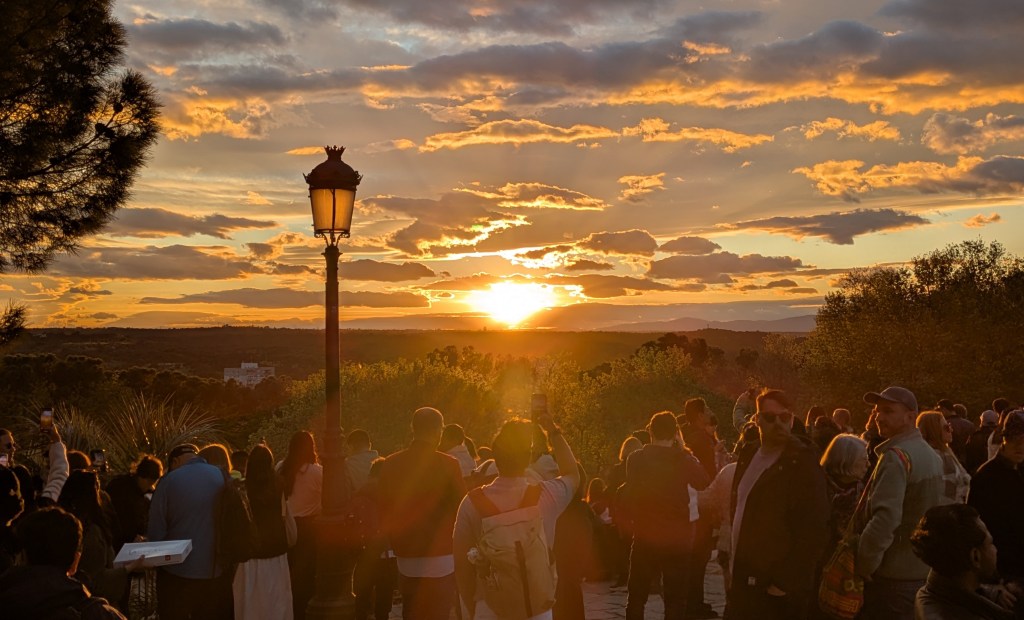
(Above: crowds gather for sunset at Templo de Debod)
Suggested reading and listening for Madrid:
Ghosts of Spain by Giles Tremlett
Leaving the Atocha Station by Ben Lerner
Bad Habit by Alana S. Portero
Soldiers of Salamis by Javier Cercas
History’s Greatest Cities: Madrid (a HistoryExtra podcast)


Leave a Reply