“Confused by our clumsy gestures of interpretation, history is never kind to those who expect anything of her” – from Prospero’s Cell by Lawrence Durrell.
Corfu
Corfu is green and blue, sounds like cicadas, and smells like cigarettes.
The green covers the island like an ill-fitted carpet, except where the magnolia and peach villages poke through. There are two shades: one, the bottle-green of the ubiquitous Cypress trees, ever standing sentry; the second is the silvery sage of the olives, wilting as if apologising for wanting their share of the sun.
Then the blues. The inky Ionian, heavy and dark. Approaching the shore it absorbs some of the island’s green and, with the help of fine sand, turns into turquoise. No ‘wine dark sea’ here. The Ionian reflects a bright sky.
Corfu Town, or Kerkyra to the locals (and for this post I’ll use ‘Kerkyra’ for the town and ‘Corfu’ for the island), is a shambles of narrow streets and alleys. Its old town, mostly Venetian with French and British influences, protrudes out onto a small peninsular and swells with tourists, especially when the mammoth cruise ships are in port. Kerkyra has its warm charm and is far from ugly, but as southern European towns go, it’s not one of the stunners.
Beyond the old town, the shambles continues. My experience of modern Greek urban areas is that they are rarely pretty, and suburban Kerkyra is no different. Structures often look unfinished, with piles of building materials stacked up in front yards. Hotels could equally be in mid-construction or in the process of being dismantled and roadworks repeatedly seem to lead to dead ends. Across Corfu’s hinterlands, fly-tipping is not uncommon. It’s as if the Corfiots know how beautiful their homeland is and long ago gave up trying to match it with their built environment.
I experience suburban Kerkyra through the window of the #8 ‘blue bus’ to and and from the village of Agios Ioannis, 4 miles inland, where my base is the Archontiko Petrettini Hotel. An elegant whitewashed mansion, at 300 years young it dates to Corfu’s late-Venetian period.
To describe Corfu’s history as ‘storied’ would be an understatement. I had imagined setting out this post in chapters for each of the island’s eras in chronological order, but that would have meant chapters titled something like Hellenic, Roman, Vandals & Goths, Byzantine, Pirates, Sicilian, Genoese, Byzantine redux, Venetian, Angevin French, Venetian again, Ottoman (nearly), Napoleonic French, British, Greek. This is supposed to be a 2,000 word blog, not a 1,000 page history.
And now you know why I chose that particular line of Durrell’s for the epigraph!
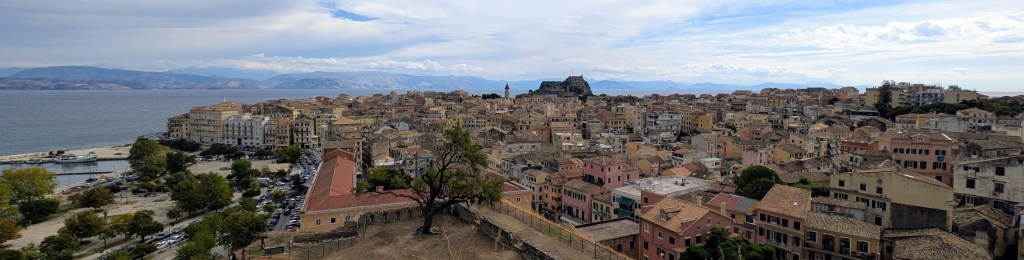
(Below: Kerkyra from the New Fortress with mainland Greece in the distance)
The continuous overnight chirp of cicadas is finally broken by a dawn chorus of dogs yapping to each other across the valleys around Agios Ioannis. The dogs awaken the village cockerel, who croaks his own alarm before swiftly giving up. The next sound is the buzz of countless mopeds as the locals set out for their days around the island.
My plan for day one on Corfu was to lounge by the swimming pool with my book, but rain clouds have set in early and the pool is covered in dead leaves with a ring of grime around the surface, so I decide to explore Kerkyra.
The ever-friendly staff at the Archontiko Petrettini tell me that the Corfu climate is dreadful from October to March, so it follows that there are things to do in Kerkyra during inclement weather. This is fortunate for me, as light drizzle becomes a torrential downpour, so I take cover in the Byzantine Art Museum, housed in the 15th century Panagia Antivouniotissa church. The outdoor gloom is matched that indoors, with the hum of the biblical deluge crashing down on the nave’s timber roof adding to the air of reverence from all the gold and burgundy iconography. The mood is on the sober side of opulent. Every saint worth his salt is on show, although there are notably fewer Marys than I had expected. Thunder peals as I leave, a groan from the heavens to I the skeptic.
Kerkyra’s Hellenic history is well presented at the modest Archaeological Museum. The extent of ancient Corfu’s sphere of influence is on show with small exhibits on its trade routes and coinage. Perhaps most interesting is the section on the concept of ‘oikos’, literally translating to ‘household’ but shown here through domestic items, religious artefacts and childhood treasures to have meant so much more to the ancient Greeks.
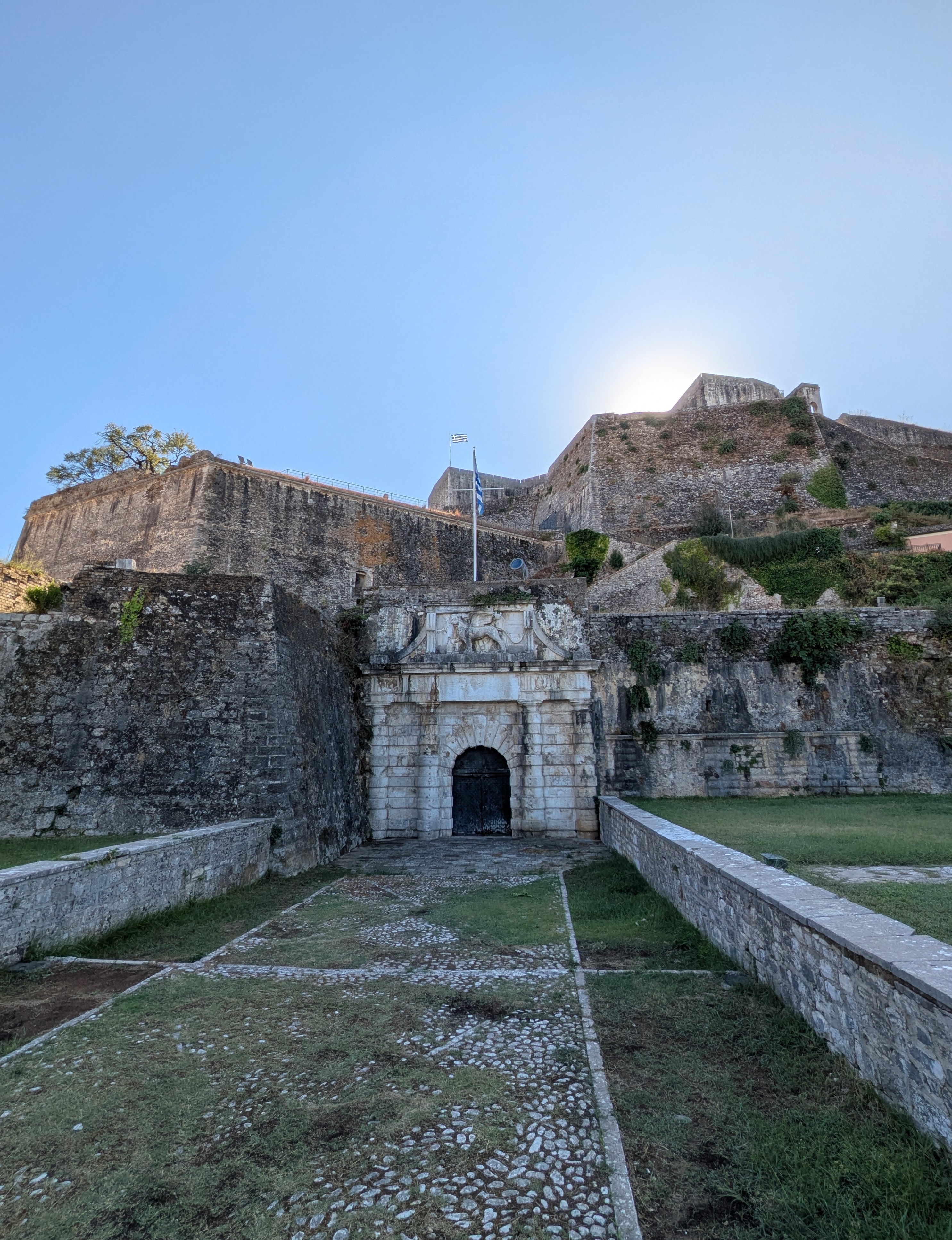
Kerkyra is dominated by two fortresses, both worthy of a half hour visit. The New Fortress was built by the Venetians in the late-16th century and added to by the British during the 19th. It is left unadorned and with very little information to explain its history to visitors, who must use their imagination to paint a picture of the site in its heyday, which is arguably no terrible thing.
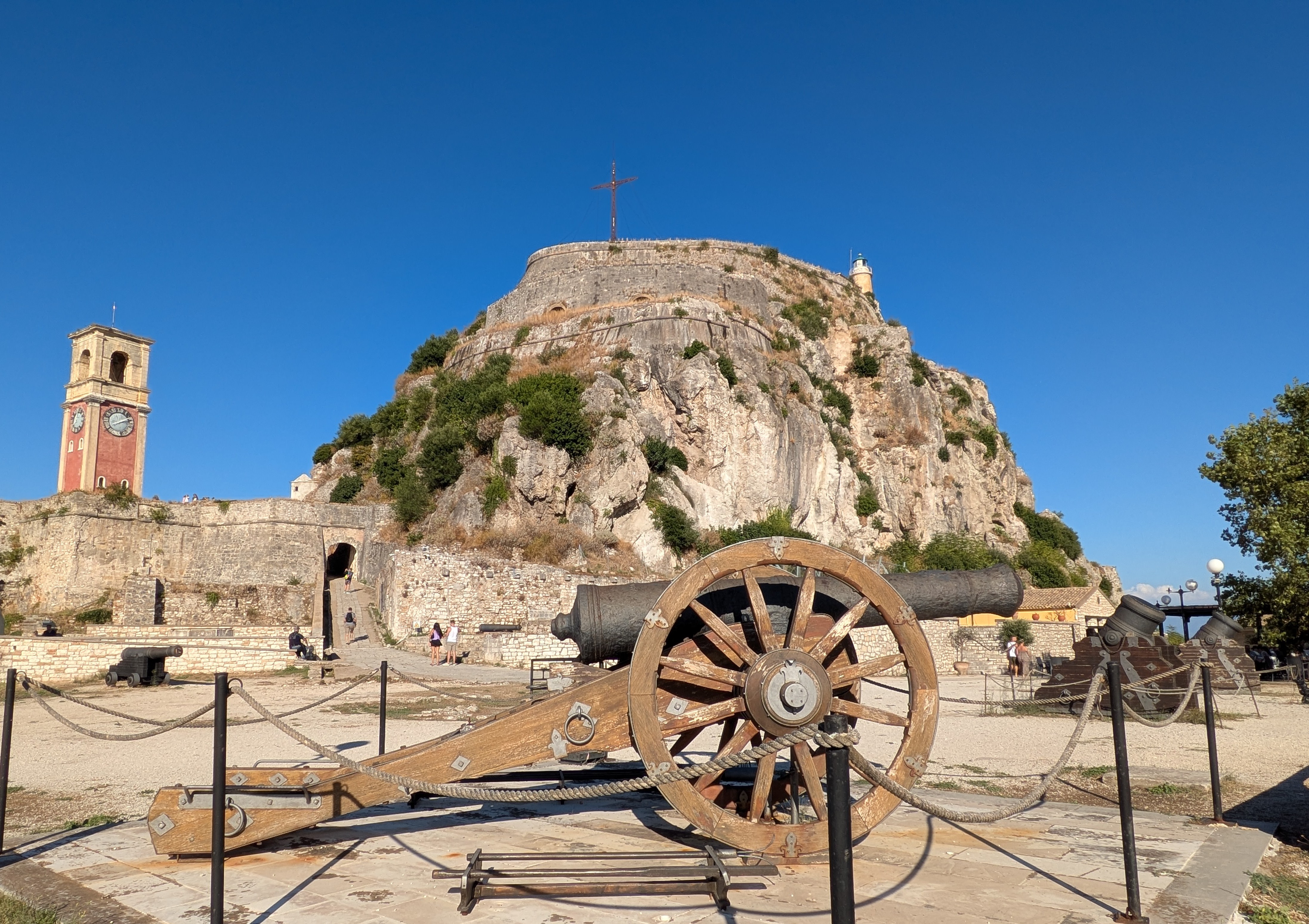
The Old Fortress, which dominates the eastern point of Kerkyra’s peninsular, was similarly built by the Venetians and added to by the British. It outdates the founding of the New Fortress by half a century and managed to repel multiple attacks from the Ottomans until it was deemed necessary to build the New Fortress to augment Kerkyra’s defences. A free app is available to act as a guide to the Old Fortress. The panoramas from both on a sunny day are glorious.
(Below L-R: the New Fortress; the Old Fortress; Kerkyra old town)
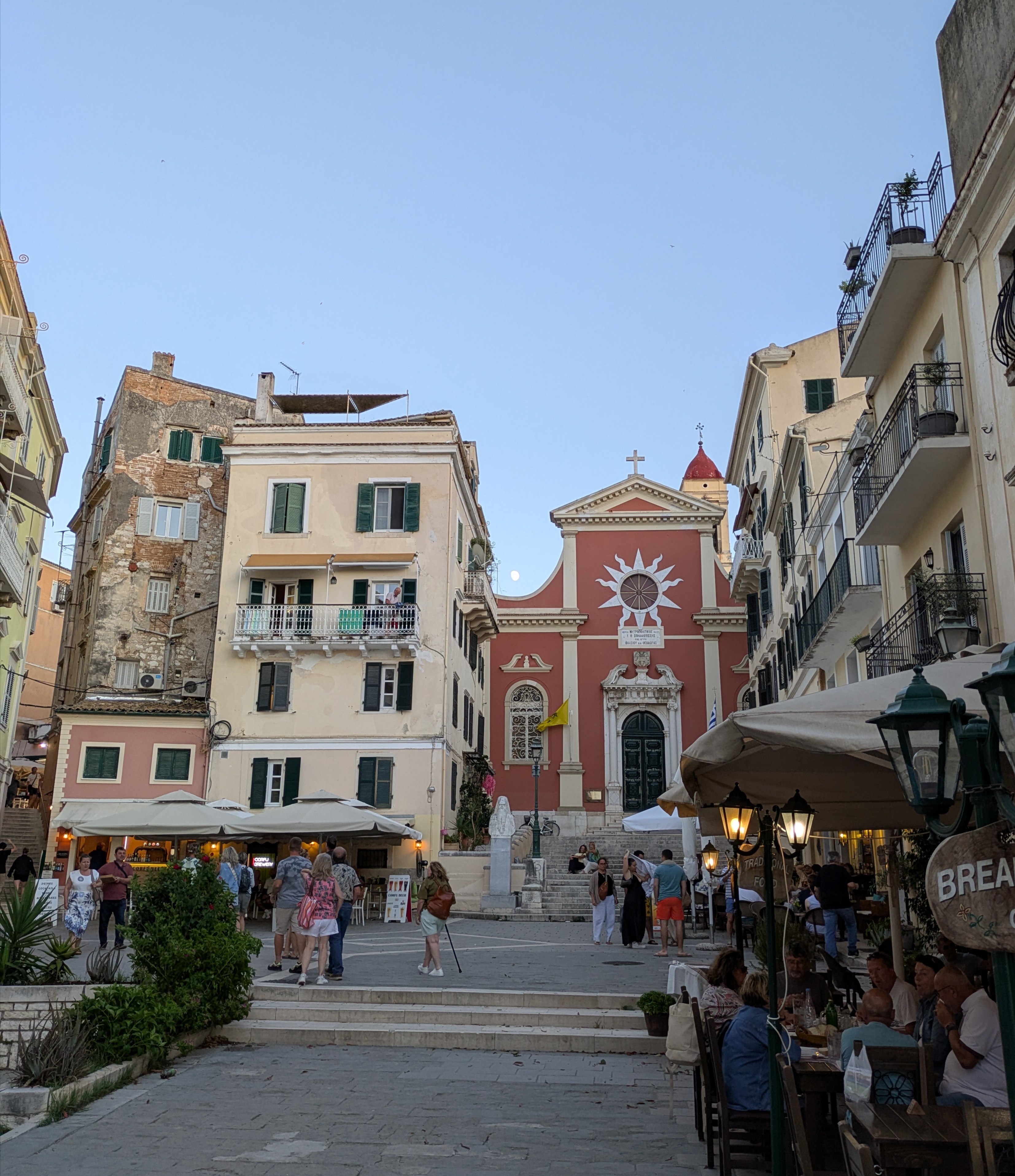
Under the shade of the French-built arcade on Liston, the old town’s most prestigious street, I plonk myself at a café table facing the Spianada Square. The Spianada is home to one of Kerkyra’s more peculiar timestamps – a cricket pitch, very obviously a remnant of the island’s British period (1814-1864). I wonder how many others there are in Greece. It has been brought up to modernity with an astroturf wicket, but the only people near the crease were dog walkers.
The cricket pitch isn’t Britain’s only legacy. It’s noticeable how English is spoken almost as frequently as Greek on Corfu. Of course English is the world’s lingua franca, there is a large ex-pat community here, and there were those five decades of British rule, but if feels more frequent than ever that foreign tourists immediately default to English, and not just for basic transactional exchanges but full conversations. I’m sure I could pass for German, Dutch or Scandinavian, but even a French couple in one restaurant automatically asked me about the menu in English. Quelle horreur!
The waitress takes my order, in English, naturally, and somehow sounds like the tone deaf yet vain Edith from ‘Allo, ‘Allo. This leads me to wonder whether English is ‘our’ language anymore or if it belongs to everyone now. Does a language belong to native speakers only when non-natives use it solely for transactional purposes? Does the creative use of language and the ability to tell your story with it make it yours even if you weren’t born speaking it? That must be the key to it. Our ability to tell our story is integral to what makes us human, so it follows that a speaker being able to tell their story means whatever language they’re using belongs to them, even if it isn’t their native tongue.
Niche it may be, but having long been fascinated with how the 20th century was bookended by Serbian nationalist violence, I was keen to visit the Serbian Museum of Corfu. Housed in the handsome, cherry red Serbian consulate building, the museum tells the overlooked story of the fate of 150,000 members of the Serbian army and government who were evacuated from their homeland following the advance of Austro-Hungarian forces in October 1915 and sought refuge on Corfu. This compelling and largely unknown episode is brought to life through items from the frontline, including weapons and uniforms, medical equipment, propaganda posters, and eye-witness accounts, and opened my eyes to an unfamiliar chapter of WW1.
However, I was perplexed that the museum opened with the Serbian retreat of 1915 having set out absolutely no context for the war itself, as if the previous year’s fighting, a period when over a million people perished, hadn’t happened. In fact, I had to ask the helpful museum attendant if I’d started in the wrong room! Gavrilo Princip is understandably considered a hero by Serbian nationalists, and he was for all intents and purposes a freedom fighter, but to fail to mention the most consequential assassin of all-time appeared to me to be a deliberate omission about Serbia’s role in igniting the conflict and all that followed. The museum tells an important story, but surely it should tell that story in its full context. Maybe it is hindered by the building in which it’s housed.
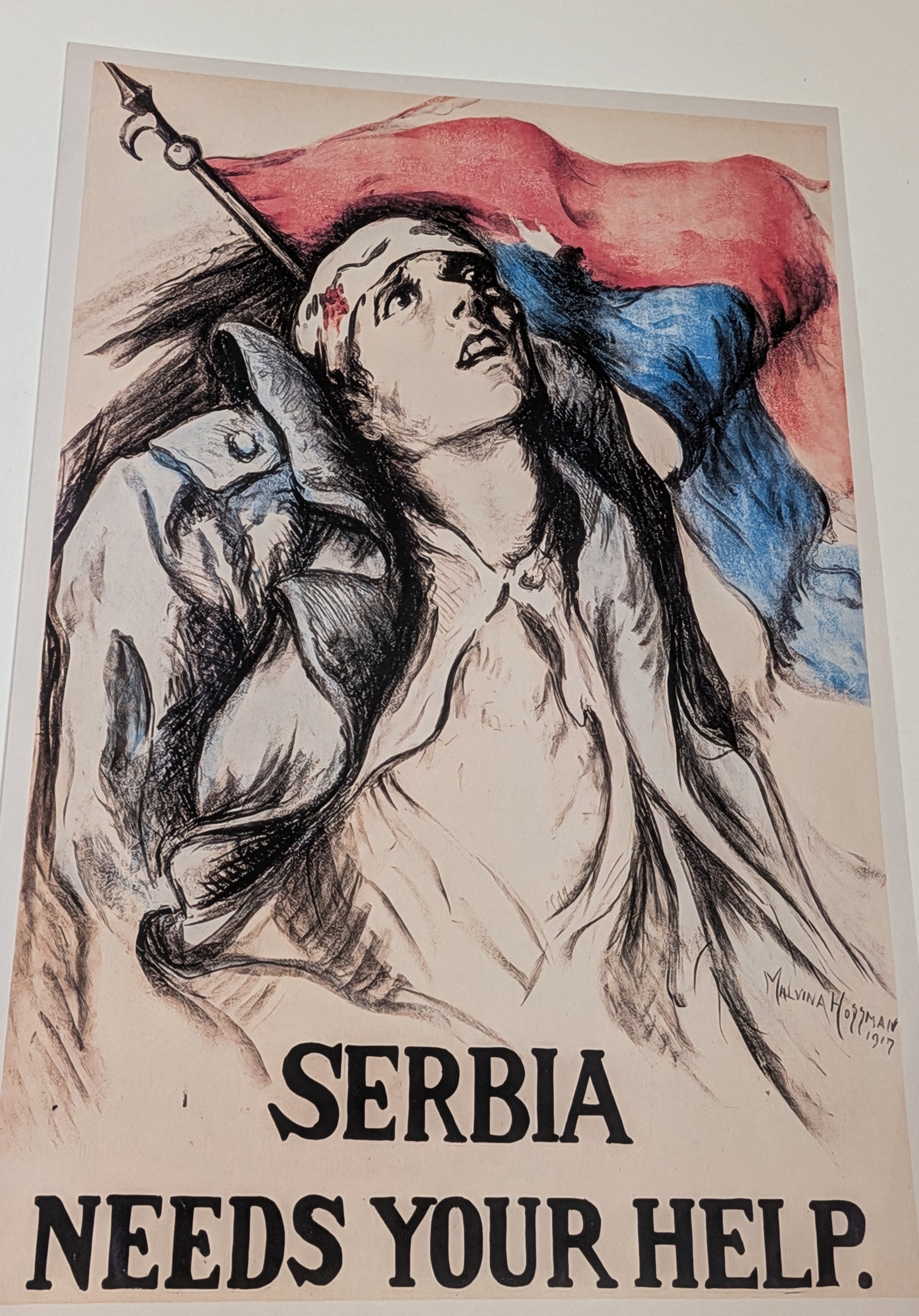
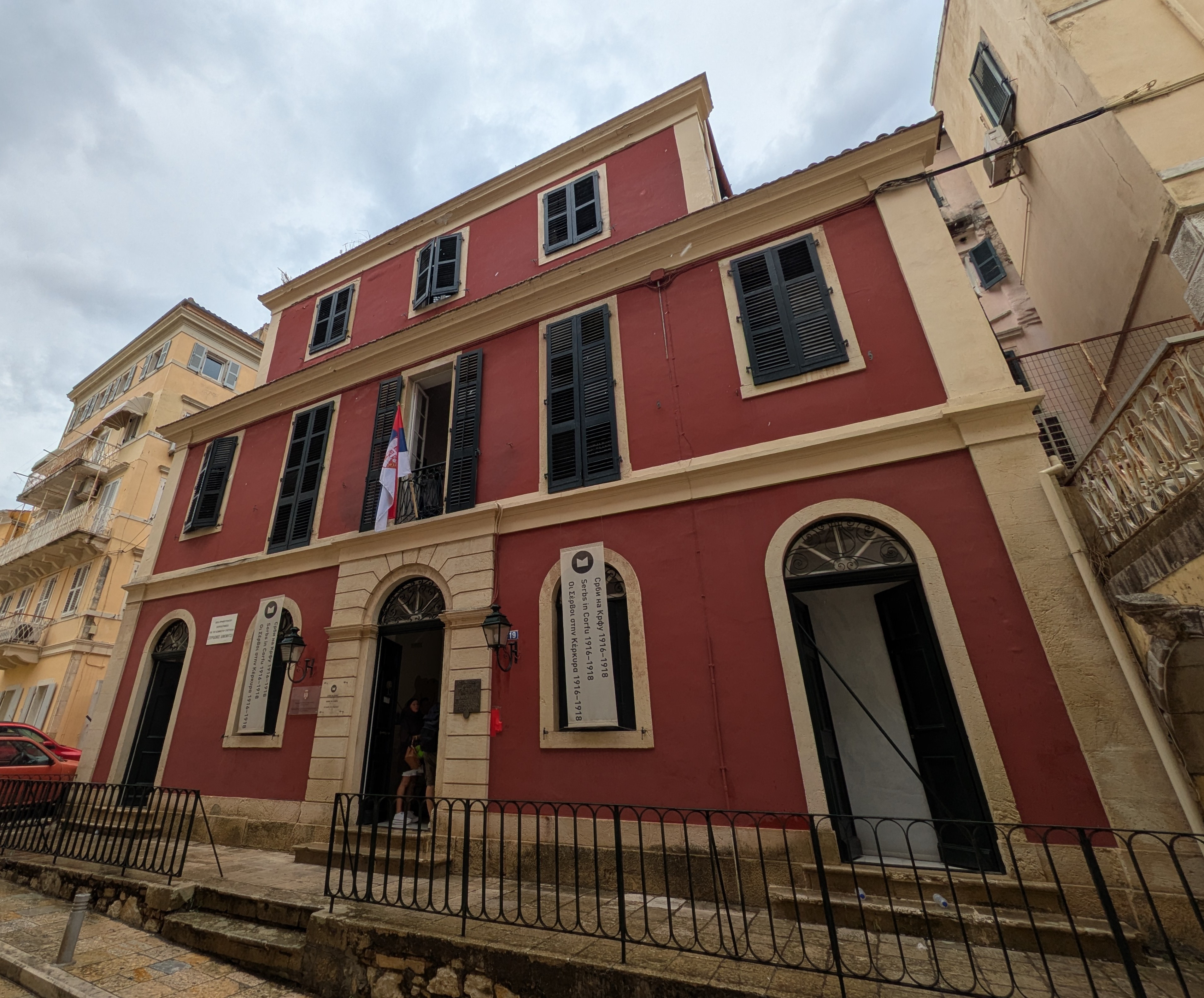
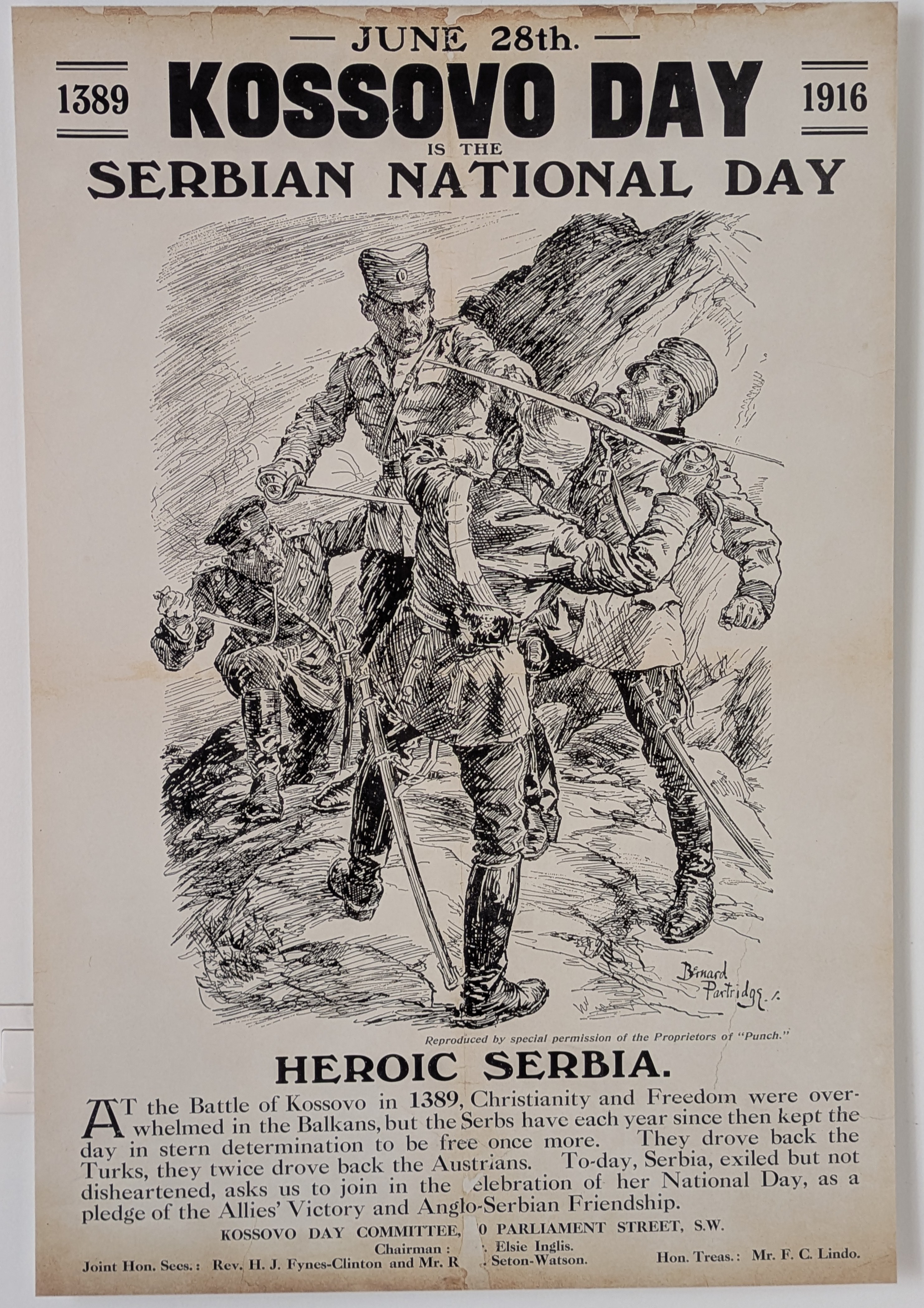
(Above: the Serbian Museum of Corfu and exhibited propaganda posters)
The sun is out and my swim shorts are on. I’m heading to the coast via the A9 ‘green bus’. The A9 heads up the east coast of Corfu towards the island’s highest peak, Table Mountain lookalike, Mount Pantokrator. Pantokrator is the easterly point of a series of ridges that divide Corfu horizontally in two, and the the bus turns inland before it meets this line and slaloms its way westwards. My destination for the day is the seaside tongue-twister of Paleokastritsa.
The road down to Paleokastritsa is a steep zigzag that reveals in instalments a series of horseshoe bays. Hemmed in by a line of low-rise hotels and sheer green hillsides, the village might be a small town, but manages to fold in on itself so well that half of it remains hidden at all times. Each bay has its own beach, and I find myself on the tightly packed Agios Spiridon.
Spiridon is small and perfectly formed. Fine sand, perfectly sheltered and watched over by a hilltop monastery, the sea is crystal and perfectly calm. Floating on my back, eyes closed and ears under water, I can hear only my own breath with the tide gently rising and falling in time with my lungs.
In Prospero’s Cell, Lawrence Durrell writes of Paleokastritsa as being a deserted fishing village. The passage is dated 20/09/1937, almost 89 years to the day before my visit. He even includes an illustration by Edward Lear depicting almost the exact spot that I (coincidentally) find myself sunbathing on, except in Lear’s day – itself a further 80 years earlier than Durrell’s – there are only a half dozen fishermen on the beach. On my visit, there must be 200 tourists and not one fishing net.
Apparently Homer had Odysseus crawl ashore after surviving shipwreck at Paleokastritsa and then set him sail yet again from Glyfada, this time to get it on with Calypso on the mythical island of Ogygia. No doubt he used one of the VW Beetle shaped pedalos rented out on Spiridon.
Durrell, Lear and Odysseus – esteemed company!
Durrell says that the Corfiots of the 1930s measured distance by how many cigarettes they could smoke between points A and B, but I make Glyfada to be 10miles down the west coast where the curlicue bays have been stretched out and rolled into one long sheet of golden sand. It is where resort tourism is said to have started on Corfu but it’s less developed than at Paleokastritsa, despite there being more room to build on.
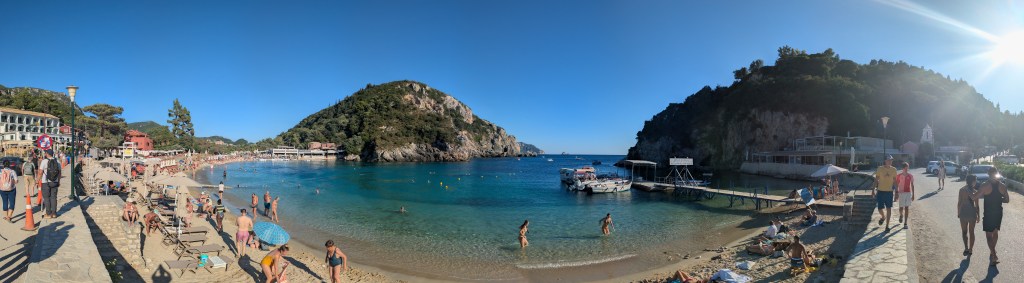
(Above: Paleokastritsa beach looks very different now to when it was visited by Durrell, Lear or Odysseus)
As I’ve previously found with their mainland brothers and sisters, the Corfiots of the 2020s still smoke constantly. Taxi drivers, waiters, mechanics and farmers, anyone in any trade and of any age or social class will be performing their tasks between drags. If this wasn’t the age of GPS, the locals would still be measuring the way using their cancer sticks. The smell drifts and lingers outdoors and in.
Even whilst waving a Marlboro in the air, they’re amiable hosts, maintaining that Greek concept of xenia in an unsentimental way, as if tourism has been bestowed upon them in the same way that making alpine cheese has to the Swiss and call centre operations have in Swindon. No fuss: it’s just what they do.
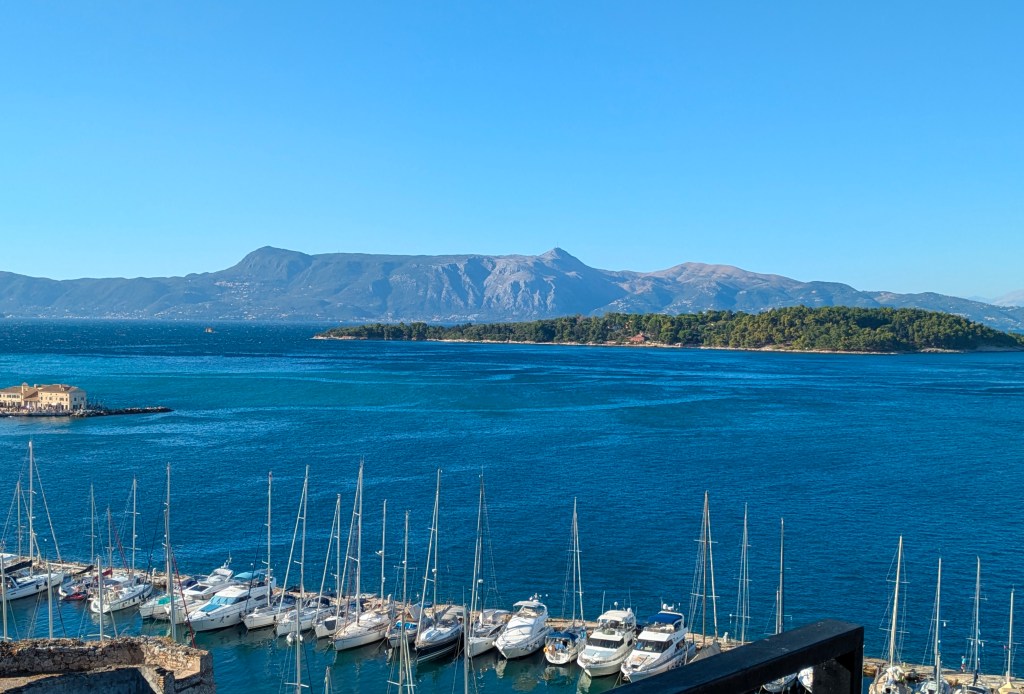
(Above: not unlike Table Mountain, Mount Pantokrator as seen across the bay from Kerkyra Old Fortress)
Paxos and Antipaxos
Sitting in the comfy lounge of my ferry to Paxos – mint green pleather sofas and white formica tables – the whiff of cigarettes has made way for the heavy malodour of diesel. The engine a throbbing drone, heaving the vessel out into the Ionian whilst the sun is still low enough that it hasn’t yet painted colour into the world.
Sailing some 30 nautical miles south-south-east of Kerkyra, we take an anticlockwise loop of Paxos for a quick swim in the turquoise waters off its tiny satellite isle, Antipaxos. With the boat dropping anchor just offshore, a dozen of us take the plunge off the gangplank into a warm and gentle sea, as gorgeous as it was at Paleokastritsa. A school of tiny jet black fish accompany me into one of the shallow caves where I clamber onto the rocks to bathe for a moment in the sun – by now approaching its zenith – and enjoy the view back to the perfect little beach across the bay.
The ship’s horn is sounded twice, our reminder that this isn’t our final destination, and we all clamber aboard to dry off. Back in the lounge I notice that the group of Greek students sat near me had stayed put during the stop to nurse one of their party, whose green complexion betrays that she has succumbed to seasickness. The boat is big and sturdy enough remain motionless on the barely detectable waves, but almost as soon as the engine revs up again there is a murmur of “όχι, όχι, όχι” from the poor girl immediately followed by the unmistakable splash of vomit across that formica surface.
Gliding slowly into Gaios, there is a satisfying hush after the din of the engine, although the port itself welcomes us with that distinctly funky harbour smell that combines putrid fish, marine petrol, and whatever effluent is being discharged by the vessels at anchor.
Having disembarked, the stench is easily escaped by the short stroll into Gaios. Paxos is tiny, just 6 miles long by 2 wide, but despite this I don’t quite have time to venture beyond Gaios before my return back to Kerkyra, so I’ll make do with a slap up lunch and a wander around the little jumble of streets that makes up Paxos’ ‘capital’ (population: 1,400).
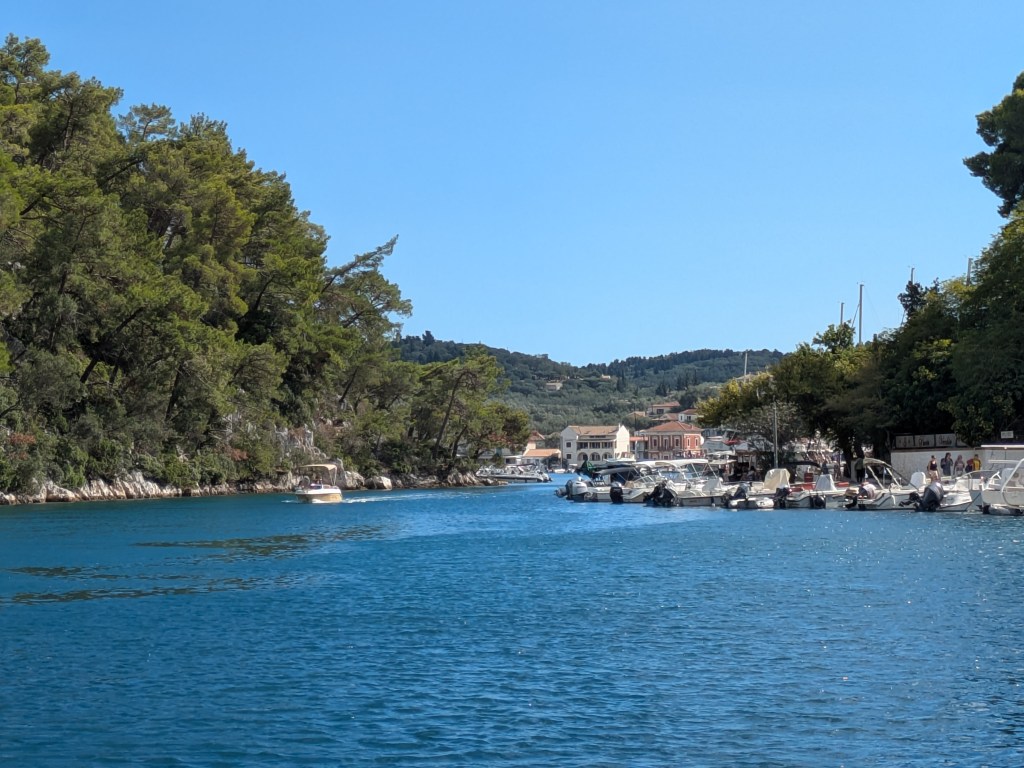
Gaios is pretty much at capacity on a Tuesday afternoon in September, so must be hellish at high season. It’s very photogenic, with the town fixed along its waterfront and the same colour swatch as Corfu. A dozen tavernas face the sheltered little marina backed by a warren of alleys full of stalls selling the usual holiday tat. It may be pretty, but frankly it’s a tourist trap.
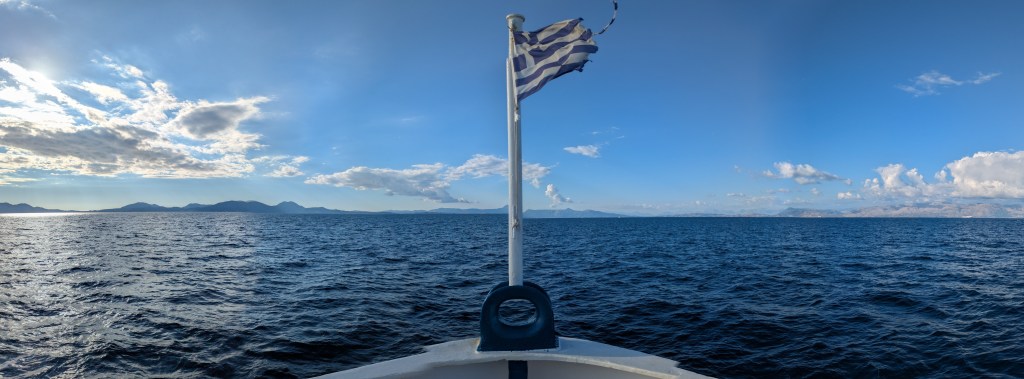
Setting sail again, the sun descending at port, mainland Greece at starboard, I find myself a wooden bench right at the prow from which to enjoy the view all the way back to Kerkyra. Surrounded by blue, a ribbon of green on the horizon.
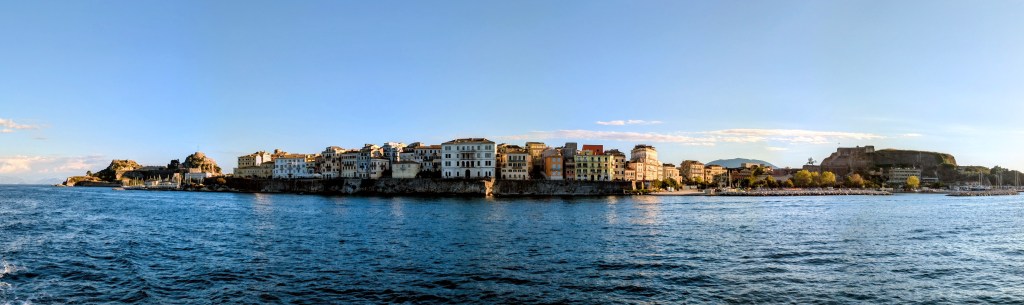
(Above: Kerkyra as seen from the approach to port)
Suggested reading: Prospero’s Cell – Lawrence Durrell


Leave a Reply