After chugging its way 15 nautical miles across the still Ionian Sea, the Finikas Lines ferry is pulling into the Albanian resort of Sarandë. Modern and gleaming white, from the deck of the ‘Georgia’ Sarandë is an attractive port, affluent in appearance, immediately challenging the western stereotype of Albania.
I only have six hours’ shore leave before my return back to Corfu, which I will be spending on a guided coach tour – a break from the independence of my preferred travel formula, but a pragmatic choice.
Our first stop is Lekursi Castle (Lëkurësi), a short but steep drive from Sarandë’s port, over which it stands sentry. What today we would consider picture postcard views of the Albanian Riviera were the very reason Suleiman the Magnificent ordered its construction in 1537. The fort is small but its position is commanding, perfect for controlling the straits off the western coast of the Balkan Peninsular.
Suleiman wasn’t the only leader to recognise its strategic importance. Little round bunkers surround Lekursi, which our guide explains were part of a huge defensive network installed by Albania’s deeply-paranoid former dictator Enver Hoxha. The Nazis arrived here too, as evidenced by the remains of several WW2 anti-aircraft guns rusting away outside the castle walls.
Lekursi affords 360 views across the Ionian to Corfu and inland across a broad plain to a series of mountain ranges. 77% of Albania’s territory is mountainous, and the different strata of rock visible in the sierra opposite must make it a geologist’s dream. Under a sky of perfect blue, thin whisps of cloud ghost down the valleys.
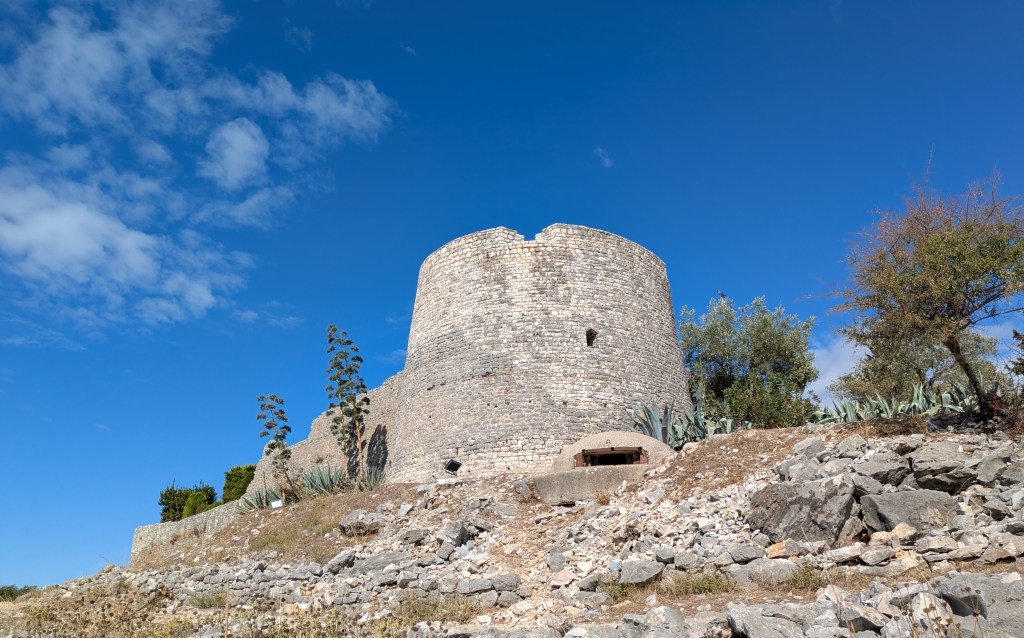
(Above: Lekursi Castle; the small dome in front of the turret is a 20th century bunker, part of a network installed thanks to Enver Hoxha’s paranoia that Albania would be invaded)
The 20 minute drive between Lekursi and Butrint National Archaeological Park allows time for our guide to give us our Albania 101, and I’m grateful for the insights. She is a Sarandë local and explains that her home town takes its name from the Greek for ’40’ after 40 local martyred saints, but that during the Italian occupation (1939-43) Mussolini briefly renamed it after his daughter Edda.
We learn that Greeks are Albania’s largest minority group, especially here in the south where there are Greek villages with their own specially designated municipality. Our guide proudly explains how tolerant Albania is, especially between religions. Although Islam is the dominant faith, only 45% of the country’s 2.3m population are Muslim, and “women wear what they want and everyone drinks alcohol”. We’re told that families often mix Islam, Catholicism and Eastern Orthodox, and twice on the drive neighbouring mosques and churches are pointed out to us so we can bear witness to such tolerance.
I’m relieved to see Latin script again – on Corfu the Greek alphabet was hurting my head – but am glad that I don’t need to learn the Albanian 36 letter alphabet. The one Albanian phrase I will take with me is ‘Tungjatjeta’, a greeting that translates as ‘a long life to you’.
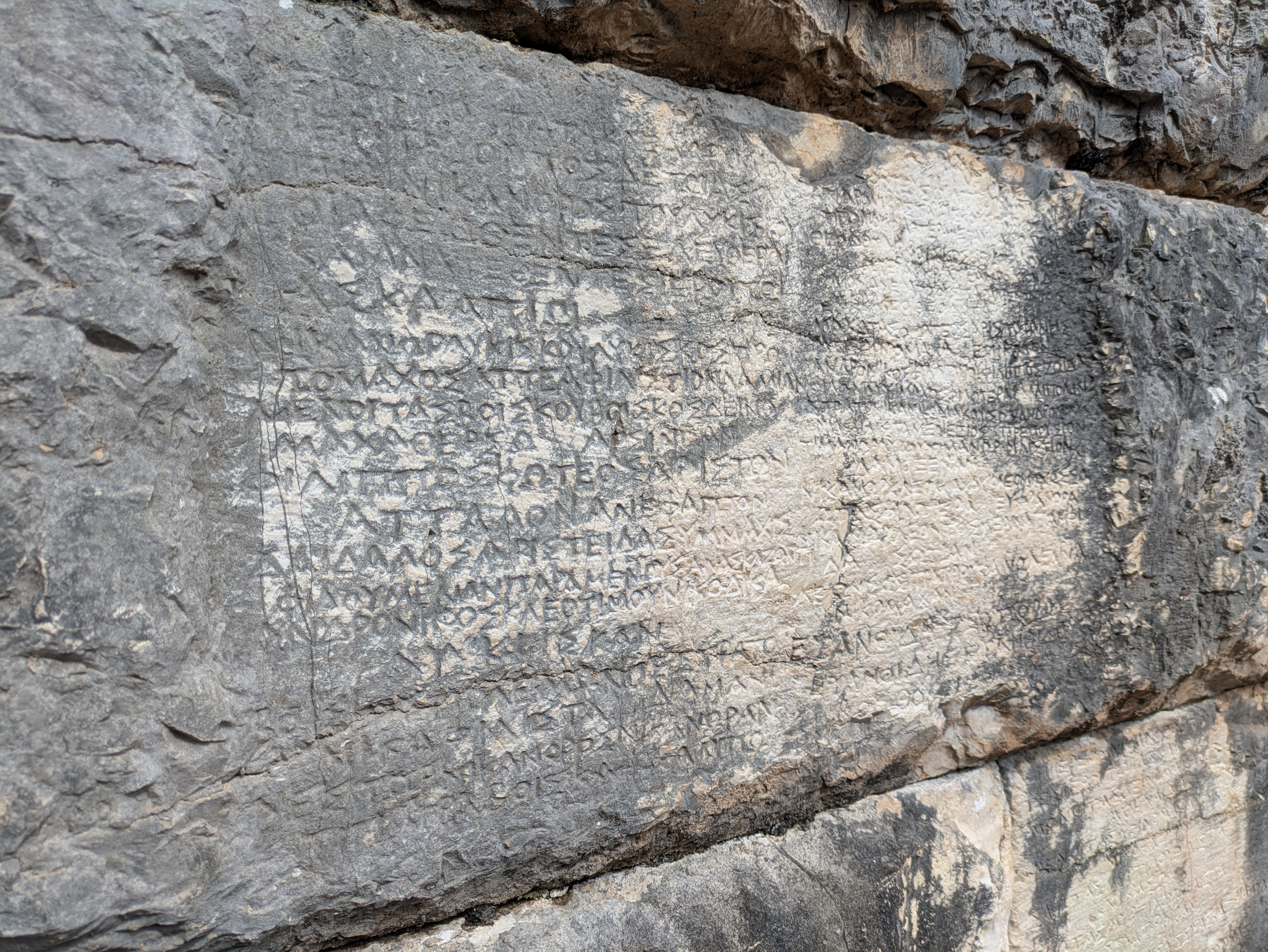
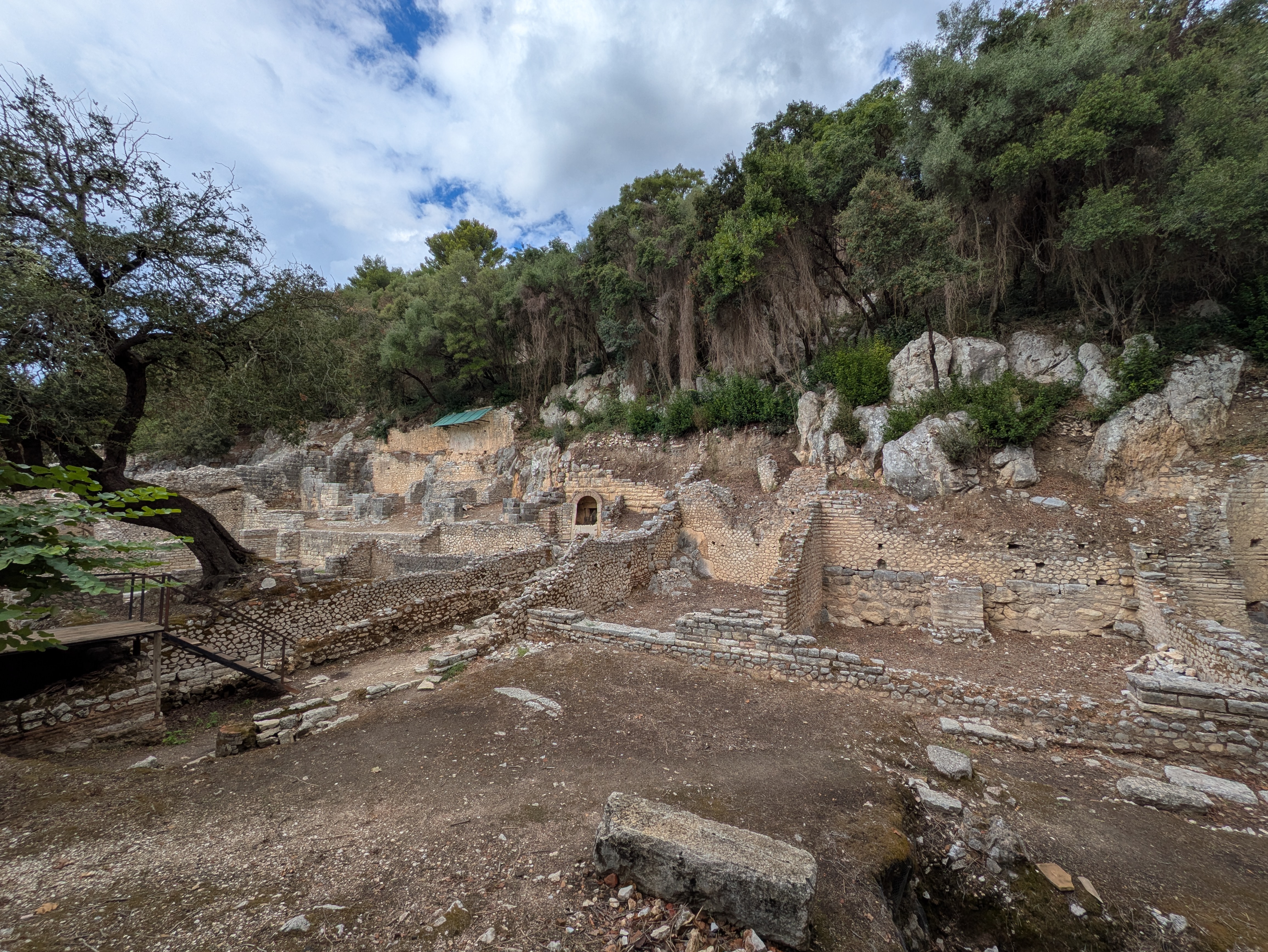
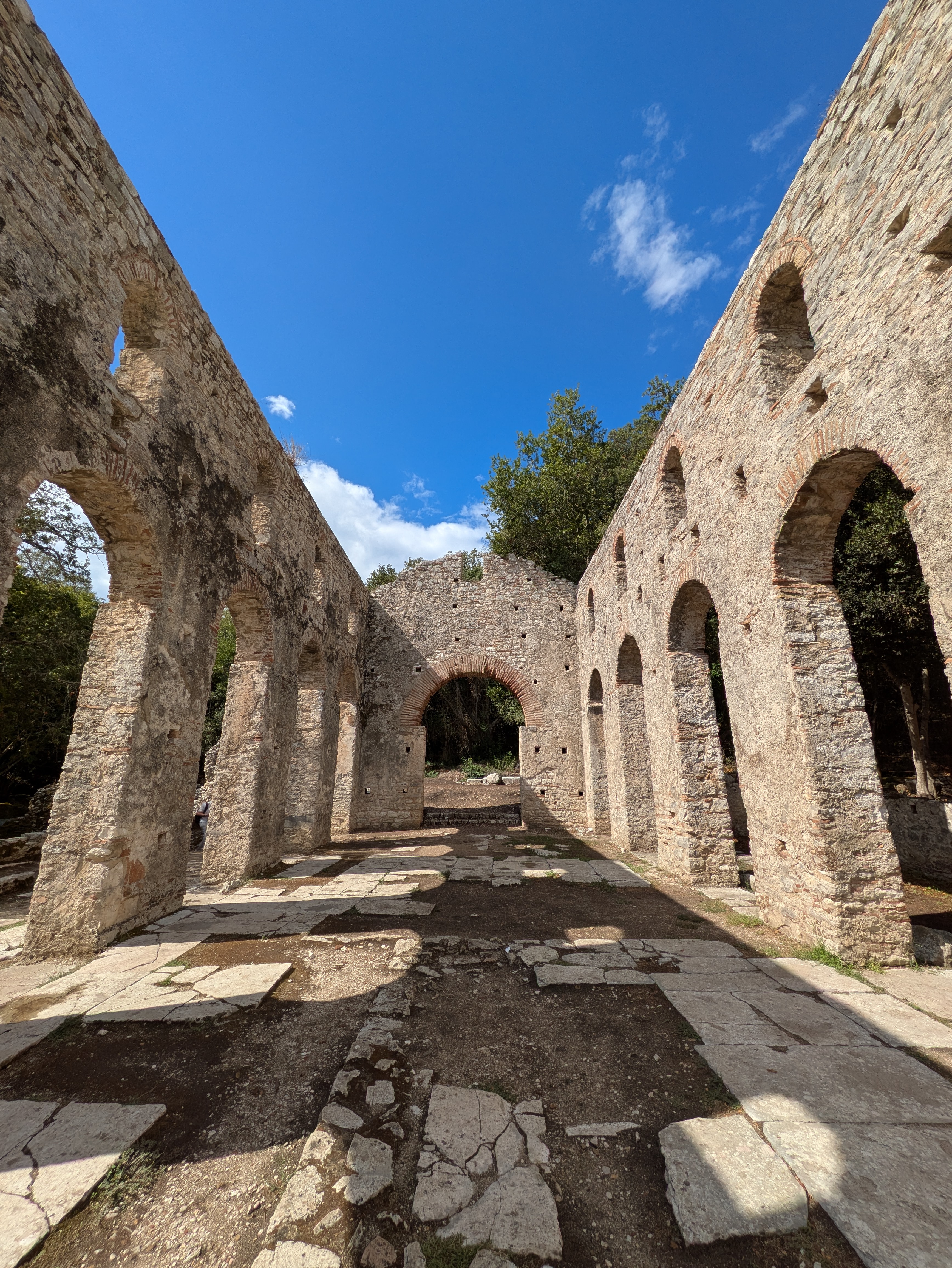
(Clockwise from top-left: Butrint National Archaeological Park – a stone ‘manumission’ by a slave owner declaring the freedom of one of his slaves; the Great Basilica; the agora near the Roman baths)
Southern Albania retains some of Corfu’s greenery, but begins to take on the ochres and marbles familiar to the Balkan Peninisular. Those are the prominent colours of the ruined citadel of Butrint, quarried from similar limestone to many of the ancient sites of the region.
Butrint is a significant if largely unknown archaeological site. Having been founded around the 7th century BCE by the Chaonians, one of the less famous Hellenic states, it remained a Greek polis until 228BCE. The Romans then stepped in to make it a protectorate (which was good of them) and later a ‘colony’ under the province of Macedonia. The colony survived a further half a millennia through to the fall of the Roman Empire, and was then subsumed into its eastern successor, the Byzantine Empire.
The picture then gets murky for a couple of hundred years, but records resurface showing Butrint clinging on as a Byzantine outpost during the final centuries of the empire, despite some ping-pong of its ownership between Byzantium and the Angevine French, who had popped up in the region during the crusades.
The Venetians and Ottomans then played tug-of-war in the region throughout the 16th century CE, but neither showed interest in the malarial marshes around Butrint, leaving it to ruin after over 2,000 years of habitation.
What remains is impressive, each wave of inhabitants having adopted and adapted past developments. The complete Greco-Roman checklist is here: theatre, gymnasium, stoa, basilica. The agora is clearly laid out, with a sense that it was much more tightly arranged than those at larger sites, such as at Athens.
Large boulders were used for the foundations of the older structures and their lower floors, which were transported to the site and then carefully cut to fit around each other mortar-free. They remind me of the Incan architecture of Cusco, Peru. Like their Incan counterparts, the massive stonework has survived earthquakes and warfare whilst the later construction, which used smaller brickwork and hydraulic concrete, has largely collapsed.
One stone is particularly poignant. Writing in ancient Greek, a slave owner has chiselled a ‘manumission’ granting one of his slaves their freedom.
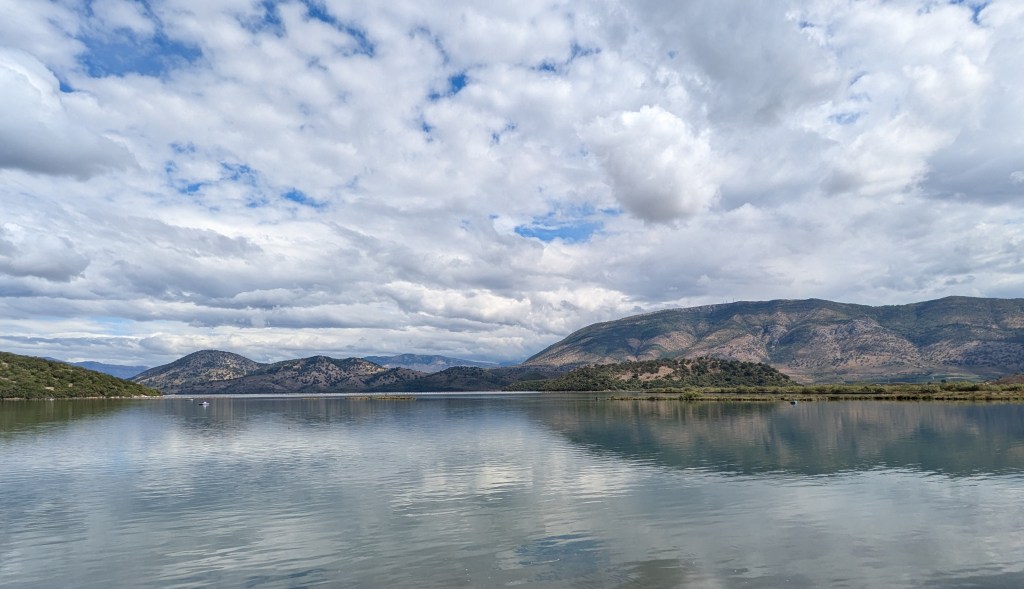
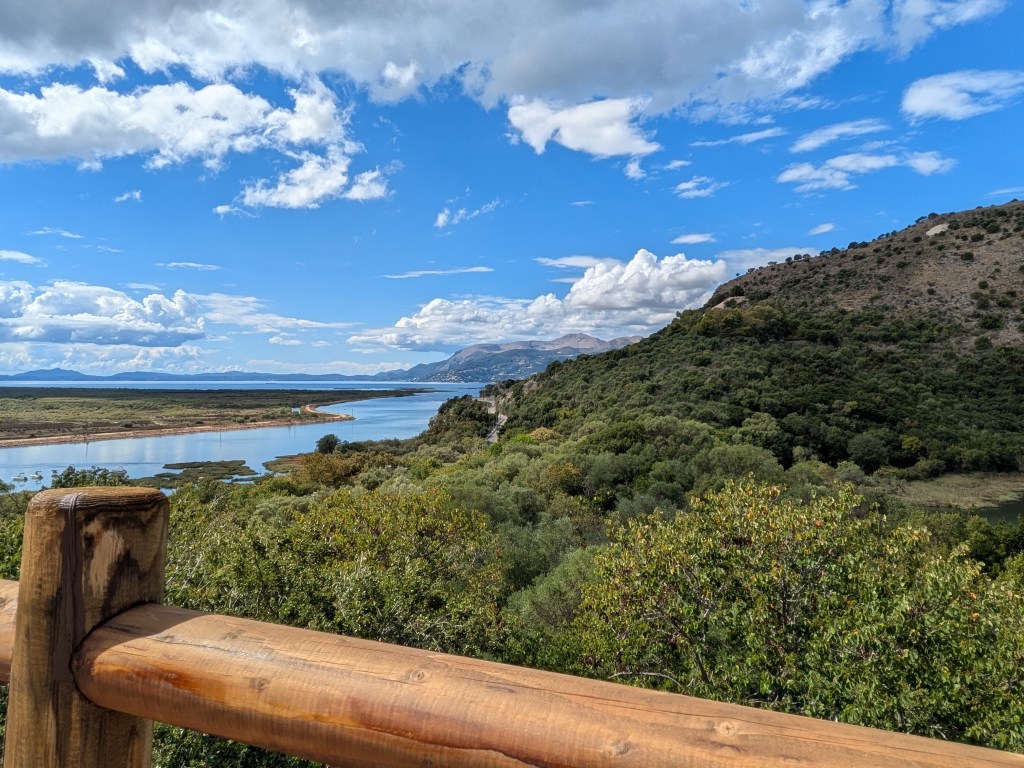
(Above: Lake Ksamil viewed from Butrint)
The coach coasts along new and relatively empty roads back to Sarandë. Empty, that is, except for the herds of goats and cows that wander freely onto the highway, nonchalantly side-eyeing us as we edge pass.
The route is flanked by alternate rows of pomegranate trees and tomato plants, both bearing bulbous red fruit, sun-soaked and ready to burst.
Our excursion has a built in late-lunch on the terrace of a Sarandë hotel. A gourmet buffet spread, largely comprised of the kind of fresh produce we’ve just seen growing at the roadside. I raise a smile at the British-Indian family who take the table next to me and, clearly distrusting of Albanian cuisine, draw out of their bags a bunch of ziplocks full of spices with which to dress their meal.
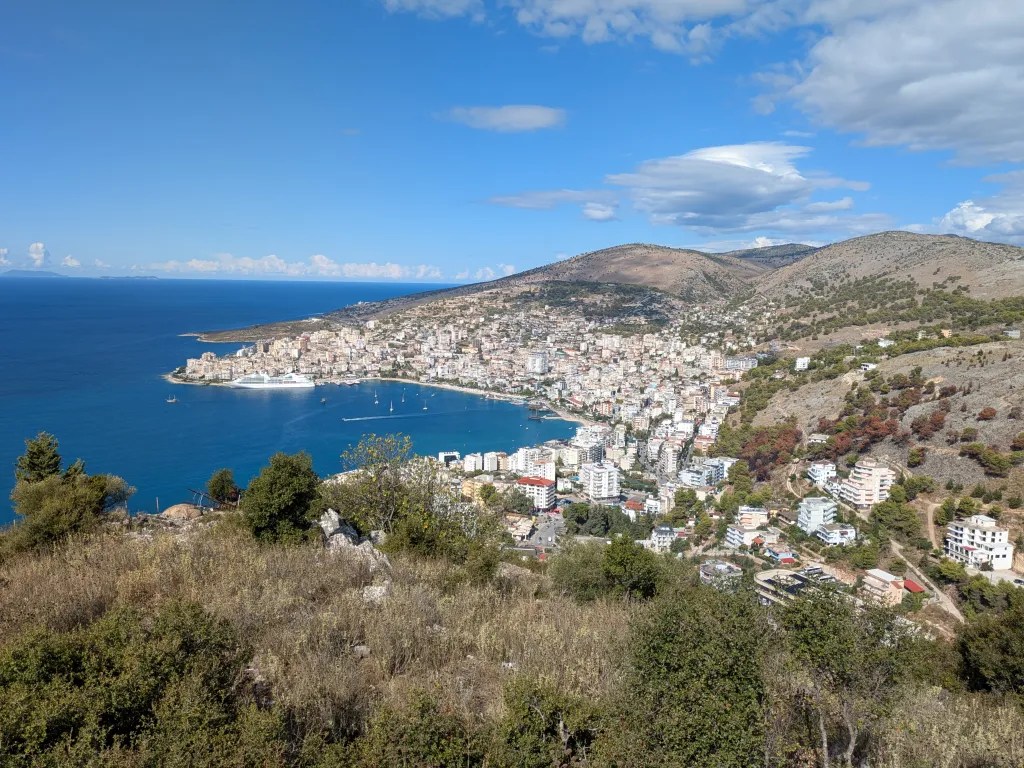
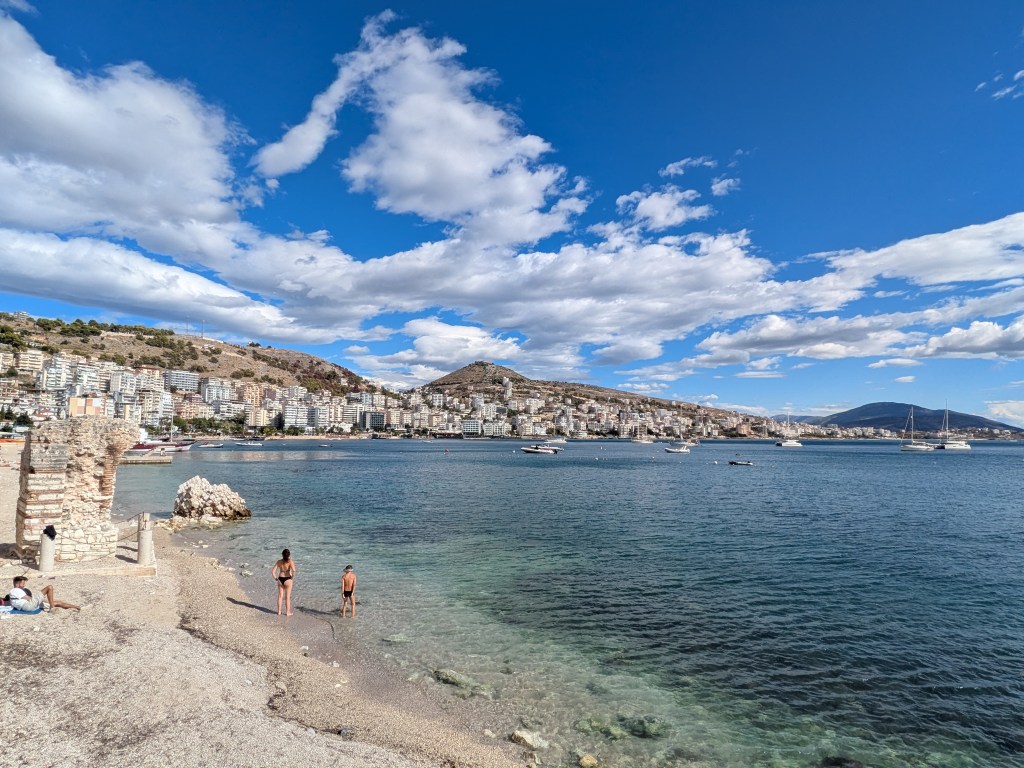
(Above: Sarandë as seen from Lerkusi Castle and from the city’s beach)
A post-lunch stroll along Sarandë’s promenade reveals a pleasant but bland resort. It could be any generic, mid-range Mediterranean destination. Bar the abundance of Albanian national football team kits on sale at the stalls along the beachfront, if I had been dropped here and asked to guess my location, I would not be able to place it. The number of new apartment blocks going up points to Albania’s building boom, which right now is engulfing the country’s current administration. They all look sleek and chic, portraying a modern and confident state, and serving to contradict the perception of Albania as an anachronistic backwater.
Six hours could never be sufficient time to fully experience a country and I’m sure that Sarandë must be quite different to the rest of Albania, which remains tantalisingly out of reach. Until next time…
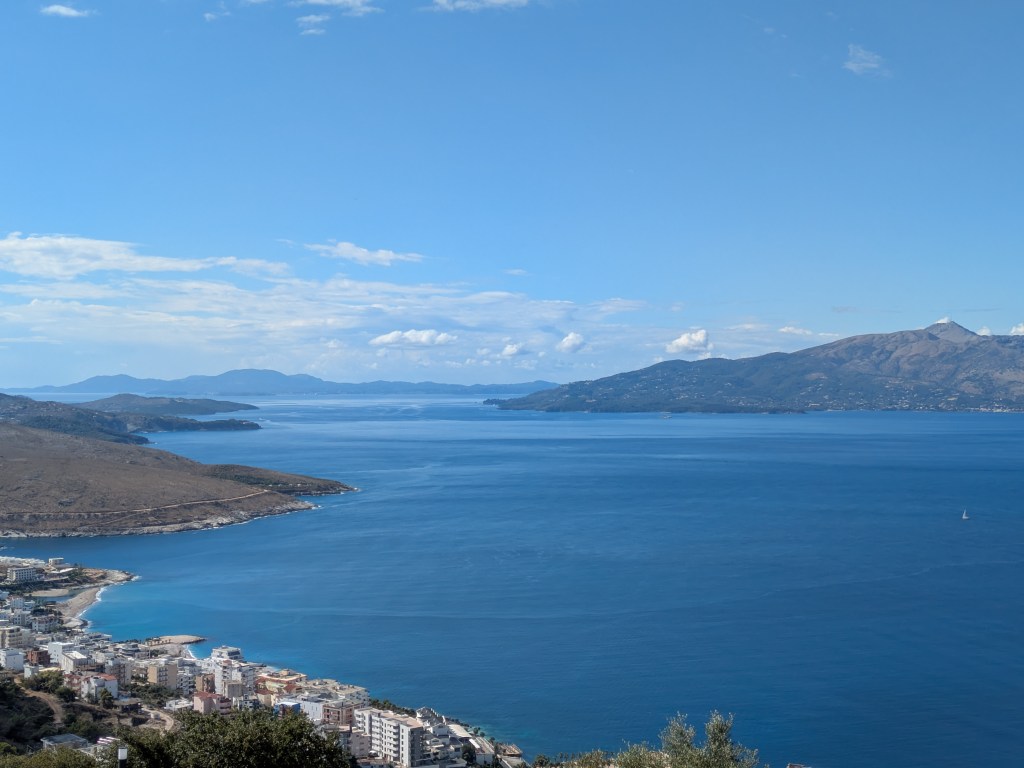
(Above: Albania left, Corfu right – looking south across the Ionian from Sarandë)
Travel tips:
A common question for a daytrip to Sarandë is whether you should take any local currency (Albanian Lek). Everywhere I stopped accepted Euros at a fair exchange rate. Most places take card, but I would suggest taking a small amount of Euros in cash.
I booked my daytrip from Corfu just two days before departure via https://www.corfu-adventures.gr/ and was pleased with their service and the excursion itself (I don’t receive any commission for the link).


Leave a Reply